Study finds high mortality of endangered loggerhead sea turtles in Baja California
October 14th, 2008 Study finds high mortality of endangered loggerhead sea turtles in Baja California

Enlarge

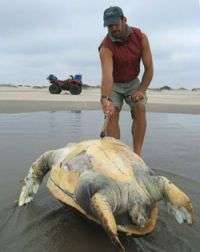
Graduate student Hoyt Peckham examines a dead sea turtle found during a survey in Baja California.

(PhysOrg.com) -- Along the southern coast of Baja California, Mexico, scientists have been counting the carcasses of endangered sea turtles for a decade as part of an effort to assess and eliminate threats to loggerhead sea turtle populations. Their findings, published this week, are shocking: almost 3,000 sea turtles were found dead along a 27-mile stretch of coast during a five-year period from 2003 to 2007.

Led by Hoyt Peckham, a graduate student at the University of California, Santa Cruz, the study underscores the enormous impact of bycatch (marine life accidentally killed by fishing operations) on sea turtles. Bycatch and, to a lesser degree, poaching are both significant threats to the survival of the endangered Pacific loggerhead sea turtle population, Peckham said.

"We saw what are apparently the highest documented stranding and fisheries bycatch rates in the world," he said. "But the high bycatch rates offer us all an unexpected conservation opportunity. By working with just a handful of fishermen to diminish their bycatch, we can save hundreds of turtles."

Peckham and his coauthors, whose findings appear in a special bycatch issue of Endangered Species Research, are working to increase awareness of the problems facing sea turtles in Baja California Sur. They hope this report will encourage Mexico's government agencies to finalize creation of a refuge that protects turtles and encourages sustainable fishing in the area.

"We have counted so many dead turtles. We have piles of data on thousands of carcasses. What we need now are conservation actions and viable solutions," said Wallace J. Nichols, research associate with the California Academy of Sciences and a coauthor of the paper.

The authors partnered with local fishermen not only to assess bycatch but also to increase awareness of its far-reaching effects and work toward ending the threat.

"Once they are aware of the ocean-wide impacts of their local bycatch, fishermen often strive to fish more cleanly by switching to different techniques, target species, or areas," Peckham said. "As a result, stranding rates were down in 2008."

In addition, local fishermen are working with the Mexican government to designate a sea turtle refuge that would officially protect an area the researchers identified as a "hotspot" of turtle bycatch.

Conservation tourism offers another potential solution to these problems by giving fishermen an alternative to dwindling, inefficient fisheries, Peckham said. Through training and a steady tourism market, many fishermen and former poachers have come to value sea turtles more highly alive than dead, because conducting tours can yield more income than fishing, he added. One organization that has promoted ecotourism in this area is the Ocean Conservancy through its SEE Turtles program. The program links travelers with critical sea turtle conservation sites so that vacation dollars can both protect the sea turtles and enhance the livelihood of community residents who protect them.

North Pacific loggerhead sea turtles travel more than 7,000 miles from Japan to Baja California Sur to feed and grow in nearshore waters, spending up to 30 years there before returning to Japan to breed. The number of nesting females in Japan has declined by 50 to 80 percent over the past 10 years, Peckham said.

In addition to Peckham and Nichols, the authors of the new study include Tim Tinker, adjunct professor of ecology and evolutionary biology at UCSC; David Maldonado Diaz and Alexander Gaos of Grupo Tortuguero, a nonprofit conservation group based in La Paz; and Volker Koch and Agnese Mancini of the Autonomous University of Baja California Sur.

Provided by University of California, Santa Cruz


print this article email this article download pdf blog this article bookmark this article     Digg this Stumble it share on Facebook share on Reddit add to delicious save to Yahoo! bookmarks
5/5 after 5 votes


October 14th, 2008 all stories
Space & Earth / Environment

Comments: 0
Rank: 5/5 after 5 votes

  • Stumble this up

  • Digg this

  • Share it:
  • share on Facebook
  • share on MySpace
  • share on Slashdot
  • rss-newsfeed
  • share on Google
  • share on Reddit
  • add to delicious
  • save to Yahoo! bookmarks
  • share on Windows Live
  • Add to Mixx!
Rating: 5/5 after 5 votes

  • Related Stories

  • Leatherback turtles' newly discovered migration route may be roadmap to salvation
    created Jul 15, 2008 | popularity not rated yet | comments 0
  • Turtles are loyal in feeding as well as in breeding
    created Apr 25, 2007 | popularity not rated yet | comments 0
  • Wildlife faces cancer threat
    created Jun 24, 2009 | popularity not rated yet | comments 0
  • New net timer could save sea turtles from drowning
    created Jun 20, 2009 | popularity not rated yet | comments 0
  • NOAA report finds threats to California's Cordell Bank Marine Sanctuary
    created Jun 19, 2009 | popularity not rated yet | comments 0


  • Physicists Demonstrate Quantum Memory with Matter Qubits
    Physicists Demonstrate Quantum Memory with Matter Qubits
    Physics / General Physics
    created Jul 03, 2009 | popularity 4.4 / 5 (17) | comments 1
  • 'Holey' Nanosheets for Wastewater Dye Removal
    Nanotechnology / Nanomaterials
    created Jul 01, 2009 | popularity 5 / 5 (5) | comments 1
  • Jellyfish Robot Swims Like its Biological Counterpart
    Jellyfish Robot Swims Like its Biological Counterpart
    Electronics / Robotics
    created Jun 26, 2009 | popularity 4.4 / 5 (8) | comments 1
  • Could Maxwell's Demon Exist in Nanoscale Systems?
    Could Maxwell's Demon Exist in Nanoscale Systems?
    Physics / General Physics
    created Jun 24, 2009 | popularity 4.4 / 5 (18) | comments 29
  • Living Safely with Robots, Beyond Asimov's Laws
    Living Safely with Robots, Beyond Asimov's Laws
    Electronics / Robotics
    created Jun 22, 2009 | popularity 4.6 / 5 (52) | comments 40
  • Other News

    Forty years ago man first walked on the moon

    Space & Earth / Space Exploration

    created 20 hours ago | popularity 4.3 / 5 (4) | comments 2

    Forty years ago on July 20, 1969, American astronaut Neil Armstrong realized the oldest dream of human civilizations when he became the first man to walk on the moon.


    The least sea ice in 800 years

    The least sea ice in 800 years

    Space & Earth / Earth Sciences

    created Jul 01, 2009 | popularity 4.1 / 5 (63) | comments 59

    New research, which reconstructs the extent of ice in the sea between Greenland and Svalbard from the 13th century to the present indicates that there has never been so little sea ice as there is now. The ...


    Gas around young galaxy

    Intense heat killed the Universe's would-be galaxies, researchers say

    Space & Earth / Astronomy

    created Jul 01, 2009 | popularity 3.4 / 5 (21) | comments 27

    (PhysOrg.com) -- Our Milky Way galaxy only survived because it was already immersed in a large clump of dark matter which trapped gases inside it, scientists led by Durham University's Institute for Computational ...


    Scientists' Drill Hits Magma: Only Third Time on Record

    Scientists' Drill Hits Magma: Only Third Time on Record

    Space & Earth / Earth Sciences

    created Jun 29, 2009 | popularity 4.7 / 5 (22) | comments 19

    (PhysOrg.com) -- Scientists drilling a borehole deep into Iceland’s rocky crust to explore new methods of using geothermal energy hit a major roadblock on Thursday: Their drill ran into molten rock at a depth ...


    NASA manager pitches a cheaper return-to-moon plan

    Space & Earth / Space Exploration

    created Jun 30, 2009 | popularity 4.1 / 5 (8) | comments 18

    (AP) -- Like a car salesman pushing a luxury vehicle that the customer no longer can afford, NASA has pulled out of its back pocket a deal for a cheaper ride to the moon.