Model predicts a system's remaining life and links info to inventory decisions
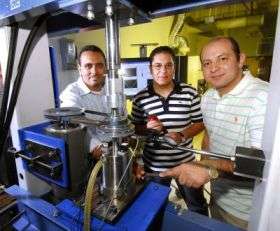
New research at the Georgia Institute of Technology could soon make predicting the degradation and remaining useful life of mechanical and electronic equipment easier and more accurate, while significantly improving maintenance operations and spare parts logistics.
Nagi Gebraeel, an assistant professor in Georgia Tech's H. Milton Stewart School of Industrial and Systems Engineering, has developed models that use data from real-time sensor measurements to calculate and continuously revise the amount of remaining useful life of different engineering systems based on their current condition and health status. These predictions are then integrated with maintenance management and spare parts supply chain policies as part of an autonomous "sense and respond" logistics paradigm.
"Recent advances in sensor technology and wireless communication have enabled us to develop innovative methods for indirectly monitoring the health of different engineering systems," said Gebraeel, who started working on this project at the University of Iowa. "This has created an environment with an abundance of data that can be exploited in decision-making processes across different application domains such as manufacturing, aging infrastructure, avionics systems, military equipment, power plants and many others."
Gebraeel's predictive models were detailed during two presentations on October 14 at the Institute for Operations Research and the Management Sciences Annual Meeting. Funding for model development was provided by the National Science Foundation.
Because Gebraeel's sensor-driven prognostic models combine general reliability characteristics with real-time condition-based signals, they provide an accurate and comprehensive assessment of a system's current health status and its future evolution. These accurate predictions are then used to determine the most economical time to order a spare part component and schedule a maintenance replacement by accounting for different costs, including those due to unexpected failures, spare part inventory holding and out-of-stock situations.
Gebraeel began his research by monitoring the vibration and acoustic emissions signals from rotating machinery, namely bearings. He extracted degradation-based characteristics pertaining to key components on the machinery and used them to develop condition-based signals. Gebraeel then created stochastic models to characterize the evolution of these condition-based signals and predict the remaining life of these critical components.
After extensive experimentation and testing, results showed that his techniques can potentially reduce the total failure costs and costs associated with running out of spare parts inventory by approximately 55 percent. With such positive results, Gebraeel turned his attention to developing models for electronics. He recently began working with Rockwell Collins to develop adaptive models to estimate the remaining useful life of aircraft electronic components.
"Aircraft take off at ambient ground temperatures and quickly reach their cruising altitudes, where the temperatures tend to be below zero," explained Gebraeel. "It's these changes in temperature coupled with inherent vibrations that affect the deterioration and lifetime of electronic equipment."
Gebraeel's goal is to embed his prognostic methodology into key avionic systems so that decisions can be made about whether an aircraft is capable of carrying out a specific mission or if it should be assigned to a shorter mission or grounded.
Gebraeel is also working closely with Virginia-based Global Strategic Solutions LLC, which has funding from two U.S. Navy Small Business Innovation Research (SBIR) grants. The focus of one of the grants is to advance the development of embedded diagnostics and prognostics to predict the remaining life distributions of electrical power generation systems on board U.S. Naval aircraft. The focus of the second grant is to develop advanced health monitoring and remaining useful life models for aircraft communication, navigation and identification (CNI) avionics systems used on the Joint Strike Fighter.
"The long term impact of all of these projects on human safety and maintenance costs will be tremendous, especially in the airline industry," noted Gebraeel.
Source: Georgia Institute of Technology


