$2 egg-beater could save lives in developing countries
October 15, 2008 $2 egg-beater could save lives in developing countries

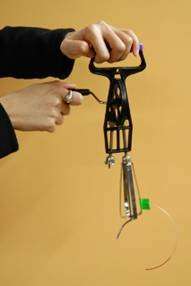
(PhysOrg.com) -- Plastic tubing taped to a handheld egg-beater could save lives in developing countries, the Royal Society of Chemistry’s journal Lab on a Chip reports.

The low-cost centrifuge replacement can separate plasma from blood in minutes, which is used in tests to detect lethal infectious diseases responsible for half of all deaths in developing countries.

George Whitesides and colleagues at Harvard University, US, say the plasma obtained is easily good enough to use in tests to detect diseases such as Hepatitis B and cysticercosis.

“The object was to separate serum [plasma] from blood using readily-obtained materials in a resource-constrained environment,” explains Whitesides.

The equipment can be bought from shops for around two dollars. It needs no special training to use, no electricity or maintenance, and can be sterilised with boiling water and reused.

The user can even prepare several samples at once – just by taping more lengths of tubing to the beater.

Contrast this with the bulky, sensitive commercial centrifuges, costing thousands of dollars and requiring extensive operation training, and it’s easy to see how this development could save lives.

“This technique is simple and works remarkably well,” says Doug Weibel, an expert in microbiology at the University of Wisconsin-Madison, US. “This technique complements several other ‘simple solutions’ that the Whitesides group has developed to tackle point-of-care diagnostics in resource-poor settings.”

Article: G. Whitesides et al, Lab Chip, 2008, DOI: 10.1039/b809830c

Provided by Royal Society of Chemistry


print this article email this article download pdf blog this article bookmark this article     Stumble it Digg this share on Facebook retweet share on Reddit add to delicious
Rate this story - 4.6 /5 (11 votes)


October 15, 2008 all stories

Comments: 0

4.6 /5 (11 votes)
  • Stumble this up

  • Digg this

  • share this

  • hide
  • Related Stories

  • Keeping hearts pumping with 'LifeFlow'
    created Nov 05, 2009 | popularity not rated yet | comments 0
  • Journal special edition outlines rotavirus burden and need for vaccines
    created Nov 05, 2009 | popularity not rated yet | comments 0
  • World's largest malaria vaccine trial now underway in 7 African countries
    created Nov 03, 2009 | popularity not rated yet | comments 0
  • Researchers develop innovative imaging system to study sudden cardiac arrest
    created Oct 30, 2009 | popularity not rated yet | comments 0
  • Rot-resistant wheat could save farmers millions
    created Oct 28, 2009 | popularity not rated yet | comments 0


Other News

Toward home-brewed electricity with 'personalized solar energy'

Toward home-brewed electricity with 'personalized solar energy'

Chemistry / Materials Science

created Nov 04, 2009 | popularity 3.4 / 5 (9) | comments 4

New scientific discoveries are moving society toward the era of "personalized solar energy," in which the focus of electricity production shifts from huge central generating stations to individuals in their ...


Scientists Reproduce a Building Block of Life in Laboratory

Scientists Reproduce a Building Block of Life in Laboratory

Chemistry / Biochemistry

created Nov 06, 2009 | popularity 4.8 / 5 (23) | comments 0

(PhysOrg.com) -- NASA scientists studying the origin of life have reproduced uracil, a key component of our hereditary material, in the laboratory.


Newly Discovered Fat Molecule: An Undersea Killer with an Upside

Newly Discovered Fat Molecule: An Undersea Killer with an Upside

Chemistry / Biochemistry

created Nov 05, 2009 | popularity 4.8 / 5 (9) | comments 0

(PhysOrg.com) -- A chemical culprit responsible for the rapid, mysterious death of phytoplankton in the North Atlantic Ocean has been found by collaborating scientists at Rutgers University and the Woods Hole ...


CU-Boulder map of human bacterial diversity shows wide interpersonal differences

Map of Human Bacterial Diversity Shows Wide Interpersonal Differences

Chemistry / Biochemistry

created Nov 05, 2009 | popularity 4.7 / 5 (11) | comments 0

(PhysOrg.com) -- A University of Colorado at Boulder team has developed the first atlas of bacterial diversity across the human body, charting wide variations in microbe populations that live in different ...


Mimicking nature, scientists can now extend redox potentials

Mimicking nature, scientists can now extend redox potentials

Chemistry / Biochemistry

created Nov 04, 2009 | popularity 4.8 / 5 (5) | comments 0

(PhysOrg.com) -- New insight into how nature handles some fundamental processes is guiding researchers in the design of tailor-made proteins for applications such as artificial photosynthetic centers, long-range ...