Violent flickering in Black Holes
October 15, 2008 Violent flickering in Black Holes

Enlarge

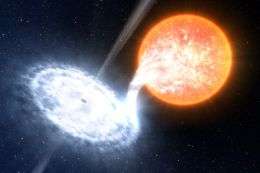
Artist's impression of the black holes studied by the astronomers, using ULTRACAM attached to ESO's Very Large Telescope. The systems — designated Swift J1753.5-0127 and GX 339-4 — each contain a black hole and a normal star separated by a few million kilometres. That's less than 10 percent of the distance between Mercury and our Sun. Because the two objects are so close to each other, a stream of matter spills from the normal star toward the black hole and forms a disc of hot gas around it. As matter collides in this so-called accretion disc, it heats up to millions of degrees. Near the black hole, intense magnetic fields in the disc accelerate some of this hot gas into tight jets that flow in opposite directions away from the black hole. The orbital period of Swift J1753.5-0127 — just 3.2 hours — is the fastest found for a black hole. The orbital period of GX 339-4, by contrast, is about 1.7 days. Credit: ESO/L. Calçada

(PhysOrg.com) -- Unique observations of the flickering light from the surroundings of two black holes provide new insights into the colossal energy that flows at their hearts. By mapping out how well the variations in visible light match those in X-rays on very short timescales, astronomers have shown that magnetic fields must play a crucial role in the way black holes swallow matter.

Like the flame from a candle, light coming from the surroundings of a black hole is not constant — it flares, sputters and sparkles. "The rapid flickering of light from a black hole is most commonly observed at X-ray wavelengths," says Poshak Gandhi, who led the international team that reports these results. "This new study is one of only a handful to date that also explore the fast variations in visible light, and, most importantly how these fluctuations relate to those in X-rays."

The observations tracked the shimmering of the black holes simultaneously using two different instruments, one on the ground and one in space. The X-ray data were taken using NASA's Rossi X-ray Timing Explorer satellite. The visible light was collected with the high speed camera ULTRACAM, a visiting instrument at ESO's Very Large Telescope (VLT), recording up to 20 images a second. ULTRACAM was developed by team members Vik Dhillon and Tom Marsh. "These are among the fastest observations of a black hole ever obtained with a large optical telescope," says Dhillon.

To their surprise, astronomers discovered that the brightness fluctuations in the visible light were even more rapid than those seen in X-rays. In addition, the visible-light and X-ray variations were found not to be simultaneous, but to follow a repeated and remarkable pattern: just before an X-ray flare the visible light dims, and then surges to a bright flash for a tiny fraction of a second before rapidly decreasing again.

None of this radiation emerges directly from the black hole, but from the intense energy flows of electrically charged matter in its vicinity. The environment of a black hole is constantly being reshaped by a riotous mêlée of strong and competing forces such as gravity, magnetism and explosive pressure. As a result, light emitted by the hot flows of matter varies in brightness in a muddled and haphazard way. "But the pattern found in this new study possesses a stable structure that stands out amidst an otherwise chaotic variability, and so, it can yield vital clues about the dominant underlying physical processes in action," says team member Andy Fabian.

The visible-light emission from the neighbourhoods of black holes was widely thought to be a secondary effect, with a primary X-ray outburst illuminating the surrounding gas that subsequently shone in the visible range. But if this were so, any visible-light variations would lag behind the X-ray variability, and would be much slower to peak and fade away. "The rapid visible-light flickering now discovered immediately rules out this scenario for both systems studied," asserts Gandhi. "Instead the variations in the X-ray and visible light output must have some common origin, and one very close to the black hole itself."

Strong magnetic fields represent the best candidate for the dominant physical process. Acting as a reservoir, they can soak up the energy released close to the black hole, storing it until it can be discharged either as hot (multi-million degree) X-ray emitting plasma, or as streams of charged particles travelling at close to the speed of light. The division of energy into these two components can result in the characteristic pattern of X-ray and visible-light variability.

The two black holes studied here, GX 339-4 and SWIFT J1753.5-0127, are the remnants of massive dead stars in the Milky Way. They are embedded in separate "binary" stellar systems, where the black hole is bound to a normal star that is losing matter to its dark companion. Both black holes have masses of around ten times that of our Sun, yet the size of their orbits is only a few million kilometres, much more compact than the orbit of Mercury around our Sun.

References:

1. Gandhi, P., Makishima, K., Durant, M., Fabian, A. C., Dhillon, V. S., Marsh, T. R., Miller, J. M., Shahbaz, T. & Spruit, H. C., Rapid optical and X-ray timing observations of GX 339-4: flux correlations at the onset of a low/hard state, Monthly Notices of the Roy. Astron. Soc. Letters, 390, L29 (2008), astro-ph/0807.1529

2. Durant, M., Gandhi, P., Shahbaz, T., Fabian, A., Miller, J., Dhillon, V. S. & Marsh, T. R,. SWIFT J1753.5-0127: a surprising optical/X-ray cross-correlation function,The Astrophysical Journal, 682, L45 (2008), astro-ph/0806.2530

Provided by ESO


print this article email this article download pdf blog this article bookmark this article     Stumble it Digg this share on Facebook retweet share on Reddit add to delicious
Rate this story - 4.7 /5 (31 votes)

Rank Filter

Move the slider to adjust rank threshold, so that you can hide some of the comments.


Display comments: newest first

  • thales - Oct 15, 2008
    • Rank: 5 / 5 (1)
    Those stars must be seriously stretched by the centrifugal force acting on them. Plus the near end is burning at a faster rate than the far end. Crazy. I wonder how the star's magnetic field is affected from end to end by the warping of spacetime.

    (For the nitpickers: yes I know the centrifugal force is a fictitious force, but I don't really want to get into kinematics and inertial frames of reference).
  • earls - Oct 15, 2008
    • Rank: 4 / 5 (2)
    A dark red glowing hell hole, eh? How bout that.
  • yyz - Oct 16, 2008
    • Rank: not rated yet
    Any chance this a young magnetar just settling in for a phase when rapidly varying Xray & visible light are to be expected as in the case of newly discovered SWIFT J1955 524106 and reported here @ http://www.physor...335.html
  • yyz - Oct 16, 2008
    • Rank: not rated yet
    Try another link to the SWIFT object at http://www.physor...561.html
  • yyz - Oct 16, 2008
    • Rank: not rated yet
    Since the above links appear inoperable, I refer to recent articles on the SWIFT J1955(plus)524106 magnetar posted Sept 24, 2008 and Sept 30, 2008 on the PhysOrg site !!
  • yyz - Oct 16, 2008
    • Rank: not rated yet
    In the article posted above, researchers noted "Strong magnetic fields represent the best candidate for the dominant physical process. Acting as a reservoir, they can soak up the energy released close to the black hole, storing it until it can be discharged either as hot (multi-million degree) X-ray emitting plasma, or as streams of charged particles travelling at close to the speed of light. The division of energy into these two components can result in the characteristic pattern of X-ray and visible-light variability". Again, might this be a nascent magnetar drawing material from its companion and strongly increasing the strength of its magnetic field, thus producing variability in its visible and Xray luminosity?
  • Velanarris - Oct 16, 2008
    • Rank: 5 / 5 (2)
    This hypothesis is pretty fantastic, I admit, but it's convenient with heaven archetype, which appears as a reflecting mirror, shining in bluish color. While the black hole from outside should appear as a dark red glowing hell hole.


    Ever figure that rather than trying to connect absolutely incompatible fantasies you could just read into the more plausable scientific ideas.

    There most likely isn't a "wall" to our universe. It's akin to when people asked Columbus what he'd do when he got to the edge of the world.

October 15, 2008 all stories

Comments: 7

4.7 /5 (31 votes)
  • Stumble this up

  • Digg this

  • share this

  • hide
  • Related Stories


  • hide
  • Relevant PhysicsForums posts

  • The shape of our solar system's orbits.
    created Nov 07, 2009
  • Above or Below the Line of Nodes
    created Nov 07, 2009
  • Supernova vs. Nova?
    created Nov 07, 2009
  • Supernova's Gamma Rays and Comets
    created Nov 06, 2009
  • Our Moon
    created Nov 06, 2009
  • Question about a Carl Zeiss lens
    created Nov 05, 2009
  • More from Physics Forums - General Astronomy

Other News

NASA satellites make a movie and get rainfall, wind info on Ida

NASA satellites make a movie and get rainfall, wind info on Ida (w/ Video)

Space & Earth / Earth Sciences

created 18 minutes ago | popularity not rated yet | comments 0

NASA satellites are amazing examples of technology. The TRMM satellite peers into tropical cyclones and can tell how much rain is falling per hour and where. QuikScat uses microwave technology to measure Ida's ...


L-R: Chiwetel Ejiofor, Amanda Peet and John Cusack at the premiere of "2012"

NASA on crusade to debunk 2012 apocalypse myths

Space & Earth / Space Exploration

created 8 minutes ago | popularity not rated yet | comments 0

The world is not coming to an end on December 21, 2012, the US space agency insisted Monday in a rare campaign to dispel widespread rumors fueled by the Internet and a new Hollywood movie.


NASA's TRMM Satellite sees most of Ida's heaviest rain stayed off coasts

NASA's TRMM Satellite sees most of Ida's heaviest rain stayed off coasts

Space & Earth / Earth Sciences

created 1hour ago | popularity not rated yet | comments 0

NASA and the Japanese Space Agency's Tropical Rainfall Measuring Mission (TRMM) satellite flew over Ida and captured her rainfall when she passed by Nicaragua, Honduras and Belize this weekend. TRMM data revealed ...


The GOES-12 satellite sees Large Hurricane Ida nearing landfall

The GOES-12 satellite sees Large Hurricane Ida nearing landfall

Space & Earth / Earth Sciences

created 1hour ago | popularity not rated yet | comments 0

Residents of the U.S. Gulf coast thought they were getting a break this hurricane season until Ida showed up. Today, November 9, Ida is a hurricane and is headed for a landfall in the western Florida Panhandle ...


Antarctica glacier retreat creates new carbon dioxide store

Antarctica glacier retreat creates new carbon dioxide store

Space & Earth / Earth Sciences

created 4 hours ago | popularity 5 / 5 (1) | comments 1

Large blooms of tiny marine plants called phytoplankton are flourishing in areas of open water left exposed by the recent and rapid melting of ice shelves and glaciers around the Antarctic Peninsula. This ...