'Fishapod' reveals origins of head and neck structures of first land animals
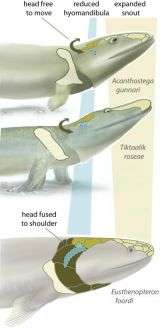
(PhysOrg.com) -- Newly exposed parts of Tiktaalik roseae--the intermediate fossil between fish and the first animals to walk out of water onto land 375 million years ago--are revealing how this major evolutionary event happened. A new study, published this week in Nature, provides a detailed look at the internal head skeleton of Tiktaalik roseae and reveals a key intermediate step in the transformation of the skull that accompanied the shift to life on land by our distant ancestors.
A predator, up to nine feet long, with sharp teeth, a crocodile-like head and a flattened body, Tiktaalik's anatomy and way of life straddle the divide between fish and land-living animals. First described in 2006, and quickly dubbed the "fishapod," it had fish-like features such as a primitive jaw, fins and scales, as well as a skull, neck, ribs and parts of the limbs that are similar to tetrapods, four-legged animals.
The initial 2006 report did not describe the internal anatomy of the head, because those parts of the fossil were buried in rock. In the October 16, 2008, issue of Nature, the researchers describe this region and show how Tiktaalik was gaining structures that could allow it to support itself on solid ground and breathe air.
"We used to think of this transition of the neck and skull as a rapid event," said study author Neil Shubin, PhD, of the University of Chicago and Field Museum and co leader of the project, "largely because we lacked information about the intermediate animals. Tiktaalik neatly fills this morphological gap. It lets us see many of the individual steps and resolve the relative timing of this complex transition."
"The braincase, palate, and gill arch skeleton of Tiktaalik have been revealed in great detail by recent fossil preparation of several specimens," said Jason Downs, PhD, a postdoctoral research fellow at the Academy of Natural Sciences and lead author on the new study. "By revealing new details on the pattern of change in this part of the skeleton, we see that cranial features once associated with land-living animals were first adaptations for life in shallow water."
"The new study reminds us that the gradual transition from aquatic to terrestrial lifestyles required much more than the evolution of limbs," said Ted Daeschler, PhD, of the Academy of Natural Sciences and co-leader of the team that discovered Tiktaalik. "Our work demonstrates that, across this transition, the head of these animals was becoming more solidly constructed and, at the same time, more mobile with respect to the body." These changes are intimately associated with the change in environment.
Fish in deep water move and feed in three-dimensional space and can easily orient their body in the direction of their prey. A neck, seen for the first time in the fossil record in Tiktaalik, is advantageous in settings where the body is relatively fixed, as is the case in shallow water and on land where the body is supported by appendages planted against a substrate.
Another important component of this transition was the gradual reduction of the hyomandibula, a bony element that, in fish, coordinates the cranial motions associated with underwater feeding and respiration. In the transition to life on land, the hyomandibula loses these functions and the bone becomes available for an eventual role in hearing.
In humans, as in other mammals, the hyomandibula, or stapes, is one of the tiny bones in the middle ear. "The bony part of Tiktaalik's hyomandibula is greatly reduced from the primitive condition," said Downs, "and this could indicate that these animals, in shallow water settings, were already beginning to rely less on gill respiration."
The discoveries were made possible by laboratory preparators Fred Mullison and Bob Masek, who prepared the underside of the skull of specimens collected in 2004. This painstaking process took several years. This work showed the underside of the skull and gill bones "beautifully preserved," said Shubin, "to a degree unlike any creature of its kind at this transition."
Having multiple Tiktaalik specimens enabled the researchers to prepare the fossils in ways that showed the bones of the head in "exceptional detail," Downs said.
The team discovered Tiktaalik roseae on Ellesmere Island, in the Nunavut Territory of Canada, 600 miles north of the Arctic Circle. Though this region of Nunavut is now a harsh Arctic ecosystem, at the time that Tiktaalik lived, the area was much further south and was a subtropical floodplain ecosystem.
The formal scientific name for the new species, "Tiktaalik" (tic-TAH-lick), was derived by the Elders Council of Nunavut, the Inuit Qaujimajatuqangit. The Inuktikuk word means "a large, shallow-water fish." The paleontology team works in Nunavut with authorization from the Department of Culture, Language, Elders and Youth. All fossils are the property of the people of Nunavut and will be returned to Canada after they are studied.
Provided by University of Chicago


