Ghostly glow reveals galaxy clusters in collision
October 15, 2008 Galaxy Cluster A521

Enlarge

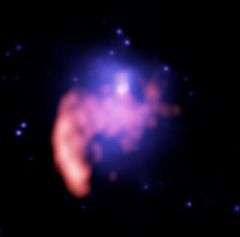
Superimposed false-color images of the galaxy cluster A521. The blue color represents hot gas typical of many galaxy clusters detected by the Chandra X-ray Observatory. The shape of the X-ray emission indicates that the cluster has undergone a recent collision or "merger event" that could generate turbulent waves. The red represents radio emission at 125 cm wavelength. The bright radio source on the lower left periphery of the X-ray gas is a separate source. The region of radio emission generated by turbulent waves is located at the center of the cluster, where the colors overlap. Credit: Radio (NCRA/GMRT/INAF/G.Brunetti et al.); X-ray (NASA/CXC/INAF/S.Giacintucci et al.)

A team of scientists, including astronomers from the Naval Research Laboratory (NRL), have detected long wavelength radio emission from a colliding, massive galaxy cluster which, surprisingly, is not detected at the shorter wavelengths typically seen in these objects.

The discovery implies that existing radio telescopes have missed a large population of these colliding objects. It also provides an important confirmation of the theoretical prediction that colliding galaxy clusters accelerate electrons and other particles to very high energies through the process of turbulent waves. The team revealed their findings in the October 16, 2008 edition of Nature.

This new population of objects is most easily detected at long wavelengths. Professor Greg Taylor of the University of New Mexico and scientific director of the Long Wavelength Array (LWA) points out, "This result is just the tip of the iceberg. When an emerging suite of much more powerful low frequency telescopes, including the LWA in New Mexico, turn their views to the cosmos, the sky will 'light up' with hundreds or even thousands of colliding galaxy clusters." NRL has played a key role in promoting the development of this generation of new instruments and is currently involved with the development of the LWA. NRL radio astronomer and LWA Project Scientist Namir Kassim says "Our discovery of a previously hidden class of low frequency cluster-radio sources is particularly important since the study of galaxy clusters was a primary motivation for development of the LWA."

The discovery of the emission in the galaxy cluster Abell 521 (or A521 for short) was made using the Giant Metrewave Radiotelescope (GMRT) in India, and its long wavelength nature was confirmed by the National Science Foundation's (NRAO) Very Large Array (VLA) radio telescope in New Mexico. The attached image shows the radio emission at a wavelength of 125cm in red superimposed on a blue image made from data taken by the Chandra X-ray Observatory.

The X-ray emission comes from hot thermal gas, a well-known sign-post of massive galaxy clusters. Furthermore, its elongated shape indicates that the cluster has undergone a recent violent collision or "merger event" in which another group or cluster of galaxies was swallowed up by the gravitational potential of the main cluster. Interferometrics Inc. and NRL scientist Tracy Clarke, who is also the LWA System Scientist, notes "In addition to teaching us about the nature of Dark Matter, merging clusters are also important in studies of the mysterious nature of Dark Energy. Understanding these two strange components of the Universe will help us understand its ultimate destiny."

In the radio image there is a strong, oblong source of emission located on the lower left periphery of the X-ray gas detected by Chandra; this is a separate source. In the center of the cluster, within the region indicated by a dashed circle, there is radio emission which changes significantly with wavelength. At the longest wavelength (125 cm, shown) it is clearly detected, but at a wavelength of 49 cm it is much fainter, and it is almost entirely gone at 21 cm wavelength. This multi-wavelength picture of the diffuse emission is in good agreement with theoretical predictions for particle acceleration by turbulent waves generated by a violent collision.

In a broader astrophysical context, galaxy clusters are the largest gravitationally bound systems in the Universe and their collisions are the most energetic events since the Big Bang. Says team leader Gianfranco Brunetti (Instituto di Radioastronomia, Bologna, Italy), "The A521 system provides evidence that turbulence acts as a source of particle acceleration in an environment that is unique in the Universe due to its large spatial and temporal scales, and due to the low density and high temperature of the gas."

Source: Naval Research Laboratory


print this article email this article download pdf blog this article bookmark this article     Stumble it Digg this share on Facebook retweet share on Reddit add to delicious
Rate this story - 4.5 /5 (15 votes)

Rank Filter

Move the slider to adjust rank threshold, so that you can hide some of the comments.


Display comments: newest first

  • yyz - Oct 16, 2008
    • Rank: not rated yet
    Interested readers may want to check out these 3 previously published papers - "CXO observations of the multiple merger cluster Abell 521" @ arXiv:astro-ph/0508585v2 and "Shock acceleration as the origin of the radio relic in A 521" @ arXiv:0803.4127v1 , both published in 2008. Even more intriguing is 2003 paper by C Ferrari et al entitled "Multiple merging events in Abell 521" (Check NED or ADS for a free preprint of this paper). All 3 papers feature excellent images of Abell 521 at different wavelengths and supply abundant information on this peculiar, nearby galaxy cluster. Does anyone have links to a free preprint mentioned in the article above, as I am conducting a study of merging galaxy clusters? Makes for a great image of Abell 521, but also studies of dark matter distribution can be directly measured as well (remember the 'Bullet Cluster anyone?).

October 15, 2008 all stories

Comments: 1

4.5 /5 (15 votes)
  • Stumble this up

  • Digg this

  • share this

  • hide
  • Related Stories

  • Astronomers seek to explore the cosmic Dark Ages
    created Oct 15, 2009 | popularity not rated yet | comments 0
  • Astronomer's new guide to the galaxy: Largest map of cold dust revealed
    created Jul 01, 2009 | popularity not rated yet | comments 0
  • Active galaxies flare and fade in Fermi telescope all-sky movie (w/Video)
    created Apr 24, 2009 | popularity not rated yet | comments 0
  • Geriatric pulsar still kicking
    created Feb 26, 2009 | popularity not rated yet | comments 0
  • Looking Back 13.8 Billion Years: The countdown for Planck satellite has started
    created Feb 05, 2009 | popularity not rated yet | comments 0


  • hide
  • Relevant PhysicsForums posts

  • SIMBAD/NED help
    created 3 hours ago
  • Black hole confusion
    created Nov 14, 2009
  • Moon tied to Earth
    created Nov 13, 2009
  • Water on the Moon!
    created Nov 13, 2009
  • More from Physics Forums - General Astronomy

Other News

MIT scientists pinpoint origin of dissolved arsenic in Bangladesh drinking water

Scientists pinpoint origin of dissolved arsenic in Bangladesh drinking water

Space & Earth / Environment

created 14 hours ago | popularity 4.9 / 5 (11) | comments 0

Researchers in MIT's Department of Civil and Environmental Engineering believe they have pinpointed a pathway by which arsenic may be contaminating the drinking water in Bangladesh, a phenomenon that has puzzled ...


Commuters wait on the platform shrouded by fog in London

Climate change not man-made, say majority of Britons: poll

Space & Earth / Environment

created 20 hours ago | popularity 2.9 / 5 (10) | comments 22

Less than half of Britons believes that human activity is to blame for global warming, according to a poll carried out for The Times newspaper and published on Saturday.


Warmer means windier on world's biggest lake

Space & Earth / Earth Sciences

created 14 hours ago | popularity 3.3 / 5 (3) | comments 0

Rising water temperatures are kicking up more powerful winds on Lake Superior, with consequences for currents, biological cycles, pollution and more on the world's largest lake and its smaller brethren.


Geeky 'tweeters' to report on space shuttle launch (AP)

Geeky 'tweeters' to report on space shuttle launch

Space & Earth / Space Exploration

created 14 hours ago | popularity not rated yet | comments 0

(AP) -- Fingers will be flying when space shuttle Atlantis blasts off Monday: About 100 of NASA's geekiest fans will be on hand, pecking away at iPhones, BlackBerrys, laptops and other Twittering gadgets.


Hawaii's famed white sandy beaches are shrinking (AP)

Hawaii's famed white sandy beaches are shrinking

Space & Earth / Environment

created 20 hours ago | popularity 5 / 5 (1) | comments 1

(AP) -- Jenn Boneza remembers when the white sandy beach near the boat ramp in her hometown was wide enough for people to build sand castles.