First Tunable, ‘Noiseless’ Amplifier May Boost Quantum Computing, Communications
October 15, 2008
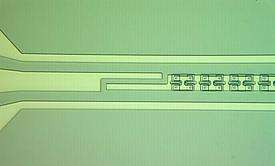
In the JILA/NIST “noiseless” amplifier, a long line of superconducting magnetic sensors (beginning on the right in this photograph) made of sandwiches of two layers of superconducting niobium with aluminum oxide in between, creates a 'metamaterial' that selectively amplifies microwaves based on their amplitude rather than or phase. Credit: M. Castellanos-Beltran/JILA
(PhysOrg.com) -- Researchers at the National Institute of Standards and Technology (NIST) and JILA, a joint institute of NIST and the University of Colorado (CU) at Boulder, have made the first tunable “noiseless” amplifier. By significantly reducing the uncertainty in delicate measurements of microwave signals, the new amplifier could boost the speed and precision of quantum computing and communications systems.
Conventional amplifiers add unwanted “noise,” or random fluctuations, when they measure and boost electromagnetic signals. Amplifiers that theoretically add no noise have been demonstrated before, but the JILA/NIST technology, described in an Oct. 5, 2008, advance online publication of Nature Physics, offers better performance and is the first to be tunable, operating between 4 and 8 gigahertz, according to JILA group leader Konrad Lehnert. It is also the first amplifier of any type ever to boost signals sufficiently to overcome noise generated by the next amplifier in a series along a signal path, Lehnert says, a valuable feature for building practical systems.
Noisy amplifiers force researchers to make repeated measurements of, for example, the delicate quantum states of microwave fields—that is, the shape of the waves as measured in amplitude (or power) and phase (or point in time when each wave begins). The rules of quantum mechanics say that the noise in amplitude and phase can’t both be zero, but the JILA/NIST amplifier exploits a loophole stipulating that if you work with only one—phase—and ignore amplitude, then the amplifier is theoretically capable of adding no noise. In reality, the JILA/NIST amplifier adds about half the noise that would be expected from measuring both amplitude and phase.
The JILA/NIST amplifier could enable faster, more precise measurements in certain types of quantum computers—which, if they can be built, could solve some problems considered intractable today—or quantum communications systems providing “unbreakable” encryption. It also offers the related and useful capability to “squeeze” microwave fields, trading reduced noise in the signal phase for increased noise in the signal amplitude. By combining two squeezed entities, scientists can “entangle” them, linking their properties in predictable ways that are useful in quantum computing and communications. Entanglement of microwave signals, as opposed to optical signals, offer some practical advantages in computing and communication such as relatively simple equipment requirements, Lehnert says.
The new amplifier is a 5-millimeter-long niobium cavity lined with 480 magnetic sensors called SQUIDs (superconducting quantum interference devices). The line of SQUIDs acts like a “metamaterial,” a structure not found in nature that has strange effects on electromagnetic energy. Microwaves ricochet back and forth inside the cavity like a skateboarder on a ramp. Scientists tune the wave velocity by manipulating the magnetic fields in the SQUIDs and the intensity of the microwaves. An injection of an intense pump tone at a particular frequency, like a skateboarder jumping at particular times to boost speed and height on a ramp, causes the microwave power to oscillate at twice the pump frequency. Only the portion of the signal which is synchronous with the pump is amplified.
Funding for the research was provided by NIST, the National Science Foundation, and a NIST-CU seed grant.
Citation: M.A. Castellanos-Beltran, K.D. Irwin, G.C. Hilton, L.R. Vale and K.W. Lehnert. Amplification and squeezing of quantum noise with a tunable Josephson metamaterial. Nature Physics, published online: 5 Oct. 5 2008; doi:10.1038/nphys1090.
Provided by NIST
-
Finnish team devise nanomechanical microwave amplifier with near least possible noise generation
Dec 15, 2011 |
4.8 / 5 (6) |
4
-
Scientists set a new record for measuring magnetic vibrations using the spin of a single atom
May 25, 2011 |
5 / 5 (1) |
0
-
Sensitivity of precision measurements enhanced by the environment
Apr 27, 2011 |
3.7 / 5 (3) |
0
-
New research stems from the sun
Jan 27, 2011 |
4.3 / 5 (4) |
1
-
Physicists build quantum amplifier with single artificial atom
May 25, 2010 |
4.4 / 5 (23) |
3
-
Engineers build first sub-10-nm carbon nanotube transistor
Feb 01, 2012 |
4.9 / 5 (31) |
30
-
Something old, something new: Evolution and the structural divergence of duplicate genes
Jan 31, 2012 |
4.6 / 5 (7) |
1
-
The hidden nanoworld of ice crystals: Revealing the dynamic behavior of quasi-liquid layers
Jan 30, 2012 |
5 / 5 (3) |
1
-
Stock market network reveals investor clustering
Jan 27, 2012 |
3.9 / 5 (23) |
8
-
Of microchemistry and molecules: Electronic microfluidic device synthesizes biocompatible probes
Jan 26, 2012 |
5 / 5 (1) |
0
-
Weight required to balance a boom stand?
1 hour ago
-
Questions about Equivalence principle & Einstein Elevator?
3 hours ago
-
Kinetic energy of gas
4 hours ago
-
Understanding induced emfs
6 hours ago
-
What is the precise definition of a year?
7 hours ago
-
Universe as a cellular automaton
9 hours ago
- More from Physics Forums - General Physics
More news stories
Explained: Sigma
It's a question that arises with virtually every major new finding in science or medicine: What makes a result reliable enough to be taken seriously? The answer has to do with statistical significance -- but ...
Feb 09, 2012 |
5 / 5 (19) |
66
Quantum physicist explains $100K offer for proof scaled-up quantum computing is impossible
(PhysOrg.com) -- MIT researcher Scott Aaronson has certainly riled the physics community with his offer this past Friday, of $100,000 to anyone who can prove that scaled-up quantum computing is impossible. ...
Diamond light, brighter than the sun
Its the size of five football pitches and generates light 10 billion times brighter than the sun. As the Diamond Light Source celebrates its tenth anniversary this year, Penny Bailey visits one of the ...
Feb 07, 2012 |
4.3 / 5 (7) |
17
|
Physicists 'record' magnetic breakthrough
An international team of scientists has demonstrated a revolutionary new way of magnetic recording which will allow information to be processed hundreds of times faster than by current hard drive technology.
Feb 07, 2012 |
4.5 / 5 (41) |
14
|
Hints of the Higgs - papers are submitted
Back in December 2011, the ATLAS and CMS experiments at CERN presented some exciting results that provided tantalising hints of the Higgs boson.
Feb 08, 2012 |
4.1 / 5 (7) |
10
Walney offshore wind farm is world's biggest (for now)
(PhysOrg.com) -- The Walney wind farm on the Irish Sea--characterized by high tides, waves and windy weather--officially opened this week. The farm is treated in the press as a very big deal as the Walney ...
GPS court ruling leaves US phone tracking unclear
A US Supreme Court decision requiring a warrant to place a GPS device on the car of a criminal suspect leaves unresolved the bigger issue of police tracking using mobile phones, legal experts say.
Europeans protest controversial Internet pact
Tens of thousands of people marched in protests in more than a dozen European cities Saturday against a controversial anti-online piracy pact that critics say could curtail Internet freedom.
Europe stakes billion-dollar bet on new rocket
A pencil-slim rocket is scheduled to lift into space from South America on Monday, carrying a billion-dollar bet that Europe can grab a juicy slice of the market to place satellites in low orbit.
Study finds that anti-diabetic medication can prevent the long-term effects of maternal obesity
In a study to be presented today at the Society for Maternal-Fetal Medicine's annual meeting, The Pregnancy Meeting, in Dallas, Texas, researchers will report findings that show that short therapy with the anti-diabetic medication ...
Netflix settlement trims 14 pct off 4Q earnings
(AP) -- Netflix pressed the rewind button on its fourth-quarter earnings after settling allegations that the video subscription service violated a consumer-privacy law.