Gold Nanostars Outshine the Competition
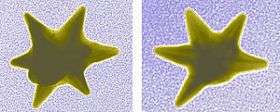
(PhysOrg.com) -- Novel nanoparticles being tested at the National Institute of Standards and Technology have researchers seeing stars. In a recent paper,* NIST scientists used surface-enhanced Raman spectroscopy (SERS) to demonstrate that gold nanostars exhibit optical qualities that make them superior for chemical and biological sensing and imaging. These uniquely shaped nanoparticles may one day be used in a range of applications from disease diagnostics to contraband identification.
SERS relies on metallic nanoparticles, most commonly gold and silver, to amplify signals from molecules present in only trace quantities. For these types of experiments, scientists shine laser light on an aqueous solution containing the nanoparticles and the molecule of interest and monitor the scattered light.
The detailed characteristics of both the molecule and the nanoparticle affect the strength of scattered light, which contains an identifying fingerprint for the molecule known as its vibrational signature. With nanoparticles amplifying the signature, it is possible to detect a very low concentration of molecules in a solution.
The NIST team tested the optical properties of the nanostars using two target molecules, 2-mercaptopyridine and crystal violet. These molecules were selected because of their structural similarity to biological molecules and their large number of delocalized electrons, a characteristic that lends itself to SERS. NIST researchers found that the Raman signal of 2-mercaptopyridine was 100,000 stronger when nanostars were present in the solution. The stars were also shown to be particularly capable of enhancing the signature of crystal violet, delivering a signal about 10 times stronger than the previous winner, nanorods. Both the nanostars and the nanorods outperformed the nanospheres commonly used for Raman enhancement.
NIST physicist Angela Hight Walker and her team perfected the process for making gold nanostars, building them from the bottom-up using surface alterations to manipulate their growth and control their shape. Once suspended in a solution, the team guided the nanostars to gather together to form multiple “hot spots,” where the enhancement is dramatically larger than for a single nanostar.
According to Hight Walker, the fact that they can now be created en masse and have desirable optical properties should prompt researchers to examine their possible applications, perhaps eventually making them the stars of the nanoworld.
Citation: E. Nalbant Esenturk and A. R. Hight Walker. Surface-enhanced Raman scattering spectroscopy via gold nanostars. Journal of Raman Spectroscopy, published online Sept. 24, 2008, DOI: 10.1002/jrs.2084.
Provided by NIST


