Reservoirs promote spread of aquatic invasive species
October 15, 2008 by Jill Sakai Reservoirs promote spread of aquatic invasive species

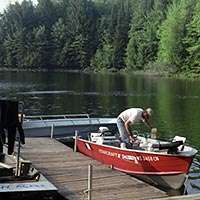
A new study shows that manmade reservoirs are up to 300 times more likely than natural lakes such as Crampton Lake in northern Wisconsin (pictured above) to harbor invasive species. Photo: Paroma Basu

(PhysOrg.com) -- The latest "damming" evidence suggests that manmade reservoirs are facilitating the spread of invasive species in Wisconsin lakes.

In a comparison of natural lakes and impoundments — reservoirs created by damming rivers — the impoundments were up to 300 times more likely than lakes to harbor invasive aquatic species, according to a study published last month in the journal Frontiers in Ecology and the Environment.

Jake Vander Zanden of UW-Madison, Pieter Johnson of the University of Colorado-Boulder and Julian Olden of the University of Washington looked at five increasingly common aquatic invasive species — Eurasian watermilfoil, spiny water flea, zebra mussel, rusty crayfish and rainbow smelt — in 1,081 lakes and impoundments in Wisconsin and Michigan's Upper Peninsula.

The impoundments had greater risk of invasion by each of the five species, ranging from a modest two-fold risk increase of harboring watermilfoil or rusty crayfish to 300 times the risk of containing spiny water flea. Impoundments were also more likely than natural lakes to host multiple invasive species.

Invasive species can have profound ecological and economic impacts, including changing water quality, fouling boats and industrial equipment, and competing with or preying on native species. "Invasions are one of the major drivers of global change, one of the major ways we are changing the surface of this planet," says Vander Zanden, a professor at the UW-Madison Center for Limnology.

The impoundments also appear to increase the invasion risk of natural lakes through what he calls a "stepping stone" effect — reservoirs' favorable conditions give invasive species an entry point into the landscape from which they can more easily spread to nearby lakes.

"These impoundments bridge the gap so that it's easier for an invasive to make the hop from one [natural] system to the next," Vander Zanden says. For example, the spiny water flea was first discovered in inland Wisconsin in the Gile Flowage, a reservoir situated halfway between Lake Superior and the Northern Highlands Lake District. It has since spread to at least one natural lake in the region.

The new analysis links higher non-native invasion risk to high levels of human use, especially boating, and environmental conditions such as water body size and chemical properties. In addition, manmade reservoirs typically contain young, less established ecological communities that may allow invasive species to gain a foothold, says Johnson, a former UW-Madison scientist who is now an ecologist at UC-Boulder.

Much of the data used for the study came from resource management agencies, including the Wisconsin Department of Natural Resources and the Great Lakes Indian Fish and Wildlife Commission. The researchers hope that improving the understanding of invasion risk will help guide and prioritize management and eradication efforts.

"Targeted prevention and control efforts can give more bang for the buck," Johnson says. "Impoundments may be a good target for those efforts."

Provided by University of Wisconsin


print this article email this article download pdf blog this article bookmark this article     Stumble it Digg this share on Facebook retweet share on Reddit add to delicious
Rate this story - 3.3 /5 (8 votes)

Rank Filter

Move the slider to adjust rank threshold, so that you can hide some of the comments.


Display comments: newest first

  • Modernmystic - Oct 16, 2008
    • Rank: 5 / 5 (1)
    Because of course none of our activities can possibly be "good" for the ecosystem....
  • Velanarris - Oct 17, 2008
    • Rank: not rated yet
    Because creating man made obstacles to species' movement helps them propagate throughout a system....

    The title of this article is junk. If they wanted to report on this it should read "Invasive species receive assitance through man-made leisure pursuits"

    then it would be more pertinent to things like boating which is a main introduction method.

October 15, 2008 all stories

Comments: 2

3.3 /5 (8 votes)
  • Stumble this up

  • Digg this

  • share this

  • hide
  • Related Stories


  • hide
  • Relevant PhysicsForums posts

  • The IPCC and the term "most"
    created Nov 23, 2009
  • Is global warming a fact?
    created Nov 23, 2009
  • Random variability of wind patterns
    created Nov 23, 2009
  • Record precipitation in the UK
    created Nov 22, 2009
  • More from Physics Forums - Earth

Other News

Past regional cold and warm periods linked to natural climate drivers

Space & Earth / Earth Sciences

created 3 hours ago | popularity 5 / 5 (4) | comments 5

Intervals of regional warmth and cold in the past are linked to the El Niño phenomenon and the so-called "North Atlantic Oscillation" in the Northern hemisphere's jet stream, according to a team of climate scientists. These ...


Russia: no space for space tourists (AP)

Russia: no space for space tourists

Space & Earth / Space Exploration

created 10 hours ago | popularity 2.7 / 5 (3) | comments 2

(AP) -- A top Russian space official says there is no space for tourists wishing to fly to the International Space Station.


Monster Waves on the Sun are Real

Monster Waves on the Sun are Real (w/ Video)

Space & Earth / Astronomy

created 23 hours ago | popularity 4.9 / 5 (15) | comments 2

Sometimes you really can believe your eyes. That's what NASA's STEREO (Solar Terrestrial Relations Observatory) spacecraft are telling researchers about a controversial phenomenon on the sun known as the "solar ...


Climate experts debate strategies for reducing atmospheric carbon and future warming

Climate experts debate strategies for reducing atmospheric carbon and future warming

Space & Earth / Environment

created 23 hours ago | popularity 2.9 / 5 (9) | comments 14

(PhysOrg.com) -- Reducing carbon dioxide to safe levels may require extracting carbon from the air, says Cornell climate researcher.


Astronauts surprised by holiday turkey dinners (AP)

Astronauts surprised by holiday turkey dinners

Space & Earth / Space Exploration

created 6 hours ago | popularity not rated yet | comments 0

(AP) -- Space shuttle Atlantis' astronauts thought they were going to give thanks with pantry leftovers Thursday as their mission drew to a close, but found turkey dinners awaiting them.