Brain structure provides key to unraveling function of bizarre dinosaur crests
October 16, 2008 Corythosaurus

Enlarge

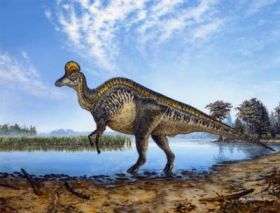
A life reconstruction of the helmet-crested lambeosaur Corythosaurus. Credit: Courtesy of Michael Skrepnick.

Paleontologists have long debated the function of the strange, bony crests on the heads of the duck-billed dinosaurs known as lambeosaurs. The structures contain incredibly long, convoluted nasal passages that loop up over the tops of their skulls.

Scientists at the University of Toronto, Ohio University and Montana State University now have used CT-scanning to look inside these mysterious crests and reconstruct the brains and nasal cavities of four different lambeosaur species. At the annual meeting of the Society for Vertebrate Paleontology in Cleveland, Ohio, on Oct. 16, the team will present new study findings that suggest the crests were used for communication.

"The shape of the brain can tell us a lot about what senses were important in a dinosaur's everyday life, and give insight into the function of the crests," said study lead author David Evans, a paleontologist at the Royal Ontario Museum and the University of Toronto.

Some paleontologists have suggested that the crests heightened the sense of smell by increasing the surface area of the sensory tissue. Others have argued that they regulated temperature, and still others have speculated that the crests acted as sound resonators for communication.

"It's difficult to infer the function of structures in an extinct dinosaur when there is so little resemblance to any living animal," said Jack Horner, a member of the team and paleontologist at Montana State University.

By analyzing CT scans, conducted by Lawrence Witmer and Ryan Ridgely of Ohio University's College of Osteopathic Medicine, the scientists were able to circumvent the problems of fossilization.

"Even though the soft tissues are not preserved in the fossils, the shape of the bones that encase the brain and nasal passages are," said Evans. "From there, the anatomy of these missing soft parts is easily interpreted."

The CT scan results revealed a mismatch between the external shape of the crest (which no doubt functioned as a visual display) and the internal shape of the nasal passages in closely related species, suggesting a special function for the nasal cavity. The portion of the brain responsible for the sense of smell was relatively small and primitive, indicating that the crest did not evolve to improve that sense.

Computer models done by other researchers suggest that the crests could have been used to make low, eerie bellowing calls that could have been used in communication, perhaps to call for mates or warn others of predators. The CT scans documented a delicate inner ear that confirms that the dinosaurs could hear the low-frequency calls produced by the crest.

"We were surprised to see just how large the centers of the brain associated with higher cognitive functions were," said Witmer, Chang Professor of Paleontology in Ohio University's College of Osteopathic Medicine. "We suspected that the crested duck-billed dinosaurs used both vocal and visual displays, but now we see that they had the brain power and hearing to pull off these behaviors."

When all the available information is put together, including the digital brain and ear casts, the evolutionary relationships of the species, and the growth pattern of the crest and its high degree of variability in different co-existing species, it supports the idea that the elaborate nasal cavity was likely used to produce sounds for communication. This study demonstrates the power of using an integrated approach combining 3D imaging, growth studies, and phylogenetic sampling to test ideas about the function and evolution of unusual structures in extinct animals.

Source: Ohio University


Rate this story - 4.4 /5 (34 votes)

Rank Filter

Move the slider to adjust rank threshold, so that you can hide some of the comments.


Display comments: newest first

  • gmurphy - Oct 16, 2008
    • Rank: 4 / 5 (1)
    it would have been amazing to see these creatures in their prime.
  • Arikin - Oct 17, 2008
    • Rank: not rated yet
    Isn't it an assumption that the functions of their brains were located in the same places as modern animals and humans? How do we know that the function for smell was where they think it was?

    Ah if only we could do a scan of a living lambeosaur while testing its senses.
  • TJ_alberta - Oct 17, 2008
    • Rank: not rated yet
    Arikin - check out any good textbook on comparative vertebrate anatomy. I think you will find an assumption that rests on a firm foundation.
  • ofidiofile - Oct 17, 2008
    • Rank: not rated yet
    the olfactory lobes leave a distinct impression on the inside of the brain case. probably the same for the other senses as well.

October 16, 2008 all stories

Comments: 4

4.4 /5 (34 votes)

  • hide
  • Related Stories

  • New MEMS sensor based on human organ is no tin ear
    created Nov 04, 2005 | popularity not rated yet | comments 0
  • Evolution of skull and mandible shape in cats
    created Jul 30, 2008 | popularity not rated yet | comments 0
  • Brain, Size and Gender Surprises in Latest Fossil Tying Humans, Apes and Monkeys
    created May 15, 2007 | popularity not rated yet | comments 0
  • Research project could help create computers that run on light
    created Mar 14, 2007 | popularity not rated yet | comments 0
  • Duck-bill dinosaur mystery finally solved
    created Jan 25, 2006 | popularity not rated yet | comments 0


  • hide
  • Relevant PhysicsForums posts

Other News

Study challenges bird-from-dinosaur theory of evolution - was it the other way around?

Study challenges bird-from-dinosaur theory of evolution - was it the other way around?

Other Sciences / Archaeology & Fossils

created 7 hours ago | popularity 4.3 / 5 (7) | comments 4 | with audio podcast

(PhysOrg.com) -- A new study just published in the Proceedings of the National Academy of Sciences provides yet more evidence that birds did not descend from ground-dwelling theropod dinosaurs, experts say, a ...


The Glass Cliff: Female representation in politics and business

Other Sciences / Social Sciences

created 1hour ago | popularity not rated yet | comments 0

Leadership positions in business have proven to be precarious for women. Female business leaders are more likely to be appointed to powerful leadership positions when an organization is in crisis or high-risk circumstances. ...


'Counterfactual' thinkers are more motivated and analytical, study suggests

Other Sciences / Social Sciences

created 10 hours ago | popularity 4.5 / 5 (4) | comments 4 | with audio podcast

(PhysOrg.com) -- "If only I had..." Almost everyone has said those four words at some time. Rather than intensifying regret, '"what if" reflection about pivotal moments in the past helps people to weave a coherent life story, ...


Office romance? Not a problem most of time: study

Office romance? Not a problem most of time: study

Other Sciences / Social Sciences

created 8 hours ago | popularity not rated yet | comments 1

(PhysOrg.com) -- Pam and Jim on The Office. Meredith and McDreamy on Grey's Anatomy. Television shows depict many workplace romances, but in the real world how do co-workers view love on the job? According ...


Women on board: Does forced diversity hurt firm performance?

Other Sciences / Social Sciences

created 8 hours ago | popularity 1 / 5 (1) | comments 1

(PhysOrg.com) -- New SEC rules will require public firms to disclose what role, if any, diversity plays in appointing members to their corporate boards, but University of Michigan researchers say any forced restructuring ...