Colossal black holes common in early universe
October 16, 2008 Colossal black holes common in early universe

Enlarge

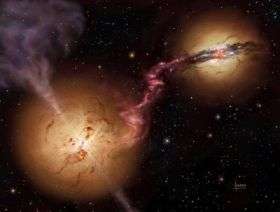
Artist's conception of the 4C60.07 system of colliding galaxies. The galaxy on the left has turned most of its gas into stars, and the black hole in its center is ejecting charged particles in the two immense jets shown. The galaxy on the right also has a black hole causing the galaxy's central region to shine, but much of its light is hidden by surrounding gas and dust. Vast numbers of stars are forming out of the gas and dust, and some of the material is being pulled away from the galaxy. Credit: David A. Hardy/UK ATC

Astronomers think that many - perhaps all - galaxies in the universe contain massive black holes at their centers. New observations with the Submillimeter Array now suggest that such colossal black holes were common even 12 billion years ago, when the universe was only 1.7 billion years old and galaxies were just beginning to form. The new conclusion comes from the discovery of two distant galaxies, both with black holes at their heart, which are involved in a spectacular collision.

4C60.07, the first of the galaxies to be discovered, came to astronomers' attention because of its bright radio emission. This radio signal is one telltale sign of a quasar - a rapidly spinning black hole that is feeding on its home galaxy.

When 4C60.07 was first studied, astronomers thought that hydrogen gas surrounding the black hole was undergoing a burst of star formation, forming stars at a remarkable rate - the equivalent of 5,000 suns every year. This vigorous activity was revealed by the infrared glow from smoky debris left over when the largest stars rapidly died.

The latest research, exploiting the keen vision of the Submillimeter Array of eight radio antennas located in Hawaii, revealed a surprise. 4C60.07 is not forming stars after all. Indeed, its stars appear to be relatively old and quiescent. Instead, prodigious star formation is taking place in a previously unseen companion galaxy, rich in gas and deeply enshrouded in dust, which also has a colossal black hole at its center.

"This new image reveals two galaxies where we only expected to find one," said Rob Ivison (UK Astronomy Technology Centre), lead author of the study that will be published in the Monthly Notices of the Royal Astronomical Society. "Remarkably, both galaxies contain supermassive black holes at their centers, each capable of powering a billion, billion, billion light bulbs. The implications are wide-reaching: you can't help wondering how many other colossal black holes may be lurking unseen in the distant universe."

Due to the finite speed of light, we see the two galaxies as they existed in the distant past, less than 2 billion years after the Big Bang. The new image from the Submillimeter Array captures the moment when 4C60.07 ripped a stream of material from its neighboring galaxy, as shown in the accompanying artist's conception. By now the galaxies have merged to create a football-shaped elliptical galaxy. Their black holes are likely to have merged and formed a single, more massive black hole.

The galaxies themselves show surprising differences. One is a dead system that has formed all of its stars already and used up its gaseous fuel. The second galaxy is still alive and well, holding plenty of dust and gas that can form new stars.

"These two galaxies are fraternal twins. Both are about the size of the Milky Way, but each one is unique," said Steve Willner of the Harvard-Smithsonian Center for Astrophysics, a co-author of the paper.

"The superb resolution of the Submillimeter Array was key to our discovery," he added.

Source: Harvard-Smithsonian Center for Astrophysics


print this article email this article download pdf blog this article bookmark this article     Stumble it Digg this share on Facebook retweet share on Reddit add to delicious
Rate this story - 4.4 /5 (33 votes)

Rank Filter

Move the slider to adjust rank threshold, so that you can hide some of the comments.


Display comments: newest first

  • DarkMindgame - Oct 16, 2008
    • Rank: 4 / 5 (2)
    I just hope those black holes keep their distance from us!


    You do realize that these galaxies are over 12 Billion light years away right?
  • axemaster - Oct 17, 2008
    • Rank: 1 / 5 (1)
    He's obviously joking, give him a break jeez.
  • Alexa - Oct 17, 2008
    • Rank: 1 / 5 (2)
    The logical question is, why these giant BH aren't so common today. Do you know answer of AWT?
  • Velanarris - Oct 17, 2008
    • Rank: 5 / 5 (1)
    The logical question is, why these giant BH aren't so common today. Do you know answer of AWT?


    They are. They're in the center of galaxies.
  • barakn - Oct 17, 2008
    • Rank: 2.7 / 5 (3)
    He's obviously joking, give him a break jeez.

    He's not joking, he's spamming. If you do a google search for RedFoxOne site:physorg.com you'll find that almost all of his/her comments are stupid one-liners ending in an exclamation mark and then a spam URL.

October 16, 2008 all stories

Comments: 5

4.4 /5 (33 votes)
  • Stumble this up

  • Digg this

  • share this

  • hide
  • Related Stories


  • hide
  • Relevant PhysicsForums posts

  • Sideral question
    created 20 hours ago
  • Doppler shifted blackbody spectrum
    created 23 hours ago
  • Earth v. Moon
    created Nov 21, 2009
  • help me with coordinates and orbits
    created Nov 21, 2009
  • More from Physics Forums - General Astronomy

Other News

Baby can wait as expectant dad finishes spacewalk (AP)

Baby can wait as expectant dad finishes spacewalk

Space & Earth / Space Exploration

created 12 hours ago | popularity 3 / 5 (2) | comments 0

(AP) -- A spacewalking astronaut put aside the impending birth of his daughter and blazed through his first-ever venture outside the International Space Station on Saturday.


Unseasonably hot and dry weather combined with strong winds to fan scores of blazes in the country's southeastern states

Australia issues 'catastrophic' alerts as fires rage

Space & Earth / Environment

created 18 hours ago | popularity 4 / 5 (3) | comments 0

Australia has issued "catastrophic" alerts after record-breaking temperatures and wild lightning storms sparked more than 100 fires across the country, officials said Saturday.


Commuters wait on the platform shrouded by fog in London

Climate change not man-made, say majority of Britons: poll

Space & Earth / Environment

created Nov 15, 2009 | popularity 3.3 / 5 (15) | comments 46

Less than half of Britons believes that human activity is to blame for global warming, according to a poll carried out for The Times newspaper and published on Saturday.


Mysteriously warm times in Antarctica

Mysteriously warm times in Antarctica

Space & Earth / Earth Sciences

created Nov 18, 2009 | popularity 4.2 / 5 (21) | comments 28

(PhysOrg.com) -- A new study of Antarctica's past climate reveals that temperatures during the warm periods between ice ages (interglacials) may have been higher than previously thought. The latest analysis ...


UN: Fight climate change with free condoms (AP)

UN: Fight climate change with free condoms

Space & Earth / Environment

created Nov 18, 2009 | popularity 3.1 / 5 (11) | comments 24

(AP) -- The battle against global warming could be helped if the world slowed population growth by making free condoms and family planning advice more widely available, the U.N. Population Fund said Wednesday.