When it comes to forest soil, wildfires pack 1-2 punch
October 16, 2008 Soil Particles Take Flight?

Enlarge

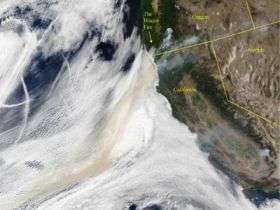
New research conducted by PNW Research Station scientists and their colleagues on the 2002 Biscuit Fire is the first to document the toll of wildfire on forest soils -- namely, the loss of significant amounts of carbon and nitrogen and 1 full inch of the upper soil layer. The work also raises an intriguing question: might the missing fine soil have been transported away in the fire's massive smoke plume, such as the one seen in this satellite image from July 29, 2002? Large plumes of smoke, some more than 900 miles long, were visible most days during the months-long fire, and scientists know that smoke contains fine mineral-soil particles as well as partially burned organic matter. The possibility that a substantial mass of mineral-soil particles was transported high into the atmosphere raises new questions about the effects of intense fire on radiation interception and offsite land and ocean fertilization. Image courtesy of MODIS

For decades, scientists and resource managers have known that wildfires affect forest soils, evidenced, in part, by the erosion that often occurs after a fire kills vegetation and disrupts soil structure. But, the lack of detailed knowledge of forest soils before they are burned by wildfire has hampered efforts to understand fire's effects on soil fertility and forest ecology.

A new study led by the Pacific Northwest (PNW) Research Station addresses this critical information gap and represents the first direct evidence of the toll wildfire can take on forest soil layers. It draws on data from the 2002 Biscuit Fire, which scorched some 500,000 acres in southwest Oregon, including half of a pre-existing study's experimental plots, which had been studied extensively before the fire. The result was a serendipitous and unprecedented opportunity to directly examine how wildfire changes soil by sampling soils before and after a wildfire. The study appears in the November issue of the Canadian Journal of Forest Research.

"Losing our experiment in the fire was hard, but the opportunity to better understand fire as a dominant ecosystem process has been very exciting," said Bernard Bormann, a research forest ecologist with PNW Research Station and the study's lead investigator. "This study, covering over 300 acres, provided nearly 400 soil sampling points as well as extensive tree and understory plots to use in our analysis."

Bormann—along with study co-author and Western Washington University professor Peter Homann and colleagues from the PNW Research Station and Oregon State University—conducted chemical analyses on soil samples collected before and after the fire. They found that the combustion of the organic layer at the soil's surface, including woody debris, caused intense, 1,300 °F-plus temperatures, which, in turn, displaced considerable amounts of carbon and nitrogen from the underlying mineral soil layer and left mostly ash behind. What was more surprising to the researchers was how these organic materials may have been lost. Some carbon and nitrogen were lost as gases—consisting mostly of carbon dioxide, nitrogen dioxide, and water vapor—and some in an inch of fine mineral-soil particles, which disappeared and left behind a crust of rocks.

"Altogether, we documented losses of more than 10 tons per acre of carbon and between 450 to 620 pounds per acre of nitrogen," Bormann said. "The loss of topsoil and combustion of organic materials together led to losses that are higher than most previous estimates."

The loss of topsoil and carbon from soil can negatively affect a range of processes, Bormann said, including nutrient retention and water infiltration. In the absence of special nitrogen-fixing plants, which are capable of converting atmospheric nitrogen into nitrogen compounds for growth, losses of nitrogen in the order of what he and his colleagues documented would require at least a century to be reversed.

Equally disconcerting is the role these released organic materials might have on the atmosphere, especially in the face of a warming climate. The burning of soil by wildfire may contribute to global warming, in the short term, by releasing carbon as a greenhouse gas and, in the long term, by reducing soil productivity through losses of organic matter and nutrients. With less productive soils, Bormann said, a forest will not grow as quickly nor reabsorb as much carbon as before a burn—a process critical to mitigating the accumulation of atmospheric carbon, which traps heat in the atmosphere and can, thus, raise temperatures.

"Our findings suggest that forest managers should carefully consider the effects of wildfire on soils when planning to reduce fuels, suppress future fires, and help trees and habitat recover after fire," Bormann said.

To read the article online, visit http://rparticle.web-p.cisti.nrc.ca/rparticle/AbstractTemplateServlet?calyLang=eng&journal=cjfr&volume=38&year=0&issue=11&msno=x08-136 .

Source: USDA Forest Service


print this article email this article download pdf blog this article bookmark this article     Stumble it Digg this share on Facebook retweet share on Reddit add to delicious
Rate this story - 2.3 /5 (3 votes)


October 16, 2008 all stories

Comments: 0

2.3 /5 (3 votes)
  • Stumble this up

  • Digg this

  • share this

  • hide
  • Related Stories

  • Does carbon labelling give developing countries a bad deal?
    created Nov 24, 2009 | popularity not rated yet | comments 0
  • ORNL, Los Alamos pioneer new approach to assist scientists, farmers
    created Nov 19, 2009 | popularity not rated yet | comments 0
  • Early hominid first walked on two legs in the woods
    created Oct 08, 2009 | popularity not rated yet | comments 0
  • Nitrogen deposition limits climate change impacts on carbon sequestration
    created Oct 07, 2009 | popularity not rated yet | comments 0
  • Senate's climate bill emphasizes jobs, security, protecting planet
    created Oct 01, 2009 | popularity not rated yet | comments 0


  • hide
  • Relevant PhysicsForums posts

  • Climate Science Update
    created 8 hours ago
  • The IPCC and the term "most"
    created Nov 23, 2009
  • Is global warming a fact?
    created Nov 23, 2009
  • Random variability of wind patterns
    created Nov 23, 2009
  • More from Physics Forums - Earth

Other News

The Energy Sources of Ultraluminous Galaxies

The Energy Sources of Ultraluminous Galaxies

Space & Earth / Astronomy

created 6 hours ago | popularity 4.2 / 5 (6) | comments 0

(PhysOrg.com) -- Ultraluminous infrared galaxies ((ULIRGs) are galaxies whose luminosity exceeds that of a trillion suns; for comparison, the Milky Way galaxy has a typical (and much more modest) luminosity ...


Space shuttle Atlantis, 7 astronauts back on Earth (AP)

Space shuttle Atlantis, 7 astronauts back on Earth

Space & Earth / Space Exploration

created 6 hours ago | popularity not rated yet | comments 0

(AP) -- Space shuttle Atlantis and its seven astronauts returned to Earth with a smooth touchdown Friday to end an 11-day flight that resupplied the International Space Station.


Fermi Telescope Peers Deep into Microquasar

Fermi Telescope Peers Deep into Microquasar (w/ Video)

Space & Earth / Astronomy

created 5 hours ago | popularity 4.5 / 5 (2) | comments 0

(PhysOrg.com) -- NASA's Fermi Gamma-ray Space Telescope has made the first unambiguous detection of high-energy gamma-rays from an enigmatic binary system known as Cygnus X-3. The system pairs a hot, massive ...


China is set to launch its second moon orbiter next October, state media have reported

China to launch second lunar probe: state media

Space & Earth / Space Exploration

created 11 hours ago | popularity 5 / 5 (3) | comments 0

China will launch its second moon orbiter next October, state media reported Friday, as it powers ahead with a space programme that has sparked concerns abroad.


In Greenland, warming fuels dream of hidden wealth (AP)

In Greenland, warming fuels dream of hidden wealth

Space & Earth / Environment

created 9 hours ago | popularity 3 / 5 (3) | comments 1

(AP) -- Gert Ignatiussen returns to this fjord-front Inuit town with the spoils of his hunting trip. Six seals, all killed with a single shot to the head.