First gamma-ray-only pulsar observation opens new window on stellar evolution
October 16, 2008 First gamma-ray-only pulsar observation opens new window on stellar evolution

Enlarge

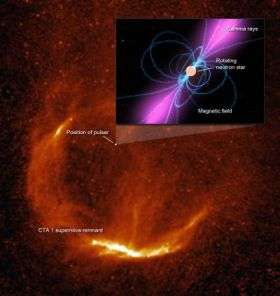
NASA's Fermi Gamma-ray Space Telescope discovered the first pulsar that beams only in gamma rays. The pulsar (illustrated, inset) lies in the CTA 1 supernova remnant in Cepheus. Credit: NASA/S. Pineault, DRAO

About three times a second, a 10,000-year-old stellar corpse sweeps a beam of gamma-rays toward Earth. This object, known as a pulsar, is the first one known to "blink" only in gamma rays, and was discovered by the Large Area Telescope (LAT) onboard NASA's Fermi Gamma-ray Space Telescope, a collaboration with the U.S. Department of Energy (DOE) and international partners.

"This is the first example of a new class of pulsars that will give us fundamental insights into how stars work," says Stanford University's Peter Michelson, principal investigator for the LAT. The LAT data is processed by the DOE's Stanford Linear Accelerator Center and analyzed by the International LAT Collaboration.

The gamma-ray-only pulsar lies within a supernova remnant known as CTA 1, which is located about 4,600 light-years away in the constellation Cepheus. Its lighthouse-like beam sweeps Earth's way every 316.86 milliseconds and emits 1,000 times the energy of our sun. These results appear in the Oct. 16 edition of Science Express.

A pulsar is a rapidly spinning neutron star, the crushed core left behind when a massive sun explodes. Astronomers have cataloged nearly 1,800 pulsars. Although most were found through their pulses at radio wavelengths, some of these objects also beam energy in other forms, including visible light and X-rays.

Unlike previously discovered pulsars, the source in CTA 1 appears to blink only in gamma-ray energies, offering researchers a new way to study the stars in our universe. Scientists think CTA 1 is only the first of a large population of similar objects. "The LAT provides us with a unique probe of the galaxy's pulsar population, revealing objects we would not otherwise even know exist," says Fermi Gamma-ray Space Telescope Project Scientist Steve Ritz, at NASA's Goddard Space Flight Center in Greenbelt, Md.

The pulsar in CTA 1 is not located at the center of the remnant's expanding gaseous shell. Supernova explosions can be asymmetrical, often imparting a "kick" that sends the neutron star careening through space. Based on the remnant's age and the pulsar's distance from its center, astronomers believe the neutron star is moving at about a million miles per hour--a typical speed.

The LAT scans the entire sky every 3 hours and detects photons with energies ranging from 20 million to over 300 billion times the energy of visible light. The instrument sees about one gamma ray each minute from CTA 1. That's enough for scientists to piece together the neutron star's pulsing behavior, its rotation period, and the rate at which it's slowing down.

A pulsar's beams arise because neutron stars possess intense magnetic fields and rotate rapidly. Charged particles stream outward from the star's magnetic poles at nearly the speed of light to create the gamma-ray beams the telescope sees. Because the beams are powered by the neutron star's rotation, they gradually slow the pulsar's spin. In the case of CTA 1, the rotation period is increasing by about one second every 87,000 years.

This measurement is also vital to understanding the dynamics of the pulsar's behavior and can be used to estimate the pulsar's age. From the slowing period, researchers have determined that the pulsar is actually powering all the activity in the nebula where it resides.

"This observation shows the power of the LAT," Michelson says. "It is so sensitive that we can now discover new types of objects just by observing their gamma-ray emissions."

Source: US Department of Energy


print this article email this article download pdf blog this article bookmark this article     Stumble it Digg this share on Facebook retweet share on Reddit add to delicious
Rate this story - 4.8 /5 (18 votes)

Rank Filter

Move the slider to adjust rank threshold, so that you can hide some of the comments.


Display comments: newest first

  • manojendu - Oct 17, 2008
    • Rank: 5 / 5 (1)
    Outstanding discovery!
  • E_L_Earnhardt - Oct 17, 2008
    • Rank: not rated yet
    62nd edition of Chem. and Physics defines "rays" as "electrons", (not photons). It makes a difference in such observations. ???
  • Velanarris - Oct 17, 2008
    • Rank: 4 / 5 (1)
    If it defines rays as electrons then the book is in error.
  • yyz - Oct 21, 2008
    • Rank: not rated yet
    The paper announcing the discovery of the GR pulsar in CTA 1 is available at arXiv:0810.3562 ('The Fermi Gamma Ray Space Telescope Discovers the Pulsar in the Young Supernova-Remnant CTA 1') available at the arXiv astro-ph site for 10-21-08. Mention is made of the suspicion of the object known as 3EG J0010 7309 (from EGRET on GRO) & RXJ0007.0 7303 (from XMM-Newton & CXO observations) as likely being a gamma ray pulsar, but only observations from Fermi were able to confirm this.Pages 8-9 describe how extended observations with Fermi (which has an internal clock accurate to 300ns) eventually collect enough GR photons for an accurate spin rate to be determined even with 'a gamma ray photon per minute' statistics. An earlier paper describing how GR pulsar observations would be feasible with Fermi is available at arXiv:0810.1637 submitted 10-8-08. Mention was made of the extremely high magnetic field deduced from Fermi observations( 1.1×10^13 Gauss ), probably making this GR pulsar also a magnetar candidate!

October 16, 2008 all stories

Comments: 4

4.8 /5 (18 votes)
  • Stumble this up

  • Digg this

  • share this

  • hide
  • Related Stories


  • hide
  • Relevant PhysicsForums posts

  • Question about 2-body gravity
    created Nov 24, 2009
  • life on Mars
    created Nov 24, 2009
  • Semi-major axis from cartesian co-ordinates
    created Nov 23, 2009
  • Primary Mirror grinding
    created Nov 23, 2009
  • More from Physics Forums - General Astronomy

Other News

No Wheel Stall in Diagnostic Drive

Spirit Mars Rover: No Wheel Stall in Diagnostic Drive

Space & Earth / Space Exploration

created 3 hours ago | popularity 5 / 5 (1) | comments 0

(PhysOrg.com) -- On Sol 2095 (Tuesday, Nov. 24), Spirit performed a set of diagnostic actions related to a stall of the right-rear wheel on the previous drive, three days earlier.


Monster Waves on the Sun are Real

Monster Waves on the Sun are Real (w/ Video)

Space & Earth / Astronomy

created 2 hours ago | popularity 5 / 5 (6) | comments 0

Sometimes you really can believe your eyes. That's what NASA's STEREO (Solar Terrestrial Relations Observatory) spacecraft are telling researchers about a controversial phenomenon on the sun known as the "solar ...


Cosmic 'dig' reveals vestiges of the Milky Way's building blocks

Cosmic 'Dig' Reveals Vestiges of the Milky Way's Building Blocks

Space & Earth / Astronomy

created 7 hours ago | popularity 5 / 5 (11) | comments 1

(PhysOrg.com) -- Peering through the thick dust clouds of our galaxy's "bulge" (the myriads of stars surrounding its center), a team of astronomers has unveiled an unusual mix of stars in the stellar grouping ...


Oceanic crust formation is dynamic after all

Oceanic crust formation is dynamic after all

Space & Earth / Earth Sciences

created 6 hours ago | popularity 4.5 / 5 (2) | comments 0

Imagine the Earth's crust as the planet's skin: Some areas are old and wrinkled while others have a fresher, more youthful sheen, as if they had been regularly lathered with lotion.


Climate experts debate strategies for reducing atmospheric carbon and future warming

Climate experts debate strategies for reducing atmospheric carbon and future warming

Space & Earth / Environment

created 3 hours ago | popularity 3 / 5 (4) | comments 2

(PhysOrg.com) -- Reducing carbon dioxide to safe levels may require extracting carbon from the air, says Cornell climate researcher.