The earliest blacksmiths may have been bacteria
October 16, 2008
The earliest blacksmiths may have been bacteria

Enlarge

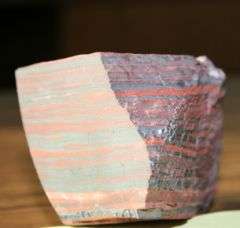
A 2.8 billion-year-old piece of rock may hold a clue that unfolds the age old mystery behind the formation of iron.

(PhysOrg.com) -- Talk about a Cold Case. This mystery goes back to when there was no oxygen on the planet and bacteria were the most sophisticated life form. But Kurt Konhauser holds a clue to answering some ancient questions. It's a 2.8 billion-year-old piece of rock.

Konhauser is a professor in the Department of Earth and Atmospheric Sciences. The bookcase that lines his office at the University of Alberta is loaded with rock samples. Each one could be hiding secrets about the earliest days of the planet.

Konhauser holds a small orange-coloured rock up to the window. The daylight reveals thin lines of black streaking across the rock. The black lines are iron and by all rights shouldn't be there.

Konhauser is incredulous.

"How did iron get in a rock that dates back this far?"

He grabs a piece of paper, scribbling out a chemical formula, and continues talking. "You need oxygen in the ocean to oxidize the iron and 2.8 billion years ago there was no oxygen on the planet, so there had to be another way that iron was oxidized and turned into rock."

Konhauser's pride is plain to see. "We figured out how it happened."

It was bacteria, the only form of life on Earth at that time. The oceans were dense with photosynthetic bacteria and dissolved iron poured into the seas from active volcanoes. In this stew, iron became oxidized. Konhauser says 90 per cent of Earth's iron was produced this way. When prospectors find iron deposits today they can be as thin as a pencil line or massive bands or rock, hundreds of metres thick.

"This is one of the earliest examples of life interacting with the planet."

In addition to identifying the role of bacteria, Konhauser and his colleagues figured out why, over the course of millions of years, bands of iron deposits were intermittent, sometimes disappearing completely from the geological record.

Konhauser uses simple language to explain the phenomenon. "During spring and summer, when the bacteria are happy and active, they oxidize iron." And the reverse is true, he says: cold weather made the bacteria "unhappy" and oxidation shuts down. With that knowledge scientists can use the size and frequency of iron deposits to plot the climate changes that affected the young planet. "Happy" bacteria could work feverishly for decades, and then vanish for just as long.

Konhauser and his colleagues from Germany published their finding this month in Nature Geoscience. He's hopeful more breakthroughs are coming.

"We have a good idea of how life affects Earth today and now a new window about the massive effects the simplest form of life had on this planet. How it changed Earth and it still impacts us today."

Provided by University of Alberta

4.6 /5 (10 votes)  

Rank 4.6 /5 (10 votes)
Related Stories
Relevant PhysicsForums posts
  • Do some geologists actually act a lot like Randy Marsh?
    createdFeb 11, 2012
  • Discrepancy between oxygen and carbon-dioxide levels
    createdFeb 09, 2012
  • where gems are found in the world
    createdFeb 09, 2012
  • Wind Waves in Reservoir ~ Wind run-up and Wind set-up
    createdFeb 08, 2012
  • Balance of oxygen in the atmosphere
    createdFeb 01, 2012
  • The case for a methanol-based economy
    createdJan 30, 2012
  • More from Physics Forums - Earth

More news stories

Latin America mining boom clashes with conservation

Latin America is experiencing a mining boom as prices rise fuelled by a hike in global demand, but the region is also being hit by a wave of violent protests, strikes and rallies by environmentalists.

Space & Earth / Environment

created 6 hours ago | popularity not rated yet | comments 0

Political leaders play key role in how worried Americans are by climate change: study

More than extreme weather events and the work of scientists, it is national political leaders who influence how much Americans worry about the threat of climate change, new research finds.

Space & Earth / Environment

created Feb 06, 2012 | popularity 5 / 5 (6) | comments 72

NASA budget will axe Mars deal with Europe: scientists

US President Barack Obama's budget proposal to be submitted next week for 2013 will cut NASA's budget by 20 percent and eliminate a major partnership with Europe on Mars exploration, scientists said Thursday.

Space & Earth / Space Exploration

created Feb 10, 2012 | popularity 5 / 5 (3) | comments 55

Humans may have helped the decline of African rainforests 3000 years ago

(PhysOrg.com) -- Large areas of rainforests in Central Africa mysteriously disappeared over three thousand years ago, to be replaced by savannas. The prevailing theory has been that the cause was a change ...

Space & Earth / Environment

created Feb 10, 2012 | popularity 4.1 / 5 (14) | comments 20 | with audio podcast report

Study shows global glaciers, ice caps, shedding billions of tons of mass annually

Earth's glaciers and ice caps outside of the regions of Greenland and Antarctica are shedding roughly 150 billion tons of ice annually, according to a new study led by the University of Colorado Boulder.

Space & Earth / Earth Sciences

created Feb 08, 2012 | popularity 4.4 / 5 (9) | comments 14 | with audio podcast


Google might launch Drive for cloud storage soon

(PhysOrg.com) -- Google's next big move, according to the Wall Street Journal, is a cloud storage service called Drive. Hardly first to the plate, Google is simply catching up to introducing its cloud reposi ...

Love a click away in Indonesia's Twitter Republic

He was a geeky kid from Yogyakarta, she a glamorous city girl in Jakarta. In a country with one of the world's most vibrant social networking scenes they fell in love on Twitter.

Europeans protest controversial Internet pact

Tens of thousands of people marched in protests in more than a dozen European cities Saturday against a controversial anti-online piracy pact that critics say could curtail Internet freedom.

Walney offshore wind farm is world's biggest (for now)

(PhysOrg.com) -- The Walney wind farm on the Irish Sea--characterized by high tides, waves and windy weather--officially opened this week. The farm is treated in the press as a very big deal as the Walney ...

Navy to begin tests on electromagnetic railgun prototype launcher

The Office of Naval Research (ONR)'s Electromagnetic (EM) Railgun program will take an important step forward in the coming weeks when the first industry railgun prototype launcher is tested at a facility ...

Explained: Sigma

It's a question that arises with virtually every major new finding in science or medicine: What makes a result reliable enough to be taken seriously? The answer has to do with statistical significance -- but ...