Intel Ships Enterprise-Class Solid-State Drives
October 16, 2008
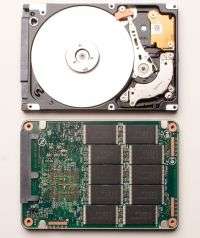
Comparison of the inside of a hard disk drive (HDD) versus a solid-state drive (SSD), which has no moving parts for quieter and more reliable operation.
Intel Corp. has begun shipping its highest- performing solid-state drive (SSD), the Intel X-25E Extreme SATA Solid-State Drive, aimed at server, workstation and storage systems. Unlike mechanical drives, the SSDs contain no moving parts and instead feature 50nm single-level cell (SLC) NAND flash memory technology. Systems equipped with these drives will not suffer from the performance bottlenecks associated with conventional drives. By reducing the total infrastructure, cooling and energy costs, SSDs can lower total cost of ownership for enterprise applications by more than five times.
"Hard disk drive performance has not kept pace with Moore's Law," said Kirk Skaugen, general manager, Intel Server Platforms group. "Intel's high-performance SSDs unleash the full performance of the latest Intel Xeon processor-based systems while increasing reliability and lowering the total cost of ownership for a broad range of server and storage workloads."
The Intel X25-E increases server, workstation and storage system performance by 100 times* over hard disk drives as measured in Input/Output Per Second (IOPS), today's key storage performance metric. A storage model which includes SSDs can also lower energy costs by up to five times, an added benefit for businesses focused on electricity savings. "Solid-state drive technology will change the economics of enterprise data centers," said John Fowler, executive vice president, Systems Group, Sun Microsystems. "SSDs, along with our systems and Solaris ZFS with hybrid storage pools, are important components of the Open Storage initiative. Sun expects to offer enterprise storage solutions that will exploit the breakthrough performance of Intel's High Performance Solid-State Drives and deliver significant performance gains while consuming a fraction of the energy of traditional spinning disk arrays."
The product was designed for intense computing workloads which benefit primarily from high random read and write performance, as measured in IOPS. Key technical performance specifications of the 32 GB Intel X-25E SATA SSD include 35,000 IOPS (4KB Random Read), 3,300 IOPS (4KB Random Write) and 75 microsecond read latency. This performance, combined with low active power of 2.4 watts, delivers up to 14,000 IOPS per watt for optimal performance/power output. The product also achieves up to 250 megabytes per second (MB/s) sequential read speeds and up to 170 MB/s sequential write speeds, all in a compact 2.5-inch form factor.
Intel achieves this breakthrough performance through innovations such as 10-channel NAND architecture with Native Command Queuing, proprietary controller and firmware efficient in advanced wear-leveling and low write amplification. The 32GB X25-E is capable of writing up to 4 petabytes (PB) of data over three-year period (3.7 TB/day), and double that for the 64GB version - delivering outstanding data reliability.
The 32GB capacity drive is in production and priced at $695 for quantities up to 1,000. The 64GB version is expected to sample in the fourth quarter with production estimated for the first quarter of 2009. For more information go to http://www.intel.com/go/ssd .
Provided by Intel
-
Hitachi ships the industry's first 25-nanometer SLC NAND flash enterprise-class SSDs
Feb 08, 2012 |
not rated yet |
0
-
Intel packs performance and reliability into its latest SSD 520 series
Feb 07, 2012 |
5 / 5 (1) |
3
-
Intel, Micron introduce world's first 128Gb NAND device and mass production of 64Gb 20nm NAND
Dec 07, 2011 |
4.7 / 5 (6) |
2
-
Finally Intel brings TRIM to SSDs in RAID arrays
Nov 28, 2011 |
5 / 5 (1) |
0
-
Can new Ultrabook PCs catch Air?
Nov 24, 2011 |
3 / 5 (3) |
0
-
Engineers build first sub-10-nm carbon nanotube transistor
Feb 01, 2012 |
4.9 / 5 (33) |
30
-
Something old, something new: Evolution and the structural divergence of duplicate genes
Jan 31, 2012 |
4.6 / 5 (7) |
1
-
The hidden nanoworld of ice crystals: Revealing the dynamic behavior of quasi-liquid layers
Jan 30, 2012 |
5 / 5 (4) |
1
-
Stock market network reveals investor clustering
Jan 27, 2012 |
3.9 / 5 (23) |
8
-
Of microchemistry and molecules: Electronic microfluidic device synthesizes biocompatible probes
Jan 26, 2012 |
5 / 5 (2) |
0
-
How to tilt a object
2 hours ago
-
How to calculate total compressibility in liquid porous solid system
7 hours ago
-
Need help reading 3-D
Feb 11, 2012
-
A way to send and receive wireless data
Feb 11, 2012
-
Calling function with no input argument
Feb 10, 2012
-
Force free body diagram problem on gym equipment
Feb 10, 2012
- More from Physics Forums - General Engineering
More news stories
Japan scientist makes 'Avatar' robot
A Japanese-developed robot that mimics the movements of its human controller is bringing the Hollywood blockbuster "Avatar" one step closer to reality.
Feb 10, 2012 |
5 / 5 (9) |
12
Intel packs performance and reliability into its latest SSD 520 series
Intel Corporation announced today its fastest, most robust client/consumer solid-state drive (SSD) to date, the Intel Solid-State Drive 520 Series (Intel SSD 520), a 6 gigabit-per-second (gbps) SATA III SSD ...
Feb 07, 2012 |
5 / 5 (1) |
4
Google rumored to have built Heads-Up-Display glasses prototype
(PhysOrg.com) -- 9to5Google is reporting that they have received a tip from someone they believe to be a reliable source saying that Google is working on a Heads-Up-Display (HUD) pair of eye-glasses. The per ...
New Kindle Touch is an impressive e-reader
When it comes to reading digital books, tablets are all the rage. But there's a lot to like about simple e-readers, which over the past year have become both a lot cheaper and a lot less clunky.
Electronics / Consumer & Gadgets
Feb 09, 2012 |
5 / 5 (4) |
1
Apple to debut 'iPad 3' in March: report
Apple will unveil a new version of its market-ruling iPad table computer in March, according to a report in Dow Jones-owned technology blog All Things D.
Electronics / Consumer & Gadgets
Feb 09, 2012 |
1.9 / 5 (21) |
0
Scientists discover molecular secrets of 2,000-year-old Chinese herbal remedy
For roughly two thousand years, Chinese herbalists have treated Malaria using a root extract, commonly known as Chang Shan, from a type of hydrangea that grows in Tibet and Nepal. More recent studies suggest that halofuginone, ...
New method to examine batteries -- MRI from the inside
There is an ever-increasing need for advanced batteries for portable electronics, such as phones, cameras, and music players, but also to power electric vehicles and to facilitate the distribution and storage of energy derived ...
Google might launch Drive for cloud storage soon
(PhysOrg.com) -- Google's next big move, according to the Wall Street Journal, is a cloud storage service called Drive. Hardly first to the plate, Google is simply catching up to introducing its cloud reposi ...
A mitosis mystery solved: How chromosomes align perfectly in a dividing cell
Although the process of mitotic cell division has been studied intensely for more than 50 years, Whitehead Institute researchers have only now solved the mystery of how cells correctly align their chromosomes during symmetric ...
Lab study raises questions over nano-particle impact
Tests involving chickens have raised questions about the impact on health from engineered nano-particles, the ultra-fine grains commonly used in drugs and processed foods, scientists said on Sunday.
Starve a virus, feed a cure? Findings show how some cells protect themselves against HIV
A protein that protects some of our immune cells from the most common and virulent form of HIV works by starving the virus of the molecular building blocks that it needs to replicate, according to research published online ...
Oct 17, 2008
Rank: 3.5 / 5 (4)
Decent Speed SSD 64GB at
Oct 21, 2008
Rank: 4 / 5 (2)
The home user, with lots and lots of RAM would probably find this not so useful.
The laptop user would not nesicarily need the speed, but would find the low noise and low power particularly useful. Some magnetic storage hard drives use more power than some of the new low-power CPU's that some laptops are shipping with. Cutting this power use would dramatically increase battery charge life.
Jan 30, 2009
Rank: 5 / 5 (2)