Philips Designs the 'Light Blossom,' an Intelligent Street Light Concept
October 17, 2008 by Lisa Zyga Light Blossom

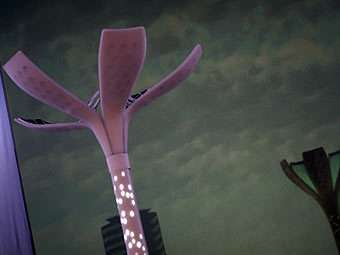
The Light Blossom collects energy from the sun and wind during the day. At night, the device glows dimly when no one is around, and brighter when it senses motion, such as people walking nearby. Image: Pocket-Lint.

Designing nighttime lighting solutions for urban areas presents a challenge for city planners. Too much light results in light pollution - not just limiting the enjoyment of stargazers, but also interfering with the routines of plants and animals. On the other hand, having too little light threatens a neighborhood's overall safety.

One solution to the urban lighting problem is a new concept called "Light Blossom," designed by Philips Electronics. Light Blossom is an intelligent LED lighting system that can provide bright light when it senses people walking nearby, and decrease its luminosity when people aren't around. The technology is also energy-efficient and operates off the grid, gathering solar and wind energy during the day to use for light at night.

During the day, Light Blossom works similar to a flower, opening its "petals" to collect solar energy. As the sun moves across the sky, the petals gradually reorient themselves so they're facing the sun head-on to operate at maximum efficiency, similar to a sunflower.

On cloudy days when the wind is strong, the Light Blossom automatically converts its petals into an upward, open position that allows them to catch the wind. As the petals rotate, they transfer the motion to a built-in rotor that converts the motion to energy.

The Light Blossom continuously switches between solar and wind modes depending on weather conditions. It also displays its energy-collecting flow on its "trunk," or pole, with a decorative light for passers-by to see.

When the sun sets, the Light Blossom's LEDs automatically turn on, illuminating the ground below it. Philips claims that the downward-facing lamp design minimizes light pollution enough to enable people to see the stars in some areas. When people pass by the light, proximity sensors detect their movement and the LEDs switch from dim stand-by mode to a higher-intensity light.

Philips says that the Light Blossom's energy-efficient LEDs use just half of the energy of a traditional street light to produce the same light output. Because the device doesn´t require power infrastructure, rural communities without electricity could install Light Blossoms without investing in grid infrastructure. In urban communities, the devices could even supply power back to the grid when they generate an excess of energy, making the Light Blossom a light pole that generates rather than consumes power.

Philips unveiled the Light Blossom concept earlier this week at its 2008 Philips Simplicity Event, held in Moscow, Russia.

More information: Philips


print this article email this article download pdf blog this article bookmark this article     Stumble it Digg this share on Facebook retweet share on Reddit add to delicious
Rate this story - 4.6 /5 (123 votes)

Rank Filter

Move the slider to adjust rank threshold, so that you can hide some of the comments.


Display comments: newest first

  • DGBEACH - Oct 17, 2008
    • Rank: 3.7 / 5 (6)
    This adds a whole new dimension to power generation. We should also be installing solar panels on the fins of wind generators, so that they too can produce electricity even when there's no wind! Brilliant
  • ScottyB - Oct 17, 2008
    • Rank: 2.8 / 5 (4)
    Brilliant! i was wondering why this sort of intelligent approach to street lighting hadn%u2019t been done before. doesn%u2019t sound hard to change the sensors from light sensing to motion sensing.
  • deatopmg - Oct 17, 2008
    • Rank: 3.3 / 5 (16)
    actual environmental cost of this contraption to replace existing lighting is??? Is there enough gallium? What will these actually cost? MTBF of the system?

    Existing lighting is used as a load leveler for the generators. If the existing lighting systems are replaced with things like this a different operating concept will have to be applied to generating plants, i.e. some type of generation for peak loading - good luck! That will take a generation or 2.

    cute concept, but practical?????
  • itistoday - Oct 17, 2008
    • Rank: 2.5 / 5 (17)
    deatopmg - obviously, you have all the knowledge about this situation, and can speak on the behalf of electric companies, and know all the possibilities, and have therefore reached the (obvious) conclusion that we cannot try to do things intelligently because our current system is too stupid and broken to even attempt a rehabilitation.

    Thank you, deatopmg, for opening up my eyes.
    [/sarcasm]
  • Egnite - Oct 17, 2008
    • Rank: 4.3 / 5 (7)
    Cute, sensible, more practical after some integrating than current lighting but I bet the initial costs will make turn most city planners away from the idea.
  • GrayMouser - Oct 17, 2008
    • Rank: 4 / 5 (9)
    deatopmg is probably right, it'll take some working out and the failure rate (for the moving parts, the LEDs, and vandalism) will probably be high. They'll also have to hook it in to the power grid for dark days with no wind..

    Beyond that... I like the idea and aesthetics.
  • ShadowRam - Oct 17, 2008
    • Rank: 3.7 / 5 (6)
    Not a fan of the moving parts idea.
    Too easy to break...

    But Solar LED Motion = good idea...
  • redhans - Oct 17, 2008
    • Rank: 2.3 / 5 (9)
    Yeah, deatopmg is totally right, these things are so impractical. I'm so glad he put me through that reality check, I was just on the verge of getting up to turn off all the extra lights in my house - now that I know how useful that extra load is for the electric company, what was I thinking?!? And really, with lamps like this everywhere the 15 BILLION kg. of world gallium resources (used in blue LEDs) are really going to go fast...and again collecting all those blue LEDs for recycling I'm sure is a total hassle that nobody is going to want to do-especially with it selling for only $500 a key. REAL costs?...failure times?...Oh so many hard questions!!! You know what...lets just forget it, it's not like anybody is reliably predicting any reason to protect the environment. It's not like the stock market crash at all...now that is something that nobody saw coming! And what is with the pink? Who they trying to sell them to, the Smurfs? Disneyland?
  • Soylent - Oct 17, 2008
    • Rank: 4.7 / 5 (7)
    We should also be installing solar panels on the fins of wind generators, so that they too can produce electricity even when there's no wind! Brilliant


    I hope that sarcasm, but it's a little hard to tell with the green movement today.

    PV is expensive enough as it is without having to form it to the shape of a turbine blade, having it spin around at high velocity and facing in some random direction that's uncorrelated with the direction of the sun(wind turbines yaw freely to match the direction of the wind).
  • axemaster - Oct 18, 2008
    • Rank: 2.3 / 5 (7)
    This is a very cool idea. Should be expanded immediately.
  • drivin98 - Oct 18, 2008
    • Rank: 1.5 / 5 (2)
    Neat but expensive up front. A quick retrofit of existing light to LED would be a great place to start. These would be nice for new installations.
  • Soylent - Oct 18, 2008
    • Rank: 5 / 5 (3)
    Neat but expensive up front. A quick retrofit of existing light to LED would be a great place to start.


    Why?

    Existing street lights use various kinds of gas discharge lamps and they all beat commercially available LEDs in luminous efficacy. Low pressure sodium lights are especially good with 180-200 lm/W.
  • gopher65 - Oct 18, 2008
    • Rank: 3.7 / 5 (3)
    Low Pressure Sodium Lights are more efficient than LEDs, but they give off a nasty colour.

    However, High Pressure Sodium Lights are more commonly used, and the performance of such lights has now been equalled by the newest LEDs. As for cost, LEDs have a much longer lifespan, so it requires fewer maintenance workers (at 25 bucks an hour, lounging around), but they're more expensive to initially purchase.

    I haven't seen any estimates on the long term costs of high efficiency LEDs vs HPS lights, so who knows what the final cost difference will turn out to be.
  • Jayman - Oct 19, 2008
    • Rank: 3.5 / 5 (2)
    The problem with all such innovative ideas is maintainability. It becomes very expensive to maintain and they are not 'fit and forget' solutions. By the looks of it, it could also be prohibitively expensive. But, a great concept though.
  • Soylent - Oct 19, 2008
    • Rank: not rated yet
    However, High Pressure Sodium Lights are more commonly used, and the performance of such lights has now been equalled by the newest LEDs.


    As far as I know, the best commercially available white(or white-ish, I don't care too much about CRI for street lighting) LEDs reach efficiencies of 100-110 lm/W as opposed to 140-150 lm/W for the best HPS.

    LEDs win hands-down only if you include motion sensors to toggle the brightness up and down; HPS deals badly with being dimmed.
  • fingersinterlaced - Oct 19, 2008
    • Rank: 1 / 5 (1)
    Hows about, in the mean time, turning off every second street light on major roads after, say, midnight.

    Basically, the way I see it, humans tend not to change their ways until a crisis even if we can see the crisis approaching.
  • Modernmystic - Oct 19, 2008
    • Rank: 5 / 5 (2)
    Basically, the way I see it, humans tend not to change their ways until a crisis even if we can see the crisis approaching.


    We also have a habit of inventing crisis when none exists in order to get our fellow humans to do our will, and "toe the line" to suit our own political/personal ends.

    One of the oldest tricks in the book...
  • Doug_Huffman - Oct 19, 2008
    • Rank: 3 / 5 (2)
    The caption first removes this from the realm of science or engineering, "Too much light results in light pollution - not just limiting the enjoyment of stargazers..." Uhhh, no. Stargazers' light 'pollution' is from poorly designed trophers showing the glare to the night sky.

    As to 'solar powered', that's limited to the Solar Constant = 1350 W m^-2 and about 4 - 6 kWh m^-2 per day.

    Wind powered? Any of these greenies prating here know what is the average wind duty cycle?
  • gopher65 - Oct 19, 2008
    • Rank: 5 / 5 (1)
    As far as I know, the best commercially available white(or white-ish, I don't care too much about CRI for street lighting) LEDs reach efficiencies of 100-110 lm/W as opposed to 140-150 lm/W for the best HPS.

    Yup. The newest LEDs (pre-market) have hit 150 lu/m now. They're really progressing quickly (FINALLY!) now.
  • barkster - Oct 19, 2008
    • Rank: 4 / 5 (3)
    Good concept, but not a plug-n-play solution by any stretch. Expensive up front and lots of new tech that needs to mature to make it practical. I'd say this "light blossom" concept will have to morph and mature over the next 5-10 years before it becomes viable for large urban implementation.

    As for the power companies... the use of existing lights for power leveling on the grid is no excuse to resist the change of your generator systems or procedures. Be a part of the solution. You have a head start.
  • Linktothepast - Oct 19, 2008
    • Rank: 2 / 5 (2)
    Great aesthetics, autonomous with it's energy needs, if only it can have a logical price i would love to see something like that in my neighborhood.
  • death - Nov 06, 2008
    • Rank: not rated yet
    deatopmg and others are missing the point. This innovation represents a milestone in the science of how we light our streets. "Lighting on demand" IS the future. Regarding load on the power stations: These things are not going to replace all street lighting within zero (or little) time so there is plenty of time to adapt, also the entire net of street lighting in this country only acounts for 0.6% of the electricity consumption so I'm sure that this will resolve itself easily.
    Secondly to those who say that low pressure sodium is more efficacious, I say a word rhyming with rowlocks. Sure lumens per watt, more comes out of a SOX lamp however the light is less controllable, i.e. significantly more waste plus with a start up time of over 5 minutes this source could never be considered for "on demand" lighting and would therefore by default have to be dusk to dawn use only. When this is considered the 180 lumens/watt becomes insignificant.

October 17, 2008 all stories

Comments: 22

4.6 /5 (123 votes)
  • Stumble this up

  • Digg this

  • share this

  • hide
  • Related Stories


  • hide
  • Relevant PhysicsForums posts

  • Relative pressure & specific volume
    created 3 hours ago
  • Making 4'x8' sign inkjet printer - need nozzles - help?
    created Nov 06, 2009
  • Calculating Velocity
    created Nov 06, 2009
  • shear stress distribution in triangular steel profile
    created Nov 06, 2009
  • More from Physics Forums - General Engineering

Other News

Microsoft websites were the most visited in September

Microsoft websites top spots in September: comScore

Technology / Internet

created 12 hours ago | popularity 2.3 / 5 (3) | comments 0

Industry tracker comScore on Friday released a study showing that Internet users in September spent more time at Microsoft websites that at any other online properties.


Brazil blackouts result of cyber hacking: report

Technology / Internet

created 12 hours ago | popularity 2.5 / 5 (2) | comments 0

Massive power outages in Brazil in 2005 and 2007 that impacted millions were caused by cyber hackers attacking control systems, the US television network CBS said Sunday.


The Beatles perform in 1964 at the Olympia in Paris

Bluebeat to battle EMI over Beatles songs

Technology / Internet

created 10 hours ago | popularity not rated yet | comments 0

US online music service Bluebeat said it plans to fight British recording label EMI over rights to stream and sell versions of Beatles songs.


airpod

Car That Runs on Compressed Air Questioned by Critics (w/ Video)

Technology / Energy

created Nov 03, 2009 | popularity 3.8 / 5 (17) | comments 26

(PhysOrg.com) -- As electric cars begin breaking into the short-distance vehicle market, one French company thinks that it has an alternative to the electric vehicle: a car that runs on compressed air. Motor ...


Sahara

Will Europe Be Powered by the Sahara

Technology / Energy

created Nov 04, 2009 | popularity 4.1 / 5 (19) | comments 23

(PhysOrg.com) -- Europe has long been interested in developing alternative energy sources. And, one of the more interesting places that some Europeans are looking for solar power is the Sahara. With the vast ...