Pret-a-sauver fashion for disasters
(PhysOrg.com) -- European researchers are helping rescue workers and disaster victims by creating innovative clothing from smart fabrics. The clothes can monitor people’s health, identify their location and even detect dangerous chemicals in the atmosphere.
Fire fighters, paramedics and rescue workers could soon carry a new weapon into the danger zones with European researchers completing work on smart clothing for disasters.
Smart clothing incorporates technology and microelectronics to perform a wide variety of functions, from communication to health monitoring. It is an important emerging field, with the market thought to be worth over €300m with current growth rates about 20 percent a year, according to reports from the Smartfabrics Conference 2006.
Europe is one of the world’s leaders in the area and that leadership will be maintained through the smart clothing research undertaken by the Proetex project.
“Proetex arose from partner inputs and from emergency teams like fire fighters and civil protection units,” explains Annalisa Bonfiglio, coordinator of the Proetex project.
“Gradually, we arrived at the awareness that technical garments for improving safety were especially needed in the field of emergency work and we decided to start a common effort towards this goal.”
The Proetex project is an ideal test case for smart clothing for a variety of reasons. It responds to an immediate need: better equipment improves the safety and effectiveness of disaster response.
Rescue workers are often laden with equipment, whether it is oxygen or medical equipment, so any additional gear they use must be as light as possible and low power consuming.
Smart strength
Fortunately, this is the very strength of smart clothing. With microelectronics incorporated into the garment, or even into the very weave, designers can minimise on bulk while maximising the benefits.
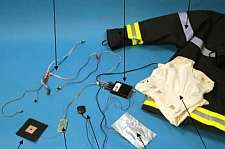
The complete Proetex package consists of a raft of sensors incorporated into different elements of the overall system: vest, jacket, shoes and a belt for victims.
The inner garment includes sensors that provide continuous monitoring of life-signs like breathing, cardiac rhythm and body temperature. The outer garment (jacket) detects external threats like high temperatures and toxic chemicals. The first warns rescue command of local conditions, while the second can alert the rescue worker to dangerous gases.
The jacket incorporates accelerometers to track the wearer’s motion and position and GPS to track location. Integrated light and sound alerts can be activated to make finding a lost or injured fire fighter easier. The jacket also has GPS and a textile antenna. A small box of electronic controls manages all the data from various sensors. Finally, textile batteries are also included to provide a light power source.
The fire fighter boots developed by Proetex are ergonomically designed and include a pocket for a gas sensor, but researchers hope that later models will include batteries, more sensors and communication devices.
Safety and efficiency
“Monitoring rescuers and fire fighters during emergency operations is especially important, not only because they risk their own lives, but also for improving their efficiency,” according to project information.
“For instance, being able to locate a large number of rescuers across a large area using an efficient, portable telecommunication system embedded in normal garments is already an important means for improving coordination of the rescue operations.”
The project is in the second of three phases and later versions of the system could integrate biosensors to monitor sweat, dehydration, electrolytes, stress indicators, oxygen and carbon dioxide. The system can also monitor the wearer’s pose, indicating whether the person is lying down or standing.
Challenging technology integration
“This project is especially challenging for the integration of many different technologies on a common ‘platform’, in this case the garment,” reveals Bonfiglio. “My research field, textile applications for plastic electronics, is extremely interesting … The mechanical properties of textiles (for example flexibility) are very similar to those of the polymers used in plastic electronics.”
There is more research to come and the project partners are looking into potential commercial opportunities, reveals Bonfiglio.
But the effects of this Sixth Framework Programme-funded project will extend further than the emergency services or even the market. Not only are the results useful in themselves, this research tackles many of the fundamental problems that affect smart clothing regardless of sector, namely reliability, effectiveness and comfort.
This is part three of the three-part special feature in October on smart textiles.
Part 1: www.physorg.com/news143298276.html
Part 2: www.physorg.com/news143386844.html
Provided by ICT Results


