'Stamping' self-assembling nanowires
October 17, 2008 By Bill Steele 'Stamping' self-assembling nanowires

Enlarge

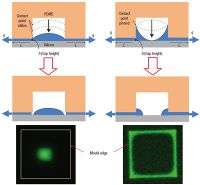
The thickness of the gap between a mold and the surface below determines how a drop of fluid will dry. A thin gap, left, lets the droplet pull away from the edges and shrink into a nanoscale structure. A thick gap, right, pulls the droplet toward the edges to form a "corral." Although the mold is a few microns across, the result is measured in nanometers, in a process developed by Cornell professor Dan Luo and colleagues. (Luo Molecular Bioengineering Lab)

(PhysOrg.com) -- By manipulating the way tiny droplets of fluid dry, Cornell researchers have created an innovative way to make and pattern nanoscale wires and other devices that ordinarily can be made only with expensive lithographic tools. The process is guided by molds that "stamp" the desired structures.

"You can in principle build almost any types of architectures you want at nanoscale," reported Dan Luo, Cornell associate professor of biological and environmental engineering, postdoctoral researcher Wenlong Cheng and colleagues. Their work is described in the online edition of the journal Nature Nanotechnology and in the October 2008 print issue.

To demonstrate the process, the researchers assembled gold nanoparticles into nanoscale wires, disks, squares, triangles and "corrals" (spaces enclosed by nanowires), and demonstrated that their nanowires could be connected to microfabricated electrodes, and through them to other circuitry. In addition to metal nanoparticles, the process could be applied to quantum dots, magnetic spheres and other nanoparticles, they said. They also assembled arrays of single salt crystals, suggesting that any material capable of crystallization could be manipulated by the process.

They began with gold nanoparticles about 12 nanometers in diameter suspended in water. To suspend metal particles in water, the researchers coated them with a "ligand" that adheres to the metal and to water. A second innovation in the Cornell process is to use single chains of synthetic DNA as the ligand. The DNA molecules extend out from the particles like hairs and, as the water evaporates, entangle the particles with one another. Adjusting the DNA lengths can precisely control the distance between the particles to make them assemble into orderly arrays called superlattices, rather than clumping together at random. Metal superlattices have applications in computer memory and photonics and have unique properties in electronic circuits.

The next step is to press down a silicone rubber mold onto a thin layer of the solution on a silicon substrate. Microscopic holes and channels in the underside of the mold effectively "stamp" the desired shapes on the fluid. As they dry, droplets shrink to create wires and other shapes measured in nanometers from a mold measured in microns. This means, the researchers say, that nanoscale superlattice features -- currently possible only with expensive, specialized equipment -- can be made in an inexpensive way.

The research was funded by the National Science Foundation under a CAREER award to Luo, and by the New York State Foundation for Science, Technology and Innovation.

Provided by Cornell University


print this article email this article download pdf blog this article bookmark this article     Stumble it Digg this share on Facebook retweet share on Reddit add to delicious
Rate this story - 4.7 /5 (35 votes)

Rank Filter

Move the slider to adjust rank threshold, so that you can hide some of the comments.


Display comments: newest first

  • guiding_light - Oct 18, 2008
    • Rank: not rated yet
    The demonstration looks troublesome and expensive (gold, DNA, etc.). Still it would be nice to get some pictures of the process working.
  • NanoStuff - Oct 19, 2008
    • Rank: not rated yet
    I don't think the raw material cost of gold is a problem on those scales.

October 17, 2008 all stories

Comments: 2

4.7 /5 (35 votes)
  • Stumble this up

  • Digg this

  • share this

  • hide
  • Related Stories

  • Tiny bubbles clean oil from water
    created Nov 16, 2009 | popularity not rated yet | comments 0
  • Right first time: Pioneering new methods of drug manufacture
    created Nov 11, 2009 | popularity not rated yet | comments 0
  • Green heating and cooling technology turns carbon from eco-villain to hero
    created Nov 10, 2009 | popularity not rated yet | comments 0
  • Researchers bring noise to virtual worlds
    created Oct 27, 2009 | popularity not rated yet | comments 0
  • Podcast: Tiny sea creature and a new medical adhesive
    created Oct 27, 2009 | popularity not rated yet | comments 0


  • hide
  • Relevant PhysicsForums posts

  • moment of inertia and friction
    created 10 hours ago
  • two-dimensional collision
    created 13 hours ago
  • The acceleration of mass using light
    created 15 hours ago
  • Badminton
    created 16 hours ago
  • More from Physics Forums - General Physics

Other News

Peptides control crystal growth with 'switches, throttles and brakes'

Peptides control crystal growth with 'switches, throttles and brakes'

Nanotechnology / Bio & Medicine

created 21 hours ago | popularity 5 / 5 (3) | comments 0

(PhysOrg.com) -- By producing some of the highest resolution images of peptides attaching to mineral surfaces, scientists have a deeper understanding how biomolecules manipulate the growth crystals. This research ...


Water droplets direct self-assembly process in thin-film materials

Nanotechnology / Nanomaterials

created 21 hours ago | popularity 5 / 5 (4) | comments 2

You can think of it as origami - very high-tech origami. Researchers at the University of Illinois have developed a technique for fabricating three-dimensional, single-crystalline silicon structures from thin films by coupling ...


Nanoparticles used in common household items caused genetic damage in mice

Nanotechnology / Bio & Medicine

created Nov 16, 2009 | popularity 4.8 / 5 (24) | comments 11

Titanium dioxide (TiO2) nanoparticles, found in everything from cosmetics to sunscreen to paint to vitamins, caused systemic genetic damage in mice, according to a comprehensive study conducted by researchers at UCLA's Jonsson ...


Nanotube defects equal better energy and storage systems

Nanotube defects equal better energy and storage systems

Nanotechnology / Nanomaterials

created Nov 19, 2009 | popularity 4.4 / 5 (10) | comments 2

(PhysOrg.com) -- Most people would like to be able to charge their cell phones and other personal electronics quickly and not too often. A recent discovery made by UC San Diego engineers could lead to carbon ...


Using superconducting probes to get a picture of what it's like inside CNTs

Nanotechnology / Nanophysics

created Nov 20, 2009 | popularity 4.4 / 5 (9) | comments 0

(PhysOrg.com) -- "Carbon nanotubes are exciting for fundamental physics, and for potential technological applications," Nadya Mason tells PhysOrg.com. "However, we are generally limited in the way that we can study them. ...