Nanoscale coating protect products -- and the economy
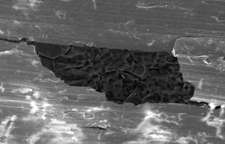
Put steel under a powerful microscope, revealing its microstructure, and prepare to be surprised. Known for its strength, the metal will appear pitted and pocked.
"It is intrinsic to the material," says Carolyn Aita, a Wisconsin Distinguished Professor at the University of Wisconsin–Milwaukee (UWM). "A pit can begin to develop from a physiochemical defect in the steel itself."
The pitting is cause for concern for industry because it can progress and lead to corrosion. But Aita's research can help.
In her state-of-the-art lab at the College of Engineering and Applied Science, she has developed a host of coatings that heal shallow pits and fractures on almost any material – from metal to glass to silicon. The coatings also prevent further degradation.
"My coatings are designed to work in adverse environments, such as in salt spray, oil, and high humidity," says Aita. "We design them to address whatever causes damage to the substrate."
Aita has an international reputation in the field of thin films for advanced materials and has been backed by some of the best-known companies in Wisconsin, including Johnson Controls, Badger Meter, Rockwell Automation, CERAC and Kohler. She also has worked with national companies such as DuPont, Rust-Oleum and Digital Equipment.
In fact, Aita's research has been continuously supported by industry – a requirement of her Wisconsin Distinguished Professorship – since the program was launched by the UW System in 1988.
Sought-after applications
In her current work, which is funded by a Rockwell Catalyst Grant from the UWM Research Foundation, Aita and four graduate students are creating new coatings that can withstand the corrosion that occurs in metals in an industrial setting.
The work is valuable to its sponsor, Rockwell Automation, a global industrial controls supplier to almost every industry sector.
In addition to natural imperfections, materials like stainless steel are susceptible to the environments in which they are used, says Christopher Genthe, a materials project engineer in Rockwell's Chemistry & Materials Engineering group who also is one of Aita's graduate students.
Rockwell's materials engineers are interested in protecting the metal parts the company manufactures – like enclosures that house electronics, for example – from high humidity, temperature and industrial contaminants.
Aita's unique nanolaminate coating is applied to the metal surface in ultra-thin layers, and together they adjust in response to a wide range of adverse conditions. The tiny crystals in the layers transform to surround and contain the defect.
Aita's work has applications in many industries, including manufacturing, optical products and biomedical devices, an area in which she holds two patents.
Taped to a wall in her lab is a magnified image of a hole in the type of stainless steel used in artificial joints. "Imagine if that was in your hip replacement," she says. "Our coatings can prevent that from happening."
They do it by adjusting to conditions within the human body that can cause hairline cracks to form in heart valves or holes in artificial joints, for example, preventing implant rejection or failure.
Relying on 'Dorothy'
Achieving the right characteristics for these protective coatings depends on choosing the right combination of elements and manipulating them to act in a precise way.
For the Rockwell project, the team in Aita's Advanced Coatings Experimental Laboratory (AceLab) uses hafnia, zirconia and alumina in their smart ceramic coatings for metal.
"We engineer these to behave differently than they would in a ceramic with a larger microstructure," says Elizabeth Hoppe, the AceLab manager and a Ph.D. student of Aita's.
"We grow the film in layers so that the growth of tiny crystals within a layer is stopped at a particular size, which allows us to control their behavior," says Hoppe.
It's the arrangements of the molecules in the tiny crystals embedded in a layer that ultimately determine film characteristics, says Aita.
Aita's lab group was the first to demonstrate the advantages of using nanolaminate architectures in ceramic films, says Robert Lad, director of the Laboratory for Surface Science and Technology at the University of Maine. Today, there is intense R&D in this area worldwide.
Because they work at the nanoscale, the job of actually applying the thin films falls on "Dorothy," a large "sputter deposition" apparatus in the AceLab. (The equipment is named for one of Aita's mentors, the late Dorothy Hoffman, a pioneer in film growth by physical vapor deposition.)
In sputter deposition, energetic ions formed from a vapor bombard a disk, or "target," made of a particular element, sending energetic atoms from it scattering like billiard balls in a game of pool. Those atoms then coat the substrate in ultra-thin layers.
A career of leadership
Aita has accomplished many "firsts" since arriving at UWM in 1981. She was the first woman hired as a tenure-track engineering professor at a research campus in the University of Wisconsin System. In 1988, she became the first Wisconsin Distinguished Professor in the UWM College of Engineering and Applied Science (CEAS).
After earning her Ph.D. in materials science from Northwestern University, Aita worked for private industry for several years, and that's when she became hooked on thin-coatings work.
She says she entered academia for access to something she couldn't get in the private sector: students.
Students at all levels have been trained in Aita's lab with plenty of exposure to real-world business solutions, and she has helped supply an experienced work force for companies both local and national.
With backing from CEAS Dean Michael Lovell, plans are under way to acquire a machine that executes scratching and indentation of materials at the nanoscale. Although the equipment will undoubtedly be useful to many of the industries she collaborates with, Aita is most excited about what it will mean for her students.
"You are able to explore how much force you have to apply before you destroy the material," Aita says. "It will open up a whole new field of inquiry for the lab."
Source: University of Wisconsin - Milwaukee


