Relationships Between Quantum Dots - Stability and Reproduction
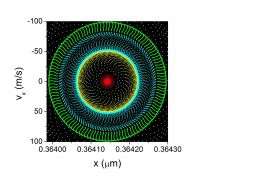
(PhysOrg.com) -- Theoretical proof of stable and measurable states extending over two quantum dots and creating offspring has now been provided for the first time. This supports the notion of what is known as Quantum Darwinism, which makes the selection and reproduction of quantum mechanical states responsible for the way in which our reality is perceived. These results of an Austrian Science Fund FWF project were recently published in Physical Review Letters and will play a part in the future development of quantum information technology.
Quantum dots are nanoscopic structures which are so small that they are subject to the laws of quantum physics. This means, among other things, that electrons in quantum dots assume states with specific energy values. If these electron states are measured, they interact with the environment. As a result of this interaction, some electron states mix with each other or with those of the environment and become energetically smeared. Some of the original states, however, are robust and retain their energy values. These are known as "pointer states" and, until now, they could only be proved to exist for single quantum dots.
Stable Relations...
A team from the Institute of Physics at the University of Leoben, together with colleagues from the Arizona State University, has succeeded in proving the existence of new kinds of pointer states in coupled quantum dots on a semiconductor layer structure made from aluminium arsenide and gallium arsenide. "We have called these pointer states of two coupled quantum dots biparpite pointer states. They are an exciting discovery because they extend over two quantum dots and thus represent an analogon to molecules. Their interaction with the environment means that values such as electrical resistance can be measured," explains Dr. Roland Brunner, a member of Professor Friedemar Kuchar's team.
...Create Offspring
The team also succeeded in finding clear indications of Quantum Darwinism, that is to say the notion that during interaction with the environment only the "strongest" states - the pointer states - remain stable and are able to create offspring. To provide proof of this notion, the group working with Brunner and Kuchar calculated the probabilitiy densities of the electrons in the system for several quantum dots in series. Such a system corresponds to a waveguide for electrons in which the electric current is determined by transmitted electron waves. Calculating the electron probability density for the energy of the bipartite pointer state demonstrated that the three-dimensional pattern for this probability density is identical for many different electron waves. In other words, offspring of the bipartite pointer state are present. This result is internationally accepted as proof that quantum Darwinism actually occurs.
Although quantum dots were investigated on a purely theoretical basis in this FWF project, they have definite practical benefits. An earlier publication has already created a link to a measured parameter - electrical resistance. What's more, quantum dots can form the quintessential basis for future quantum information technology components such as quantum computers. These computers could use the robustness of bipartite pointer states to describe more than just the states "0" or "1" of the binary logic that represents the performance spectrum of conventional computers. However, a critical factor for the development of quantum computers is the means to measure the states, i.e. the interface to the outside "classical" world. Only if several measurements record the same state can a measurement or result be deemed objective. In order to achieve this, however, such a state must create offspring as postulated by Quantum Darwinism. Further confirmation of such offspring creation was provided by this project.
Original publication: "Coupling-Induced Bipartite Pointer States in Arrays of Electron Billiards: Quantum Darwinism in Action?" R. Brunner, R. Akis, D.K. Ferry, F. Kuchar & R. Meisels, Phys. Rev. Letters 101, 024102 (2008).
Provided by Public Relations for Research & Education, Austria


