LEDs may help reduce skin wrinkles, researchers report
October 20, 2008
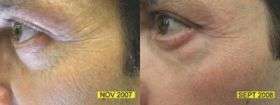
LEDs may help reduce skin wrinkles, researches report. Credit: American Chemical Society
Researchers in Germany are describing a potential alternative to Botox and cosmetic surgery for easing facial wrinkles. Their study, scheduled for the November 5 issue of ACS' Crystal Growth & Design reports that high intensity visible light from light emitting diodes (LEDs) applied daily for several weeks resulted in "rejuvenated skin, reduced wrinkle levels, juvenile complexion and lasting resilience." LEDs are the miniature lights used in an array of products, from TV remote controls to traffic lights.
In the study, Andrei P. Sommer and Dan Zhu point out that high-intensity visible light has been used in medicine for more than 40 years to speed healing of wounds. That light actually penetrates into the skin, causing changes in the sub-surface tissue. Until now, however, scientists have not known the physicochemical nature of those changes.
They report identifying how the visible light works — by changing the molecular structure of a glue-like layer of water on elastin, the protein that provides elasticity in skin, blood vessels, heart and other body structures.
Figuratively speaking, the light strips away those water molecules that are involved in the immobilization of elastin, gradually restoring its elastic function and thus reducing facial wrinkles. "We are justified in believing that our approach can be easily converted to deep body rejuvenation programs," the researchers state.
Article: "From Microtornadoes to Facial Rejuvenation: Implication of Interfacial Water Layers", http://dx.doi.org/ … 21/cg8000703
Source: American Chemical Society
-
Chemists harvest light to create 'green' tool for pharmaceuticals
Feb 09, 2012 |
5 / 5 (3) |
0
-
Elements of ExoPlanets
Feb 02, 2012 |
4.9 / 5 (8) |
0
-
Star Trek Tricorder revisited: Toward a genre of medical scanners
Jan 04, 2012 |
5 / 5 (2) |
0
-
Scientists succeed in making the spinal cord transparent
Dec 26, 2011 |
4.8 / 5 (14) |
6
-
Scientists use laser imaging to assess safety of zinc oxide nanoparticles in sunscreen
Nov 30, 2011 |
not rated yet |
0
-
Engineers build first sub-10-nm carbon nanotube transistor
Feb 01, 2012 |
4.9 / 5 (31) |
30
-
Something old, something new: Evolution and the structural divergence of duplicate genes
Jan 31, 2012 |
4.6 / 5 (7) |
1
-
The hidden nanoworld of ice crystals: Revealing the dynamic behavior of quasi-liquid layers
Jan 30, 2012 |
5 / 5 (3) |
1
-
Stock market network reveals investor clustering
Jan 27, 2012 |
3.9 / 5 (23) |
8
-
Of microchemistry and molecules: Electronic microfluidic device synthesizes biocompatible probes
Jan 26, 2012 |
5 / 5 (1) |
0
More news stories
Fool's gold may prove an unlikely alternative to overexploited catalytic materials
Catalytic materials, which lower the energy barriers for chemical reactions, are used in everything from the commercial production of chemicals to catalytic converters in car engines. However, with current catalytic materials ...
4 hours ago |
5 / 5 (2) |
1
|
Unpicking HIV’s invisibility cloak
Drug researchers hunting for alternative ways to treat human immunodeficiency virus (HIV) infections may soon have a novel targetits camouflage coat. HIV hides inside a cloak unusually rich in a sugar ...
4 hours ago |
5 / 5 (2) |
0
Flexible paper robots
(PhysOrg.com) -- These inexpensive robots can stretch, bend and twist under control, and lift objects up to 120 times their own weight. Being soft, they can apply gentle and even pressure, and adapt to varied ...
22 hours ago |
5 / 5 (5) |
4
|
No entry without protein recycling: Researchers discover new coherence in enzyme transport
The group of Prof. Dr. Ralf Erdmann at the Ruhr-Universität Bochum, Germany, discovered a connection of peroxisomal protein import and receptor export. In the Journal of Biological Chemistry, they disclo ...
4 hours ago |
not rated yet |
0
New method makes culture of complex tissue possible in any lab
Scientists at the University of California, San Diego have developed a new method for making scaffolds for culturing tissue in three-dimensional arrangements that mimic those in the body. This advance, published online in ...
21 hours ago |
5 / 5 (4) |
0
|
Putting the squeeze on planets outside our solar system
(PhysOrg.com) -- Using high-powered lasers, scientists at Lawrence Livermore National Laboratory and collaborators discovered that molten magnesium silicate undergoes a phase change in the liquid state, abruptly ...
Employers feel no love for unscrupulous practice of 'service sweethearting'
A new study led by two Florida State University marketing professors finds that some frontline service employees who are rewarded for hikes in customer loyalty and satisfaction also may engage in "service ...
Expat French get Internet vote for first time
French citizens will for the first time this year be able to vote in a parliamentary election over the Internet, an experiment that could be extended to other elections if successful.
"Twisted Metal" gamers get shot at real gunplay
Fans of "Twisted Metal" will get to welcome a long-awaited sequel of the car-battle videogame with a real-world bang by blasting an ice cream truck to bits with a machine gun.
The power of estrogen -- male snakes attract other males
A new study has shown that boosting the estrogen levels of male garter snakes causes them to secrete the same pheromones that females use to attract suitors, and turned the males into just about the sexiest ...
New error-correcting codes guarantee the fastest possible rate of data transmission
Error-correcting codes are one of the triumphs of the digital age. Theyre a way of encoding information so that it can be transmitted across a communication channel such as an optical fiber o ...
Oct 20, 2008
Rank: 4 / 5 (4)
Oct 20, 2008
Rank: 5 / 5 (2)
Oct 21, 2008
Rank: not rated yet