Spinning natural proteins into fabrics for new wound-repair products
October 20, 2008 Proteins

Enlarge

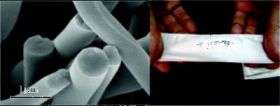
Natural protein from cow's blood may lead to improved sutures and bandages for treating wounds. Credit: American Chemical Society

Scientists in Israel are reporting the first successful spinning of a key natural protein into strong nano-sized fibers about 1/50,000th the width of a human hair. The advance could lead to a new generation of stronger, longer-lasting biocompatible sutures and bandages to treat wounds. The study is scheduled for the November 10 issue of ACS' Biomacromolecules.

Eyal Zussman and colleagues point out that researchers have tried for years to develop wound repair materials from natural proteins, hoping that such fibers would be more compatible with body tissue than existing materials. Scientists recently focused on producing these fibers through "electrospinning," a high-tech weaving process that uses electrical charges to draw out nano-sized fibers from a liquid. But the approach has achieved poor results until now.

In the new study, the scientists describe a new method for producing electrospun polymers using bovine serum albumin (BSA), a so-called "globular" protein found in cow's blood. BSA is similar to serum albumin, one of the most abundant proteins in the human body.

The method involves adding certain chemicals to a solution of BSA to loosen the bonds that hold these highly-folded proteins together. That results in a thinner, more spinnable protein solution. Using electrospinning, the process resulted in strong fibers that are easily spun into suture-like threads or thick mats resembling conventional wound dressings.

This approach is being followed by the groups of Zvi Nevo and Abraham Katzir at Tel-Aviv University, the researchers said, noting that the new method also can be applied to other types of natural proteins.

Article: "Nanofibers Made of Globular Proteins" http://dx.doi.org/10.1021/bm8005243

Source: ACS


print this article email this article download pdf blog this article bookmark this article     Stumble it Digg this share on Facebook retweet share on Reddit add to delicious
Rate this story - 4.8 /5 (16 votes)

Rank Filter

Move the slider to adjust rank threshold, so that you can hide some of the comments.


Display comments: newest first

  • Wasabi - Oct 20, 2008
    • Rank: not rated yet
    Nothing like a little Mad Cow to get you all patched up. :S Seriously though is there any real danger of introducing cross species disease with blood-based products intermingling?

October 20, 2008 all stories

Comments: 1

4.8 /5 (16 votes)
  • Stumble this up

  • Digg this

  • share this

  • hide
  • Related Stories

  • Scientists discover a new mechanism controlling neuronal migration
    created Jul 15, 2009 | popularity not rated yet | comments 0
  • Scientists study how asbestos fibers trigger cancer in human cells
    created Dec 18, 2008 | popularity not rated yet | comments 0
  • 'Edible optics' could make food safer
    created Aug 07, 2008 | popularity not rated yet | comments 0
  • Protein Fibrils as Alternative Plastics?
    created May 28, 2008 | popularity not rated yet | comments 0
  • Researchers uncover process behind heart muscle contraction
    created Apr 09, 2008 | popularity not rated yet | comments 0


  • hide
  • Relevant PhysicsForums posts

  • Thin Film Laboratory resources
    created 6 hours ago
  • Theoretical air URGENT
    created 17 hours ago
  • photoconductivity of polymers
    created Nov 25, 2009
  • Heat pipe for high temperature
    created Nov 24, 2009
  • More from Physics Forums - Materials & Chemical Engineering

Other News

Nanowire Formation

Nanowires key to future transistors, electronics

Nanotechnology / Nanophysics

created 18 hours ago | popularity 4.7 / 5 (7) | comments 1

(PhysOrg.com) -- A new generation of ultrasmall transistors and more powerful computer chips using tiny structures called semiconducting nanowires are closer to reality after a key discovery by researchers ...


Water droplets direct self-assembly process in thin-film materials

Nanotechnology / Nanomaterials

created Nov 23, 2009 | popularity 5 / 5 (4) | comments 2

You can think of it as origami - very high-tech origami. Researchers at the University of Illinois have developed a technique for fabricating three-dimensional, single-crystalline silicon structures from thin films by coupling ...


Using superconducting probes to get a picture of what it's like inside CNTs

Nanotechnology / Nanophysics

created Nov 20, 2009 | popularity 4.4 / 5 (9) | comments 0

(PhysOrg.com) -- "Carbon nanotubes are exciting for fundamental physics, and for potential technological applications," Nadya Mason tells PhysOrg.com. "However, we are generally limited in the way that we can study them. ...


Peptides control crystal growth with 'switches, throttles and brakes'

Peptides control crystal growth with 'switches, throttles and brakes'

Nanotechnology / Bio & Medicine

created Nov 23, 2009 | popularity 4.8 / 5 (5) | comments 0

(PhysOrg.com) -- By producing some of the highest resolution images of peptides attaching to mineral surfaces, scientists have a deeper understanding how biomolecules manipulate the growth crystals. This research ...


Fast, easy, and highly sensitive arsenic detection with gold nanoparticles

Nanotechnology / Nanomaterials

created Nov 25, 2009 | popularity 5 / 5 (1) | comments 0

(PhysOrg.com) -- Mention of arsenic poisoning usually brings to mind underhanded murder. However, the danger of arsenic poisoning from contaminated drinking water is far greater. Low concentrations of arsenic are found in ...