Crossing 'a bridge to nowhere'
October 20, 2008
Bridge to Nowhere

Enlarge

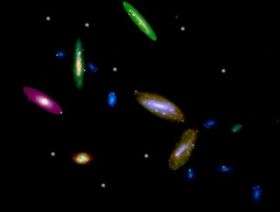
The picture shows the 14 galaxies studied at the Wise Observatory. The galaxies stretch along a line from the lower-right to the top-left corner of the image. The star-forming regions are highlighted as shining reddish points. Credit: AFTAU

Despite thousands of years of research, astronomers know next to nothing about how the universe is structured. One strong and accepted theory is that large galaxies are clustered together on structures similar to giant soap bubbles, with tinier galaxies sprinkled on the surface of this "soapy" layer.

New observations from Tel Aviv University are giving new strength to this theory. A team led by Dr. Noah Brosch, Director of the Tel Aviv University-owned Wise Observatory, is the first in the world to uncover what they believe are visible traces of a "filament" of dark matter –– an entity on which galaxies meet, cluster and form. A filament can originate at the junction of two "soap bubbles," where the thin membrane is thicker.

Dr. Brosch, with his M.Sc. student Adi Zitrin and researchers from Cornell University, studied an area of the sky opposite the constellation Virgo, where 14 galaxies were forming in a line. Pundits have called the line a "Bridge to Nowhere" because it seems to start and end in unknown locations. Strangely, 13 of these galaxies were simultaneously giving birth to new stars.

"A Hair on the Beard of the Creator"

The odds of this occurrence are very rare, leading the researchers to believe that the galaxies might somehow be forming on this elusive filament, made entirely from dark matter, which attracts regular matter that then turns into new stars. "There has long been a theoretical belief that this was the case," says Dr. Brosch, "but this new finding represents experimental results that such a filament really exists, and that possibly it is an entity made from dark matter which is aligning these galaxies."

Dr. Brosch compares the work of an astronomer to "looking for hairs of the beard of the Creator."

This line of galaxies may be one such hair. Generally speaking, matter as we know it on earth makes up only a small percentage of our universe. The composition of most of the universe is unknown ― it's either dark matter (about one quarter of the universe) or dark energy (the other three-quarters). "Our studies show that you don't need to go to the edge of the universe to find dark matter. It may be only 15 million light years away, more or less in our backyard," says Dr. Brosch.

The research has massive implications for astronomy and the understanding of galaxy-formation. And due to the surprising closeness of this new grouping of galaxies to ours, it would only be a matter of technological advances ― maybe a couple of hundred years ― and a longer human lifespan before explorers could visit this unusual dark matter in person. "Our technology is abysmally limited right now, but it could definitely happen," says Dr. Brosch.

Source: American Friends of Tel Aviv University

4.1 /5 (15 votes)  

Filter


Move the slider to adjust rank threshold, so that you can hide some of the comments.


Display comments: newest first

TimESimmons
Oct 20, 2008

Rank: 1 / 5 (3)
That'll be the anti-gravity matter.

http://www.presto...ndex.htm
Velanarris
Oct 20, 2008

Rank: 5 / 5 (1)
That'll be the anti-gravity matter.

http://www.presto...ndex.htm


Not this again.
yyz
Oct 20, 2008

Rank: 5 / 5 (2)
I think that massive amount of redshift data could be amassed in the next several years with the likes of PanSTARRS 4 & the LSST, with greatly increased precision. This data would allow astronomers 3-D maps of the universe far enough to quantify the validity of galaxy structures such as filaments of DM linking visible matter (galaxies) in a soap-bubble like configuration. Several extensive ground-based observations have supported the existence of galaxy filaments between galaxy clusters and general field galaxies. Confirming these studies may greatly increase our knowledge of DM & DE, along with observations of phenomenon closer to our galaxy itself.
yyz
Oct 20, 2008

Rank: 5 / 5 (1)
That'll be the anti-gravity matter. Please, not this again. It's like "Mars will appear as large as the full moon" stories all over again. Nice looking web page, though.
Alizee
Oct 29, 2008

Rank: 1 / 5 (2)
It's like "Mars will appear as large as the full moon"
Nope, it isn't. By AWT this idea has certain meaning, as the dark matter has character of "antigravity matter", being as manifestation of surface tension of gravity field. It really compensates the gravity action of matter, which has created this gravitational field. Compare my remarks here, for example.

http://www.physor...286.html
Rank 4.1 /5 (15 votes)
Related Stories
Relevant PhysicsForums posts
  • Never ending outer space.....
    created15 hours ago
  • Neutron Star fragments?
    created17 hours ago
  • stationary or not?
    created21 hours ago
  • Scale of the Universe
    createdFeb 10, 2012
  • Titan's lack of impact craters
    createdFeb 09, 2012
  • Real pictures of black hole eating a star?
    createdFeb 08, 2012
  • More from Physics Forums - General Astronomy

More news stories

Salvage workers begin pumping fuel from Italian shipwreck

Salvage workers Sunday began pumping fuel from the shipwrecked Italian cruise liner Costa Concordia, a day ahead of schedule, officials said.

Space & Earth / Environment

created 32 minutes ago | popularity not rated yet | comments 0

Latin America mining boom clashes with conservation

Latin America is experiencing a mining boom as prices rise fuelled by a hike in global demand, but the region is also being hit by a wave of violent protests, strikes and rallies by environmentalists.

Space & Earth / Environment

created 8 hours ago | popularity 5 / 5 (1) | comments 0

Political leaders play key role in how worried Americans are by climate change: study

More than extreme weather events and the work of scientists, it is national political leaders who influence how much Americans worry about the threat of climate change, new research finds.

Space & Earth / Environment

created Feb 06, 2012 | popularity 5 / 5 (6) | comments 73

NASA budget will axe Mars deal with Europe: scientists

US President Barack Obama's budget proposal to be submitted next week for 2013 will cut NASA's budget by 20 percent and eliminate a major partnership with Europe on Mars exploration, scientists said Thursday.

Space & Earth / Space Exploration

created Feb 10, 2012 | popularity 5 / 5 (3) | comments 55

Humans may have helped the decline of African rainforests 3000 years ago

(PhysOrg.com) -- Large areas of rainforests in Central Africa mysteriously disappeared over three thousand years ago, to be replaced by savannas. The prevailing theory has been that the cause was a change ...

Space & Earth / Environment

created Feb 10, 2012 | popularity 4.1 / 5 (14) | comments 20 | with audio podcast report


Scientists discover molecular secrets of 2,000-year-old Chinese herbal remedy

For roughly two thousand years, Chinese herbalists have treated Malaria using a root extract, commonly known as Chang Shan, from a type of hydrangea that grows in Tibet and Nepal. More recent studies suggest that halofuginone, ...

New method to examine batteries -- MRI from the inside

There is an ever-increasing need for advanced batteries for portable electronics, such as phones, cameras, and music players, but also to power electric vehicles and to facilitate the distribution and storage of energy derived ...

A mitosis mystery solved: How chromosomes align perfectly in a dividing cell

Although the process of mitotic cell division has been studied intensely for more than 50 years, Whitehead Institute researchers have only now solved the mystery of how cells correctly align their chromosomes during symmetric ...

Starve a virus, feed a cure? Findings show how some cells protect themselves against HIV

A protein that protects some of our immune cells from the most common and virulent form of HIV works by starving the virus of the molecular building blocks that it needs to replicate, according to research published online ...

Researchers find extensive RNA editing in human transcriptome

In a new study published online in Nature Biotechnology, researchers from BGI, the world's largest genomics organization, reported the evidence of extensive RNA editing in a human cell line by analysis of RNA-seq data, demons ...

The proteins ensuring genome protection

Researchers from the University of Geneva (UNIGE), Switzerland, have discovered the crucial role of two proteins in developing a cell 'anti-enzyme shield'. This protection system, which operates at the level of molecular ...