Engineering nanoparticles for maximum strength
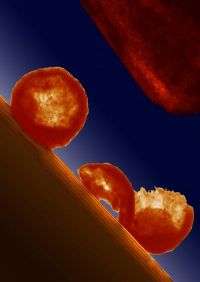
Because they are riddled with defects, bulk crystalline materials never achieve their ideal strength; nanocrystals, on the other hand, are so small there's no room for defects. Yet while nanocrystalline materials may approach ideal strength in their resistance to stress, most nanostructures have shown only a limited ability to withstand large internal strains before they fail. Overcoming this limitation could lead to great advances in engineered materials on all scales.
Scientists at the U.S. Department of Energy's Lawrence Berkeley National Laboratory and the University of California at Berkeley have used in situ transmission electron microscopy to measure hollow spherical nanoparticles that withstand extreme stress and deform without losing strength. The geometry of the novel nanospheres can be engineered to approach the theoretical ideal shear strength of the material from which they are made, in this case cadmium sulfide. The researchers report their results in the November, 2008 issue of Nature Materials, available to subscribers in advanced online publication.
"To understand what happens to the individual nanoparticles when stress is applied, you need to actually see the deformation as it is happening," says Andrew Minor of the National Center for Electron Microscopy (NCEM) in Berkeley Lab's Materials Sciences Division (MSD); Minor is also a member of UC Berkeley's Department of Materials Science and Engineering (MSE). "We put the nanospheres on a flat silicon substrate inside NCEM's In Situ Microscope sample chamber and compressed them with a flat-faced diamond punch until they fractured. Using videos of the compression tests, we could determine exactly when they fractured, and then measure the force applied at that exact moment."
Minor refers to one video in which the graph of applied pressure drops suddenly when the compressed nanosphere squirts out from between the substrate and the punch like a watermelon seed. "If you didn't see that happening, you'd have no way of knowing why the force suddenly vanished," he says. "So while setting up the experiment in the In Situ Microscope is a little more difficult and time-consuming, it's essential."
The nanospheres of cadmium sulfide were prepared in the laboratories of Paul Alivisatos, Berkeley Lab's Deputy Director and Division Director of MSD, and a member of UC Berkeley's MSE and Chemistry Departments. The chemical methods used to create the hollow spheres allow their dimensions to be manipulated with great precision, including the outer diameter of the spheres and the thickness of the shells.
"Essentially we're investigating structural hierarchy, which is known to play an important role in determining the strength of many bulk materials – bone, for example – only here we're applying it on the nanoscale," says Minor. "In this case the hierarchy is the size of the crystal domains, from three or four nanometers up to 10 nanometers; the thickness of the shells, from 35 to 70 nanometers; and the diameter of the spheres, from about 200 to 450 nanometers. We experimented on dozens of nanospheres with variations in each of these dimensions."
What they observed as the diamond anvil slowly bore down on the hollow nanospheres was that the spheres gradually bulged at the sides as they were squashed. Cadmium sulfide is inherently brittle and might have been expected to break easily, but instead the spheres deformed by as much as 20 percent of their original diameter before they shattered.
To understand the distribution of stresses throughout the sphere, Daryl Chrzan of MSD and MSE and his research group performed theoretical calculations. The sphere was computationally divided into a fine grid and the deformation for each grid element was calculated, giving the reaction to the applied force for the overall geometry of the sphere at that point.
These local strengths were combined to model the behavior of the whole sphere, a process called finite element analysis, or FEA. When simulated by a computer, the strain at each point in a sphere of specific dimensions, subjected to the applied compression, could be calculated and visualized. The simulations revealed that as displacement increased, the sphere's shape served to transfer stress to certain regions experiencing maximum shear – regions corresponding to the top and bottom of the sphere where it contacted the substrate and the diamond anvil. This is where the spheres were usually observed to fail in the actual experiments. Indeed, the experimental results generally followed the predictions of the FEA model.
"The model incorporates the actual experimental conditions as well as possible," says Minor, "including the 'glue' we use to hold the nanosphere on the substrate. This is just a little of the carbonaceous material left over from the chemical process used to create the cadmium sulfide nanospheres. Originally we cleaned this away, but after we experienced a couple of instances of the spheres slipping away when they were squeezed, we stopped cleaning them so they would stay attached to the surface. The FEA model had to take this carbonaceous material into account."
The FEA model showed that the stresses within the FEA model at the point of fracture were indeed quite high. For example, a nanosphere 450 nanometers in diameter with a shell about 69 nanometers thick, deformed by compression to some eight percent of its original diameter, experiences local shear stresses approaching the ideal shear strength of cadmium sulfide. A 'fracture criterion,' derived by the researchers from their model, accurately predicts that a typical nanosphere experiences some 70 percent of the ideal shear strength at its point of failure.
"These are the most complete analyses of the mechanical properties of single nanoparticles that I am aware of," says Minor, "because in situ observations under the transmission electron microscope allowed us to see the precise dimensions of each particle and see exactly when and how it fails – thus eliminating the gap between experiment and theory."
Previous attempts to increase the deformability of nanomaterials, in order to reduce their tendency to fail under limited strains, have also unfortunately reduced their strength. The new experiments with hollow nanospheres show that, by combining strength and deformability, the hollow spherical geometry confers both high strength and relatively high strains at failure. The ability to endure high stress and strain is a direct result of structural hierarchy: the small grain size gives high strength, while the overall shape of the sphere distributes stress and allows the structure to withstand high strains.
"This work could only have been done with an In Situ Microscope like NCEM's, plus a quantitative mechanical testing holder like the one developed by Hysitron, Inc. and NCEM, and with hollow nanospheres like those made in the Alivisatos lab – as well as the complete analysis with sophisticated computational tools provided by the Chrzan group," says Minor. "We believe the surprising results have opened a path toward much greater possible advances in structural materials at a range of scales."
Citation: "Ultrahigh stress and strain in hierarchically structured hollow nanoparticles," by Zhiwei Shan, Giulia Adesso, Andreu Cabot, Matthew Sherburne, S. A. Syed Asif, Oden Warren, Daryl Chrzan, Andrew Minor, and A. Paul Alivisatos, appears in the November issue of Nature Materials and is available in advanced online publication to subscribers at dx.doi.org/10.1038/nmat2295 .
Source: Lawrence Berkeley National Laboratory


