German spectrometer flies to the Moon
October 20, 2008 German spectrometer flies to the Moon

Enlarge

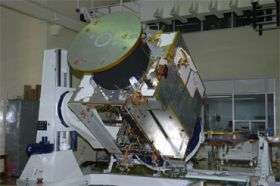
The SIR-2 spectrometer, designed and built in Lindau, following integration into the lunar probe in Bangalore. Image: ISRO, Bangalore

India’s first mission to the Moon, Chandrayaan-1, is scheduled to take off from the Satish Dhawan Space Centre on the south-eastern coast of India on Wednesday, October 22nd, at 3.00 CEST. The German science and technology contribution to the mission comprises an infrared spectrometer designed and built by the Max Planck Institute for Solar System Research (MPS) in Katlenburg-Lindau. The spectrometer will play a fundamental role in the production of the first high-resolution global mineralogical map of the Moon.

The Moon is crucial to the understanding of the Earth’s history. While both originated about 4.5 billion years ago, evidence of these early times has been mostly erased on Earth by tectonics, weather and life. On the Moon these signs have been preserved in the geological and mineralogical composition. Past lunar missions, however, have succeeded only in studying selected areas of the Moon’s surface. These missions were often very limited in time and instrumentation or had an elliptical orbit that in part carried the space probe far away from the Moon.

Chandrayyan-1 will accompany the Moon for two years. The mission will benefit from a low circular orbit of 100 km above the surface and a complementary array of several new and advanced scientific instruments. In particular, this will allow the infrared spectrometer SIR-2 from Max Planck Institute for Solar System Research (MPS) to help map the main mineralogical components of the lunar surface with unprecedented reliability and resolution.

The SIR-2 works by exploiting the optical properties of mineral components within lunar soils. Like a leaf that absorbs all colours of the rainbow except green, minerals absorb specific wavelengths of sunlight which are not reflected back into space. In order to find these characteristic gaps SIR-2 splits the reflected lunar light into is components, like a prism resolving sunlight into a rainbow. The missing wavelengths give indications as to the mineralogical composition of the Moon’s surface.

Since the characteristic ‘colours’ of the main minerals found throughout the solar system lie beyond red in the longer wavelengths called infrared, SIR-2 is optimized to work with these wavelengths. SIR-2 is the product of an on-going research and application programme at MPS aimed at developing and producing state-of-the-art and an increasingly sophisticated range of spectrometers operating in the visible to near infrared.

All in all, eleven scientific instruments are part of the Chandrayaan mission. Five of them were built in India; the others were developed by international research teams. Apart from the mineralogical mapping of the lunar surface, other scientific aims include a high-resolution, three-dimensional map of the lunar topography as well as locating and confirming the presence of ice. Past missions have already found evidence for ice on the banks of certain craters in the polar regions.

The development of SIR-2 was made possible by funding by the Max Planck Society and ESA and represents the growing relationship between the Max Planck Society and India. As a sign of this esteem, scientists from MPS were the first foreign researchers that were allowed to calibrate their instrument in India.

Provided by Max Planck Institute for Solar System Research


print this article email this article download pdf blog this article bookmark this article     Stumble it Digg this share on Facebook retweet share on Reddit add to delicious
Rate this story - 5 /5 (1 vote)


October 20, 2008 all stories

Comments: 0

5 /5 (1 vote)
  • Stumble this up

  • Digg this

  • share this

  • hide
  • Related Stories

  • SMART-1's bridge to the future exploration of the Moon
    created Mar 09, 2007 | popularity not rated yet | comments 0
  • Wistar Institute team finds key target of aging regulator
    created Jun 10, 2009 | popularity not rated yet | comments 0
  • Starve a yeast, sweeten its lifespan
    created Mar 24, 2009 | popularity not rated yet | comments 0
  • Where does the gene activity of youth go? New findings may hold the key
    created Nov 26, 2008 | popularity not rated yet | comments 0
  • Life-extending protein can also have damaging effects on brain cells
    created Jul 01, 2008 | popularity not rated yet | comments 0


  • hide
  • Relevant PhysicsForums posts

  • Consistency of Meteor Shower Dates (i.e. the peak of Perseids always on Aug 13th)
    created 2 hours ago
  • Favourite Astronomy Book?
    created 17 hours ago
  • dark energy
    created 17 hours ago
  • The shape of our solar system's orbits.
    created Nov 07, 2009
  • More from Physics Forums - General Astronomy

Other News

Controversial new climate change results

Controversial new climate change results

Space & Earth / Environment

created 15 hours ago | popularity 4.4 / 5 (14) | comments 19

(PhysOrg.com) -- New data show that the balance between the airborne and the absorbed fraction of CO2 has stayed approximately constant since 1850, despite emissions of CO2 having risen from about 2 billion ...


Earth

Atomic Particles Help Solve Planetary Puzzle

Space & Earth / Earth Sciences

created 5 hours ago | popularity 4.6 / 5 (5) | comments 0

(PhysOrg.com) -- A University of Arkansas professor and his colleagues have shown that the Earth's mantle contains the same isotopic signatures from magnesium as meteorites do, suggesting that the planet formed ...


The Stars My Destination

The Stars My Destination

Space & Earth / Space Exploration

created 6 hours ago | popularity 5 / 5 (7) | comments 0

The Voyager spacecraft are now in the outermost layer of the heliosphere, traveling toward interstellar space - the first man-made spacecraft to travel such a vast distance from Earth.


Cave study links climate change to California droughts

Space & Earth / Earth Sciences

created 7 hours ago | popularity 3 / 5 (2) | comments 0

California experienced centuries-long droughts in the past 20,000 years that coincided with the thawing of ice caps in the Arctic, according to a new study by UC Davis doctoral student Jessica Oster and geology professor ...


Scientists prepare the Mini-Research Module 2 (MRM 2) "Poisk"

Rocket with new module for space station blasts off

Space & Earth / Space Exploration

created 9 hours ago | popularity 5 / 5 (1) | comments 0

A Soyuz rocket carrying a new Russian-made module for the International Space Station blasted off on Tuesday from the Baikonur space base in Kazakhstan, television pictures showed.