Microscopic structure of quantum gases made visible
October 20, 2008 Microscopic structure of quantum gases made visible

Enlarge

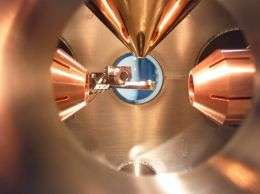
Inside the high-resolution scanning electron microscope.

Scientists at the Johannes Gutenberg University Mainz, Germany, have, for the first time, succeeded in rendering the spatial distribution of individual atoms in a Bose-Einstein condensate visible.

Bose-Einstein condensates are small, ultracold gas clouds which, due to their low temperatures, can no longer be described in terms of traditional physics but must be described using the laws of quantum mechanics. The first Bose-Einstein condensates were generated in 1995 by Eric A. Cornell, Carl E. Wieman and Wolfgang Ketterle, who received the Nobel Prize in Physics for their work only six years later. Since then, these unique gas clouds, the coldest objects humans ever created, have become a global research object.

Physicists working with Dr Herwig Ott in the study group for quantum, atomic and neutron physics (QUANTUM) at Mainz University have now developed a new tech-nology that can be used to plot the individual atoms in a Bose-Einstein condensate. In addition, the spatial resolution achieved during plotting far exceeds any previous methods used. The research results of the Emmy Noether Independent Junior Research Group, sponsored by the German Research Foundation (DFG), were published in the professional journal Nature Physics under the title of "High-resolution scanning electron microscopy of an ultracold quantum gas".

This breakthrough was possible due to the use of a high-resolution scanning elec-tron microscope that makes use of a very fine electron beam to scan the ultracold atomic cloud, thus rendering even the smallest structures visible. "The transfer of this technology to ultracold gases was a technical risk," reports Dr Herwig Ott, head of the Emmy Noether Junior Research Group, "as two different techniques had to be combined."

Moreover, atoms and molecules move completely freely and ran-domly in gases unlike they do in solids. Another advantage of this highly advanced microscopy process is the better spatial resolution compared with optical processes where the resolution capacity is limited by the wavelength of the light used. "With a resolution of 150 nm, we are able to view these quantum objects with an accuracy that is 10 times higher than has been possible to date," explains Ott.

As electron microscopy made previously unknown parts of our world visible to the viewer, so the technology developed in Mainz has opened up unique possibilities for investigating the microscopic structure of quantum gases. The physicists in Mainz have already reached their first major milestone: They managed to make the structure of a so-called optical lattice visible. Optical lattices are interference patterns comprised of laser beams, which are shone onto the atomic cloud and force their periodic structure onto it. This results in the creation of crystal-like formations.

The interesting aspect is that the movement of the atoms in an optical lattice within a quantum gas is similar to the behavior of electrons in solid bodies. Quantum gases are thus able to simulate the physical properties of solid bodies and can therefore also contribute to answering outstanding questions in solid-state physics.

Link: http://www.nature.com/nphys/journal/vaop/ncurrent/abs/nphys1102.html

Source: Johannes Gutenberg University Mainz


print this article email this article download pdf blog this article bookmark this article     Stumble it Digg this share on Facebook retweet share on Reddit add to delicious
Rate this story - 4.5 /5 (22 votes)

Rank Filter

Move the slider to adjust rank threshold, so that you can hide some of the comments.


Display comments: newest first

  • Alizee - Oct 22, 2008
    • Rank: not rated yet
    Can someone find some more relevant pictures of subject?

October 20, 2008 all stories

Comments: 1

4.5 /5 (22 votes)
  • Stumble this up

  • Digg this

  • share this

  • hide
  • Related Stories

  • Physicists develop multifunctional storage device for light
    created Jul 29, 2009 | popularity not rated yet | comments 0
  • For the First Time, Scientists Measure the Size of a One-Neutron Halo with Lasers
    created Feb 20, 2009 | popularity not rated yet | comments 0
  • Investigating new materials with ultracold atoms
    created Dec 04, 2008 | popularity not rated yet | comments 0
  • Distinguishing decoherence in quantum systems
    created Apr 22, 2008 | popularity not rated yet | comments 0
  • G-Zero Finds that Ghostly Strange Quarks Influence Proton Structure
    created Jun 20, 2005 | popularity not rated yet | comments 0


  • hide
  • Relevant PhysicsForums posts

  • Maple seed (samara)
    created 2 hours ago
  • Geothermal power entering atmosphere?
    created 3 hours ago
  • A quick question about startling forces?
    created 5 hours ago
  • speed of propagation of waves
    created 10 hours ago
  • More from Physics Forums - General Physics

Other News

Solving big problems

Solving big problems with new quantum algorithm

Physics / Quantum Physics

created 19 hours ago | popularity 4.6 / 5 (23) | comments 0

(PhysOrg.com) -- In a recently published paper, Aram Harrow at the University of Bristol and colleagues from MIT in the United States have discovered a quantum algorithm that solves large problems much faster ...


NSLS-II Project Beamline Conceptual Designs

Physics / General Physics

created 5 hours ago | popularity 5 / 5 (1) | comments 0

(PhysOrg.com) -- The NSLS-II Experimental Facilities Division achieved an important milestone in September when the conceptual design reports for the initial six project beamlines were completed and submitted to NSLS-II management.


Stars Fueled by Dark Matter Could Hold Secrets to the Universe

Stars Fueled by Dark Matter Could Hold Secrets to the Universe

Physics / General Physics

created Nov 03, 2009 | popularity 4.4 / 5 (54) | comments 43

(PhysOrg.com) -- The first stars in the universe may have been very different from the stars we see today, yet they may hold clues to understanding some of the mysterious features of the universe. These "dark ...


Second Law of Thermodynamics May Explain Economic Evolution

Second Law of Thermodynamics May Explain Economic Evolution

Physics / General Physics

created Nov 02, 2009 | popularity 4.3 / 5 (31) | comments 28

(PhysOrg.com) -- Terms such as the "invisible hand," laissez-faire policy, and free-market principles suggest that economic growth and decline in capitalist societies seem to be somehow self-regulated. Now, ...


High-performance plasmas may make reliable, efficient fusion power a reality

High-performance plasmas may make reliable, efficient fusion power a reality

Physics / Plasma Physics

created Nov 02, 2009 | popularity 4.7 / 5 (40) | comments 37

In the quest to produce nuclear fusion energy, researchers from the DIII-D National Fusion Facility have recently confirmed long-standing theoretical predictions that performance, efficiency and reliability ...