A claret-colored cloud with a massive heart
October 21, 2008 The Gum 29 Nebula

Enlarge

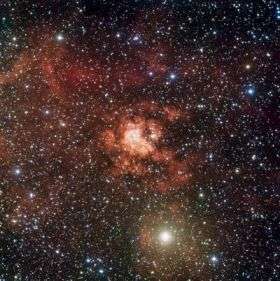
This image, based on data obtained with the Wide Field Imager camera attached to the 2.2-m Max-Planck/ESO telescope through four different filters (B, V, R, and H-alpha), shows the amazing intricacies of the vast stellar nursery Gum 29. At its centre lies the cluster of young stars Westerlund 2. One object at the bottom of the cluster is in fact a system of two of most massive stars known to astronomers. Credit: ESO

(PhysOrg.com) -- Gum 29 is a huge region of hydrogen gas that has been stripped of its electrons (ionised) by the intense radiation of the hot young stars located at its centre. Astronomers call this an HII (pronounced "H-two") region, and this particularly stunning example stretches out across space for over 200 light-years. The name stems from the fact that it is the 29th entry in the catalogue published by Australian astronomer Colin Stanley Gum in 1955.

Embedded deep within the huge, nebulous expanse of Gum 29, the relatively little known cluster of Westerlund 2 is clearly seen in the centre of this image. The latest measurements indicate that it lies at a distance of some 26 000 light-years from Earth, placing it towards the outside edge of the Carina spiral arm of the Milky Way. The cluster's distance has been the subject of intense scrutiny in the past, as it is one of the parameters needed to understand this intriguing object. Westerlund 2 is very young too, with an age of only 1—2 million years.

Previous observations have shown that two stars to the bottom right of the cluster are true leviathans. Together they form what is known as a double system. The two stars have masses of 82 and 83 times that of our Sun and rotate around each other in approximately 3.7 days. They are amongst the most massive stars known to astronomers.

Detailed observations of this intriguing pair have also shown that they are both Wolf-Rayet stars. These are massive stars nearing the end of their lives, expelling vast quantities of material as their final swansong. Observations made in X-rays have subsequently shown that streams of material from each star continually collide, creating a blaze of X-ray radiation.

The image was obtained with the Wide Field Imager (WFI) camera attached to the 2.2-m Max-Planck/ESO telescope at ESO's La Silla observatory site in Chile. Located at an altitude of 2400 metres in the arid Atacama Desert, this observatory sits under some of the clearest and darkest skies on Earth. The WFI excels at studying the farthest depths of the Universe from this unrivalled vantage point.

Provided by ESO


print this article email this article download pdf blog this article bookmark this article     Stumble it Digg this share on Facebook retweet share on Reddit add to delicious
Rate this story - 3.8 /5 (14 votes)


October 21, 2008 all stories

Comments: 0

3.8 /5 (14 votes)
  • Stumble this up

  • Digg this

  • share this

  • hide
  • Related Stories

  • Autism treatment: Risky alternative therapies have little basis in science
    created Nov 24, 2009 | popularity not rated yet | comments 0
  • Exoplanets Clue to Sun's Curious Chemistry
    created Nov 11, 2009 | popularity not rated yet | comments 0
  • Hubble Image Showcases Star Birth in M83, the Southern Pinwheel
    created Nov 05, 2009 | popularity not rated yet | comments 0
  • Research sheds new light on neutron stars (w/ Video)
    created Nov 02, 2009 | popularity not rated yet | comments 0
  • Scientists Build First 'Frequency Comb' To Display Visible 'Teeth'
    created Oct 29, 2009 | popularity not rated yet | comments 0


  • hide
  • Relevant PhysicsForums posts

  • Some help with a X-Ray astronomy question please!
    created 7 hours ago
  • Help with Images and Optical Instrument Question..
    created 19 hours ago
  • Redshift as a distance indicator
    created Nov 26, 2009
  • Question about 2-body gravity
    created Nov 24, 2009
  • More from Physics Forums - General Astronomy

Other News

Fermi Telescope Peers Deep into Microquasar

Fermi Telescope Peers Deep into Microquasar (w/ Video)

Space & Earth / Astronomy

created 1hour ago | popularity 5 / 5 (1) | comments 0

(PhysOrg.com) -- NASA's Fermi Gamma-ray Space Telescope has made the first unambiguous detection of high-energy gamma-rays from an enigmatic binary system known as Cygnus X-3. The system pairs a hot, massive ...


The Energy Sources of Ultraluminous Galaxies

The Energy Sources of Ultraluminous Galaxies

Space & Earth / Astronomy

created 1hour ago | popularity 5 / 5 (1) | comments 0

(PhysOrg.com) -- Ultraluminous infrared galaxies ((ULIRGs) are galaxies whose luminosity exceeds that of a trillion suns; for comparison, the Milky Way galaxy has a typical (and much more modest) luminosity ...


Space shuttle Atlantis, 7 astronauts back on Earth

Space & Earth / Space Exploration

created 2 hours ago | popularity not rated yet | comments 0

(AP) -- Space shuttle Atlantis and its seven astronauts returned to Earth with a smooth touchdown Friday to end an 11-day flight that resupplied the International Space Station.


New radar helps monitor site of century-old tragedy

New radar helps monitor site of century-old tragedy

Space & Earth / Earth Sciences

created 1hour ago | popularity not rated yet | comments 0

(PhysOrg.com) -- A University of Alberta researcher has turned the site of a southern Alberta rockslide tragedy into the proving ground for new equipment meant to avert such a disaster in the future.


China is set to launch its second moon orbiter next October, state media have reported

China to launch second lunar probe: state media

Space & Earth / Space Exploration

created 6 hours ago | popularity 5 / 5 (3) | comments 0

China will launch its second moon orbiter next October, state media reported Friday, as it powers ahead with a space programme that has sparked concerns abroad.