Caste in the colony: How fate is determined between workers and queens
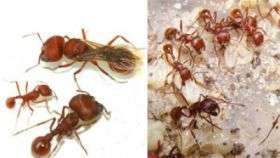
"The history of all past society has consisted in the development of class antagonisms…the exploitation of one part of society by the other". – Karl Marx and Frederick Engels, The Communist Manifesto.
Although diversity in social groups can increase group well being, it also may increase the potential for conflict. All societies are characterized by struggles for control: which individuals gain the spoils and which toil in the fields. In colonies of social insects this struggle is embodied by a reproductive division of labor. Some individuals (the queens) reproduce, while the workers provide the labor that maintains colony function. In many social insects queens enjoy nearly complete control over reproduction and workers have diversified in form and function to increase their efficiency at performing different labors.
How, then, is it determined which individuals, as developing larvae, becoming queens or different types of workers? A collaborative research team of scientists at four universities has found that caste determination in the Florida harvester ant is much more than meets the eye. Larvae become different castes (small workers, large workers, or new queens) based largely on the nutrition they receive. Those fed more insects than seeds are more likely to become larger individuals (queen>large worker>small worker). However, genetic differences also contribute and bias the larva's developmental pathway. Even once caste is determined, nutritional, social (colony size), and genetic factors all contribute, but in different ways, to how big an individual grows.
"Caste determination in most social insects likely involves both nature and nurture, but most interestingly in this species, these two forces contribute differently in different castes," says lead researcher Chris R. Smith of the University of Illinois. Although genetic factors contribute to what caste an individual becomes, the environment of the larva is controlled by the workers. Quite generally, ant colonies are supreme examples of both conflict and cooperation – each extreme of the nature-nurture continuum.
Citation: "Caste determination in a polymorphic social insect: nutritional, social, and genetic factors" by C.R. Smith (University of Illinois Urbana-Champaign), K.E. Anderson (University of Arizona), C.V. Tillberg (Linfield College), J. Gadau (Arizona State University), and A.V. Suarez (University of Illinois Urbana-Champaign). American Naturalist (2008) 172:497-507 DOI: 10.1086/590961
Source: University of Chicago


