New study shows diversity decreases chances of parasitic disease
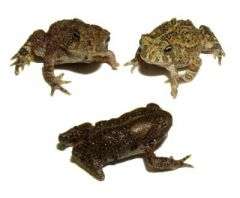
A new University of Colorado at Boulder study showing that American toads who pal around with gray tree frogs reduce their chances of parasitic infections known to cause limb malformations has strong implications for the benefits of biodiversity on emerging wildlife diseases.
The experiments showed that when the toad tadpoles were raised in tanks with the parasitic trematodes -- tiny worms whose larvae burrow into tadpole limb regions and disrupt normal leg development -- 40 percent of the emerging frogs became deformed, said CU-Boulder Assistant Professor Pieter Johnson. But when the toad tadpoles were joined in the tanks with gray tree frog tadpoles, parasitic infections in the toads dropped by almost half, said Johnson, lead author of the study.
The study showed tree frog tadpoles acted as "sponges" for the trematode parasites, which were subsequently killed by the immune systems of frog tadpoles, said Johnson. As a result, fewer parasites were available to infect and cause malformations in the toads. Both the gray tree frog and American toad are broadly distributed in the Midwest and eastern United States and often occur in the same wetlands, he said.
"This is one of the first experimental studies to definitively show that an increase in diversity of host species actually can reduce parasite transmission and disease," said Johnson of CU-Boulder's ecology and evolutionary biology department. Published in the October issue of Ecology Letters, the study has implications for the declining global diversity of wildlife species that are susceptible to parasitic infections, said Johnson.
Other research has shown that a decrease in diversity in mammal host species for ticks carrying Lyme disease increases the risk of Lyme disease in humans, Johnson said. Similar relationships between wildlife diversity and disease prevalence have been suggested by other researchers to influence other vector-borne diseases, including West Nile virus, tick-borne encephalitis and bubonic plague, he said.
"In the absence of parasites, the toads and frogs are pure competitors," Johnson said. "But when trematode parasitism is present in the ecosystem, the adage 'the enemy of my enemy is my friend' comes into play for the toads, which are essentially shielded from infections by the tree frogs." Co-authors on the Ecology Letters study included Richard Hartson from the University of Wisconsin-Madison and Donald Larson and Daniel Sutherland from the University of Wisconsin-La Crosse.
The researchers also ran experiments involving American toad tadpoles coupled with green frog tadpoles, and others involving American toads, eastern tree frogs and green frogs together in the same tanks, said Johnson. In the tanks containing toad tadpoles and green frog tadpoles, the toad tadpoles had similarly high infection rates to those shown when they were the only tadpoles in the tanks.
But when all three tadpole types were raised together, the toad tadpoles were once again buffered from the parasites by the "dilution effect" provided by tree frogs. "Thus, the important determinant of parasite transmission was not total host diversity but the specific composition of the host community," wrote the authors.
The trematode has a complex life cycle involving snails, amphibians and predators. Host snails release parasite larvae into the water, infecting amphibians and causing deformations. Deformed toads and frogs rarely survive long in the wild because of their susceptibility to predators like wading birds, which ingest them and later defecate into wetlands, releasing trematodes to infect other snails and completing the life cycle.
As few as 12 trematode larvae, known as cercariae, can kill or deform a single tadpole by forming cysts in its developing limbs, causing missing limbs, extra limbs and other severe malformations, Johnson said. A 2007 CU-Boulder study led by Johnson showed high levels of nutrients like nitrogen and phosphorus used in farming and ranching activities fuel trematode infections in North American amphibians by hiking the abundance and reproduction of the snail species that hosts trematodes.
Deformed frogs first gained international attention in the mid-1990s when a group of Minnesota schoolchildren discovered a pond where more than half of the leopard frogs had missing or extra limbs, he said. Since then, reports of deformed amphibians have become widespread in the United States, leading to speculation they were being caused by factors like pesticides, increased ultraviolet radiation or parasitic infection.
A recent study of more than 6,000 species of amphibians worldwide concluded that 32 percent were threatened and 43 percent were declining in population because of causes like habitat loss, pollution and emerging diseases.
Source: University of Colorado at Boulder


