Robotic ants building homes on Mars?
October 21st, 2008 Robotic ants building homes on Mars?

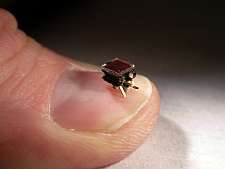
Tiny bots smaller than a thumbnail. © I-SWARM project

(PhysOrg.com) -- Recent discoveries of water and Earth-like soil on Mars have set imaginations running wild that human beings may one day colonise the Red Planet. However, the first inhabitants might not be human in form at all, but rather swarms of tiny robots.

“Small robots that are able to work together could explore the planet. We now know there is water and dust so all they would need is some sort of glue to start building structures, such as homes for human scientists,” says Marc Szymanski, a robotics researcher at the University of Karlsruhe in Germany.

Szymanski is part of a team of European researchers developing tiny autonomous robots that can co-operate to perform different tasks, much like termites, ants or bees forage collaboratively for food, build nests and work together for the greater good of the colony.

Working in the EU-funded I-SWARM project, the team created a 100-strong posse of centimetre-scale robots and made considerable progress toward building swarms of ant-sized micro-bots. Several of the researchers have since gone on to work on creating swarms of robots that are able to reconfigure themselves and assemble autonomously into larger robots in order to perform different tasks. Their work is being continued in the Symbrion and Replicator projects that are funded under the EU’s Seventh Framework Programme.

Planet exploration and colonisation are just some of a seemingly endless range of potential applications for robots that can work together, adjusting their duties depending on the obstacles they face, changes in their environment and the swarm’s needs.

“Robot swarms are particularly useful in situations where you need high redundancy. If one robot malfunctions or is damaged it does not cause the mission to fail because another robot simply steps in to fill its place,” Szymanski explains.

That is not only useful in space or in deep-water environments, but also while carrying out repairs inside machinery, cleaning up pollution or even carrying out tests and applying treatments inside the human body – just some of the potential applications envisioned for miniature robotics technology.

Creating collective perception
Putting swarming robots to use in a real-world environment is still, like the vision of colonising Mars, some way off. Nonetheless, the I-SWARM team did forge ahead in building robots that come close to resembling a programmable ant.

Just as ants may observe what other ants nearby are doing, follow a specific individual, or leave behind a chemical trail in order to transmit information to the colony, the I-SWARM team’s robots are able to communicate with each other and sense their environment. The result is a kind of collective perception.

The robots use infrared to communicate, with each signalling another close by until the entire swarm is informed. When one encounters an obstacle, for example, it would signal others to encircle it and help move it out of the way.

A group of robots that the project team called Jasmine, which are a little bigger than a two-euro coin, use wheels to move around, while the smallest I-SWARM robots, measuring just three millimetres in length, move by vibration. The I-SWARM robots draw power from a tiny solar cell, and the Jasmine machines have a battery.

“Power is a big issue. The more complex the task, the more energy is required. A robot that needs to lift something [uses] powerful motors and these need lots of energy,” Szymanski notes, pointing to one of several challenges the team have encountered.

Processing power is another issue. The project had to develop special algorithms to control the millimetre-scale robots, taking into account the limited capabilities of the tiny machine’s onboard processor: just eight kilobytes of program memory and two kilobytes of RAM, around a million times less than most PCs.

Tests proved that the diminutive robots were able to interact, though the project partners were unable to meet their goal of producing a thousand of them in what would have constituted the largest swarm of the smallest autonomous robots ever created anywhere in the world.

Nonetheless, Szymanski is confident that the team is close to being able to mass produce the tiny robots, which can be made much like computer chips out of flexible printed circuit boards and then folded into shape.

“They’re kind of like miniature origami,” he says.

Simple, mass production would ensure that the robots are relatively cheap to manufacture. Researchers would therefore not have to worry if one gets lost in the Martian soil.

The I-SWARM project received funding under the EU’s Sixth Framework Programme for research.

Provided by ICT Results


print this article email this article download pdf blog this article bookmark this article     Digg this Stumble it share on Facebook share on Reddit add to delicious save to Yahoo! bookmarks
4.7/5 after 69 votes

Rank Filter

Move the slider to adjust rank threshold, so that you can hide some of the comments.


Display comments: newest first

  • Suzu - Oct 21, 2008
    • Rank: 2.3 / 5 (9)
    Haven't we learned from Stargate that replicators are bad news ;p
  • flashgordon - Oct 21, 2008
    • Rank: 3.9 / 5 (9)
    never watched stargate . . . ;

    As for my thoughts about this; they kind of remind me of proteins . . . ;
  • NeilFarbstein - Oct 21, 2008
    • Rank: 2 / 5 (8)
    If you invent little bug sized robots that replicate themselves, maybe out of control- put them all on Mars!
  • ofidiofile - Oct 21, 2008
    • Rank: 3 / 5 (6)
    If the gov't would release all of the hi res photo's of Mars in RAW format instead of the purposely, selectively blurred (air brushed)images we (who are paying for the photo's) might also discover some interesting things that the gov't et al already know.


    google mars?! awesome idea
  • Linktothepast - Oct 21, 2008
    • Rank: 2.9 / 5 (7)
    So the planet exploration and colonization will be done by electronic bugs capable of building a termites nest for us to hide. Figures...:p

  • skyahn83 - Oct 22, 2008
    • Rank: 2.3 / 5 (4)
    Lol! Replicators from Stargate is exactly what I was thinking about when I was reading this article.
  • brant - Oct 22, 2008
    • Rank: 2.2 / 5 (5)
    Oh yeah, thats what we want!! Tiny robots that are autonomous...

    Yep, replicators jr.
  • Inflaton - Oct 22, 2008
    • Rank: 2.5 / 5 (4)
    "human beings may one day colonise the Red Planet"

    But if we find life there then would we still colonise Mars??
  • CreepyD - Oct 22, 2008
    • Rank: 3 / 5 (3)
    It's funny how sci-fi shows like star gate and star trek inspire so much science - these kinds of show are the most important tv shows ever created imo.
  • Modernmystic - Oct 22, 2008
    • Rank: 2.7 / 5 (3)
    Remember these are not self replicating. Nothing to worry about...yet...
  • Mayday - Oct 22, 2008
    • Rank: 2.5 / 5 (2)
    I read it twice and I still missed the part explaining why there's any advantage to making them SO small. They wouldn't get very far on Mars. And they would be completely impossible to repair(or even scavenge). Why not make them a little larger? Not SUV-sized, but maybe the size of a toaster?
  • googleplex - Oct 22, 2008
    • Rank: 1.3 / 5 (3)
    The key to the robot is to make it self replicate from the raw materials available on mars.
    Indeed if we understood proteins, dna and the cell better then that would be an excellent machine.
  • Star_Gazer - Oct 22, 2008
    • Rank: 3.5 / 5 (2)
    I read it twice and I still missed the part explaining why there's any advantage to making them SO small. They wouldn't get very far on Mars. And they would be completely impossible to repair(or even scavenge). Why not make them a little larger? Not SUV-sized, but maybe the size of a toaster?


    So they will be very cheap to make in very large quantities. Then there isn't a need to repair broken ones.
  • PresstoDigitate - Oct 22, 2008
    • Rank: 4 / 5 (1)
    The paper which is most relevant to the future of this research is "Some Limits to Global Ecophagy by Biovorous Nanoreplicators - with Public Policy Recommendations" by Robert A. Freitas Jr., which can be found here: http://www.foresi...agy.html
  • deatopmg - Oct 25, 2008
    • Rank: 1 / 5 (2)
    Robotic ants building homes on Mars?

    It's been done: http://www.marsan...ence.htm
  • biobotmaker - Oct 25, 2008
    • Rank: not rated yet
    A related project from The Ohio State University Art and Technology Professor Ken Rinaldo
    http://www.osu.ed...rinaldo/
  • Bob_Kob - Oct 25, 2008
    • Rank: 4 / 5 (1)
    Now we will never know if ants can be trained to sort tiny screws in space!
  • jeffsaunders - Oct 26, 2008
    • Rank: 4 / 5 (1)
    Dont give so much credit to Stargate and Star Trek. They stole their plot lines from short stories written in the 1940's and 1950's.

    I know because I have read most of the stories. Which by the way have been rehashed and written again by later authors as well as incorporate into the plot lines of those rather boring TV shows.

    As for these little micro bots - it does seem like a waste or resources. There is a hell-of-a-long-way to go from those little gadgets that vibrate to move and something that will actually replicate itself. Also they are a far cry from useful in any event.

    DNA lab produced viruses and single celled organisms now there is something useful for terraforming a planet.

    We tailor make some microbes that can exist in martian soil that will live and procreate and give of O2 and N2 as byproducts of there just doing what comes natural.

    Wait. Stop the press. That is how planet Earth got terraformed into something we can survive on.

    Also we should consider the longevity of such a product. Just how much atmosphere would Mars lose each year to space because it lacks a magnetic field? Should we consume all the oxygen in the martian soil if it is only going to last a few thousand years? Should we not make sure that any atmosphere we generate from something (not from nothing) does not get wasted?

    If we are going to Terraform Mars then we should have the decency to do the job right and not just do it for a few generations and waste forever what could be.
  • deatopmg - Oct 28, 2008
    • Rank: 1 / 5 (2)
    Look at a piece of the evidence people; http://www.marsan...ence.htm
    Read, read lots of other stuff. think!

October 21st, 2008 all stories
Electronics / Robotics

Comments: 19
Rank: 4.7/5 after 69 votes

  • Stumble this up

  • Digg this

  • Share it:
  • share on Facebook
  • share on MySpace
  • share on Slashdot
  • rss-newsfeed
  • share on Google
  • share on Reddit
  • add to delicious
  • save to Yahoo! bookmarks
  • share on Windows Live
  • Add to Mixx!
Rating: 4.7/5 after 69 votes

  • Related Stories

  • Researchers unveil whiskered robot rat
    created Jun 30, 2009 | popularity not rated yet | comments 0
  • Not space junk yet: Mars rovers carry on despite age, ailments
    created Jun 28, 2009 | popularity not rated yet | comments 0
  • Giant alien robots start life as sketches
    created Jun 26, 2009 | popularity not rated yet | comments 0
  • Autonomous robot detects shrapnel
    created Jun 18, 2009 | popularity not rated yet | comments 0
  • Study discovers clues into how eyes search
    created Jun 17, 2009 | popularity not rated yet | comments 0

Tags

robots

  • Physicists Demonstrate Quantum Memory with Matter Qubits
    Physicists Demonstrate Quantum Memory with Matter Qubits
    Physics / General Physics
    created 20 hours ago | popularity 4.5 / 5 (11) | comments 1
  • 'Holey' Nanosheets for Wastewater Dye Removal
    Nanotechnology / Nanomaterials
    created Jul 01, 2009 | popularity 5 / 5 (5) | comments 1
  • Jellyfish Robot Swims Like its Biological Counterpart
    Jellyfish Robot Swims Like its Biological Counterpart
    Electronics / Robotics
    created Jun 26, 2009 | popularity 4.4 / 5 (7) | comments 1
  • Could Maxwell's Demon Exist in Nanoscale Systems?
    Could Maxwell's Demon Exist in Nanoscale Systems?
    Physics / General Physics
    created Jun 24, 2009 | popularity 4.4 / 5 (18) | comments 29
  • Living Safely with Robots, Beyond Asimov's Laws
    Living Safely with Robots, Beyond Asimov's Laws
    Electronics / Robotics
    created Jun 22, 2009 | popularity 4.6 / 5 (51) | comments 39
  • Other News

    Zenith Flash-Matic

    TV remotes to undergo big change

    Electronics / Consumer & Gadgets

    created Jul 01, 2009 | popularity 5 / 5 (1) | comments 4

    In 1955, Zenith introduced the first wireless TV remote control, the Flash-Matic, followed a year later by the Space Command.


    HP Introduces First Professional Workstation with Six-core AMD Opteron Processor

    Electronics / Hardware

    created Jul 01, 2009 | popularity 5 / 5 (2) | comments 3

    HP today announced the integration of the highly anticipated Six-Core AMD Opteron 2400 Series processor into its family workstations.


    Digital Entertainer brings PC content to big screen

    Electronics / Consumer & Gadgets

    created Jul 02, 2009 | popularity not rated yet | comments 1

    So there you are with all those videos, photos and MP3 music files, and the only place you can play all that digital entertainment is on your computer. It's probably sequestered away somewhere in the room you've designated ...


    Jellyfish Robot Swims Like its Biological Counterpart

    Jellyfish Robot Swims Like its Biological Counterpart

    Electronics / Robotics

    created Jun 26, 2009 | popularity 4.4 / 5 (7) | comments 1

    (PhysOrg.com) -- "Jellyfish are one of the most awesome marine animals, doing a spectacular and psychedelic dance in water," explain engineers Sung-Weon Yeom and Il-Kwon Oh from Chonnam National University ...


    A group of students of robotics setup a football robot on the eve of the "RoboCup" the world largest robotic event

    Robots face off on football pitch, in kitchen at RoboCup 2009

    Electronics / Robotics

    created Jul 01, 2009 | popularity 5 / 5 (3) | comments 0

    RoboCup 2009, the world's largest robotics event, kicked off Wednesday in the southern Austrian city of Graz, with some 400 teams and 2,000 robots ready to compete in sports and rescue operations.