Beyond recognizing odors, a single neuron controls reactions
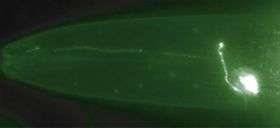
(PhysOrg.com) -- Babies will smile when they catch the scent of vanilla, but a whiff of rotting meat will send them into fits. From people to mice and flies to worms, animals of all kinds are born with likes and dislikes thanks to the evolutionary wisdom collected in their genes. But new research shows that some preferences are still surprisingly flexible at even the most basic level — that of the sensory neuron itself — and that our nervous system may be even more adaptable than we thought.
“When you’re out hiking, you’ll notice that everything tastes really delicious. That’s one of the best parts about hiking, actually, is how delicious a peanut butter and raisin sandwich can be,” says Cori Bargmann, Torsten N. Wiesel Professor and head of the Laboratory of Neural Circuits and Behavior at The Rockefeller University. “Conversely, when you are ill, everything tastes bad; everything makes you nauseous. The question is: What is changing to allow the same individual to respond to the same stimulus in different ways?”
In research published recently in Neuron, Bargmann and her colleagues pursued the question in a simpler creature and context: In Caenorhabditis elegans — a one-millimeter-long worm known as “the bloodhound of the invertebrates” for its olfactory acumen — what biochemical process causes a change in odor preference? The worm has a relatively compact nervous system of 302 neurons. Bargmann’s lab focused on the only one that is sensitive to the odor butanone, a mild, slightly oily smell that attracts normal worms when they first encounter it. The experiments showed that if worms are fed in the presence of butanone, they fall in love with it, twisting their way more quickly toward the odor. But if those same worms are starved in the presence of the smell for two hours, they have the opposite reaction. “They get really mad,” says Bargmann, who is also a Howard Hughes Medical Institute investigator. “Not only will they not go to the odor, they will run away from it.”
Bargmann found a worm with a specific mutation to the gcy-28 gene that altered the neuron under study, known as AWC-on, causing naive worms to flee from butanone. By systematically examining worms with different mutations affecting the AWC-on neuron as well as other neurons that might impact the worm’s reaction to butanone, the researchers were able to confirm that a specific chemical signaling pathway is used by the AWC-on neuron to direct the worms’ movement either toward or away from the odor. These as well as other tests, including the use of a laser to destroy specific neurons, demonstrated that a single sensory neuron, responding to stimuli from both inside and outside the worm, could change the worm’s preferences and behaviors.
The finding defies the pure “labeled-line” theory of sensation, which holds that sensory neurons are specialized to follow one path to one behavior.
Although there are vast differences in the nervous systems of worms and mammals, Bargmann believes that her findings may also be true of olfactory perception in higher mammals such as humans. “If what we’re seeing in the worms is the ability of sensory cells to respond to internal needs, and to multitask profoundly, I bet the mammalian brain can do that as well,” she says.
Citation: Neuron 59(6): 959–971 (September 25, 2008)
Provided by Rockefeller University


