3D nanotube assembly technique for nanoscale electronics
October 22, 2008 By Lisa Zyga feature
3D nanotube assembly technique for nanoscale electronics

Enlarge

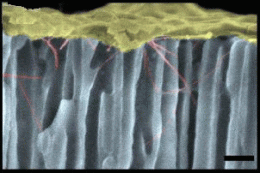
A cross-sectional view of the assembled carbon nanotubes and gold top layer in yellow (false color), taken by a scanning electron microscope. Image credit : Evin Gultepe, et al.

(PhysOrg.com) -- For the past several years, researchers have been trying to take advantage of carbon nanotubes’ good electrical properties for future nanoscale electronics applications. One of the biggest challenges in this area is finding ways to arrange and assemble the nanotubes into 3D configurations for carrying current in nanoscale devices.

Most recently, a team of physicists and engineers from the Electronic Materials Research Institute at Northeastern University in Boston, Massachusetts, has demonstrated a technique for assembling nanotubes using an applied electric field. Using this method, the researchers could assemble single-walled carbon nanotubes into 3D structures by coaxing the nanotubes into deep nanoholes in a porous alumina template. An average of one nanotube per hole was vertically assembled, and, by sweeping the 0.32cm2 area, more than one million holes were filled with nanotubes.

“The greatest significance of this technique is that it provides the potential to manufacture, at a high rate and on a large scale, three-dimensional single-wall carbon nanotube electrical interconnects, without the need for high-temperature synthesis,” Srinivas Sridhar, Director of the Electronic Materials Research Institute, told PhysOrg.com.

To achieve this nanotube assembly, the researchers attached a positive electrode to the bottom of a silicon template, which the aluminum template went on top of. Then they manually swept a negative electrode over assembly sites, pushing negatively charged nanotubes into the holes in the aluminum template. This process of using an electric field to move charged objects is called electrophoresis. Similarly, a process called dielectrophoresis, in which a non-uniform electric field moves charged or uncharged objects, also assisted in orienting the nanotubes toward the holes.

After assembling the nanotubes, the researchers sputtered a 15-nm-thick gold layer on top of the alumina template, touching the tops of the nanotubes. This layer completed an electrical connection between all the nanotubes reaching the surface of the template, with electric current traveling through the nanotubes between the gold and silicon layers. On control samples without nanotubes, no current was observed between the two layers, confirming that the nanotubes had carried the current.

By not requiring high temperatures, and providing the ability to cover centimeter-scale areas in a short time, the new assembly technique has useful advantages over other nanotube assembly techniques. The method could also integrate well into existing silicon platforms, which could be used in microelectronics, field emission displays, electronic memory devices and solar cells.

“The next step in nanoscale electronics is to integrate the 3D carbon nanotubes architectures with current CMOS technology and create hybrid systems,” Sridhar said. “The holy grail of nanoscale electronics is to completely replace CMOS technology by monolithic carbon nanotubes devices.

“Scaling down the nominal feature size makes more space available on a chip to hold more transistors and other types of devices,” he added. “Shrinking process geometries means better performance and lower costs.”

More information: Electronic Materials Research Institute

Citation: Gultepe, Evin; Nagesha, Dattatri; Casse, Bernard Didier Frederic; Selvarasah, Selvapraba; Busnaina, Ahmed; and Sridhar, Srinivas. “Large scale 3D vertical assembly of single-wall carbon nanotubes at ambient temperatures.” Nanotechnology 19 (2008) 455309 (5pp). Contact: s.sridhar(at)neu.edu

Copyright 2008 PhysOrg.com.
All rights reserved. This material may not be published, broadcast, rewritten or redistributed in whole or part without the express written permission of PhysOrg.com.

4.7 /5 (41 votes)  

Rank 4.7 /5 (41 votes)
Relevant PhysicsForums posts
  • Question about Gravity?
    created1 hour ago
  • Wearing black in a desert
    created2 hours ago
  • Did space exist before mass?
    created2 hours ago
  • How can E&M Waves be polarized?
    created2 hours ago
  • Does light travel for ever?
    created3 hours ago
  • Infinity by Particles
    created4 hours ago
  • More from Physics Forums - General Physics

More news stories

What lies beneath: Mapping hidden nanostructures

The ability to diagnose and predict the properties of materials is vital, particularly in the expanding field of nanotechnology. Electron and atom-probe microscopy can categorize atoms in thin sheets of material, ...

Nanotechnology / Nanophysics

created 13 hours ago | popularity 5 / 5 (1) | comments 1

New kind of solar cell could capture significantly more energy than current cells

New solar cells could increase the maximum efficiency of solar panels by over 25%, according to scientists from the University of Cambridge.

Nanotechnology / Nanophysics

created Feb 08, 2012 | popularity 4.5 / 5 (12) | comments 14 | with audio podcast

Nanoshell whispering galleries improve thin solar panels

Visitors to Statuary Hall in the U.S. Capitol Building may have experienced a curious acoustic feature that allows a person to whisper softly at one side of the cavernous, half-domed room and for another on ...

Nanotechnology / Nanomaterials

created Feb 07, 2012 | popularity 4.3 / 5 (6) | comments 6 | with audio podcast

'Dark plasmons' transmit energy

Microscopic channels of gold nanoparticles have the ability to transmit electromagnetic energy that starts as light and propagates via "dark plasmons," according to researchers at Rice University.

Nanotechnology / Nanophysics

created Feb 09, 2012 | popularity 5 / 5 (6) | comments 1 | with audio podcast

Revealing how a battery material works

Since its discovery 15 years ago, lithium iron phosphate (LiFePO4) has become one of the most promising materials for rechargeable batteries because of its stability, durability, safety and ability to deliver ...

Nanotechnology / Nanomaterials

created Feb 08, 2012 | popularity 5 / 5 (5) | comments 0 | with audio podcast


Google users warned of threat to smartphone wallets

Users of Google smartphone wallets were being warned on Friday that there is a way to crack pass codes intended to thwart thieves from going on illicit shopping sprees.

Anonymous knocks CIA website offline (Update)

The website of the Central Intelligence Agency was inaccessible on Friday after the hacker group Anonymous claimed to have knocked it offline.

New error-correcting codes guarantee the fastest possible rate of data transmission

Error-correcting codes are one of the triumphs of the digital age. They’re a way of encoding information so that it can be transmitted across a communication channel — such as an optical fiber o ...

Complex wiring of the nervous system may rely on a just a handful of genes and proteins

Researchers at the Salk Institute have discovered a startling feature of early brain development that helps to explain how complex neuron wiring patterns are programmed using just a handful of critical genes. ...

Humans may have helped the decline of African rainforests 3000 years ago

(PhysOrg.com) -- Large areas of rainforests in Central Africa mysteriously disappeared over three thousand years ago, to be replaced by savannas. The prevailing theory has been that the cause was a change ...

The power of estrogen -- male snakes attract other males

A new study has shown that boosting the estrogen levels of male garter snakes causes them to secrete the same pheromones that females use to attract suitors, and turned the males into just about the sexiest ...