Photo safeguards confidential information
October 22, 2008 Photo safeguards confidential information

Enlarge

(PhysOrg.com) -- These days you can take a photograph with almost every mobile phone. However, using this sort of photo to protect confidential data and send it safely is something new. Ileana Buhan, a PhD student at the University of Twente, Netherlands, has been researching this new way of employing biometrics. She receives her doctorate from the Faculty of Electrical Engineering, Mathematics and Computer Science on 23 October.

In order to recognize someone from their physical characteristics, you need to make a biometric record of them, consisting of a fingerprint, photograph or iris scan. This is a much more reliable check than the simple four-digit password on most mobile phones. As the majority of mobile phones and PDAs are already fitted with a camera, face recognition using a photo is an obvious choice. Buhan's research has made various contributions to this new biometric application.

Buhan developed a mathematical method for storing biometric data securely. Using this data, a mobile device is able to recognize people under different circumstances, so even if the user has altered his hair drastically, the system can still recognize him.

Two photos give password

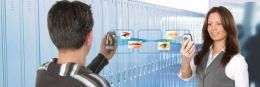
Buhan wondered if you could also use such photographs or other biometric data for accomplishing secure information exchange between two mobile devices. If Bluetooth is used to do this – again with a simple four-digit password – security and privacy cannot be guaranteed. Instead, Buhan suggested constructing a password from two photos so that it would be almost impossible to decode it. To do this, two users need to save their own photos on their PDAs. They then take photos of each other. The PDA compares the two photos and generates a security code for making a safe connection. The users can then use this connection to exchange confidential information. The photos are stored as a template that contains the essential features for recognition. This safe template transfer is not just suitable for PDAs, but for every other biometric recognition system.

A firearm recognizes its owner

This idea of using biometrics for safe storage and transfer arose from the SecureGrip project. This is a project in which the grip of a policeman’s firearm is biometrically protected, in this case with a ‘personal grip' covered with a network of pressure sensors. These recognize the way in which the user holds the firearm. If someone else holds the weapon, it does not work. So what happens if a policeman needs to borrow a firearm from his colleague? The same as for the photos: the policemen have to hold each other's firearms for a short time, in order to create a suitable code.

Provided by University of Twente, Netherlands


print this article email this article download pdf blog this article bookmark this article     Stumble it Digg this share on Facebook retweet share on Reddit add to delicious
Rate this story - 4.8 /5 (5 votes)


October 22, 2008 all stories

Comments: 0

4.8 /5 (5 votes)
  • Stumble this up

  • Digg this

  • share this

  • hide
  • Related Stories

  • Stable Opera 10.10 browser with Unite now available
    created Nov 24, 2009 | popularity not rated yet | comments 0
  • Trust Linux!
    created Nov 20, 2009 | popularity not rated yet | comments 0
  • P2P comes to the aid of audiovisual search (w/ Video)
    created Nov 18, 2009 | popularity not rated yet | comments 0
  • There's no business like Grid business (w/ Video)
    created Nov 17, 2009 | popularity not rated yet | comments 0
  • Review: Motorola's Droid is a serious smart phone
    created Nov 04, 2009 | popularity not rated yet | comments 0


  • hide
  • Relevant PhysicsForums posts

  • Sixth sense technology
    created Nov 26, 2009
  • kindle e-reader and scientific papers
    created Nov 24, 2009
  • Help with a camera choice
    created Nov 18, 2009
  • casio calculator that's similar to TI-89
    created Nov 08, 2009
  • More from Physics Forums - Computing & Technology

Other News

Building real security with virtual worlds

Technology / Computer Sciences

created 12 hours ago | popularity 4 / 5 (4) | comments 0

(PhysOrg.com) -- Advances in computerized modeling and prediction of group behavior, together with improvements in video game graphics, are making possible virtual worlds in which defense analysts can explore and predict ...


McKinnon, accused of hacking into US military and NASA computers, faces extradition to the United States

UFO-obsessed Briton loses bid to block US extradition

Technology / Other

created 8 hours ago | popularity 4 / 5 (2) | comments 1

A Briton accused of hacking into US military and NASA computers faces extradition to the United States after the British government Thursday rejected last-ditch requests to block the move.


Sony optimistic on 3-D TVs, in-house display (AP)

Sony optimistic on 3-D TVs, in-house display

Technology / Hi Tech

created 18 hours ago | popularity not rated yet | comments 0

(AP) -- A third to a half of the Sony Corp. TV sets sold annually will be packed with 3-D features by the year ending March 2013, a senior executive said Thursday.


Roku adds more 'channels' of video and other digital content

Technology / Telecom

created 12 hours ago | popularity not rated yet | comments 0

Owners of Roku's digital video player will soon have a bunch more channels to choose from.


Holiday Web shopping looks brighter than last year

Technology / Internet

created 14 hours ago | popularity not rated yet | comments 0

(AP) -- Online retailers hope the convenience of the Web, plus discounts and deals, spur still-nervous shoppers to spend more online this holiday season - even as traditional retailers brace for mediocre sales.