Magic solar milestone reached: UNSW claims 25 percent solar cell efficiency title
October 23, 2008
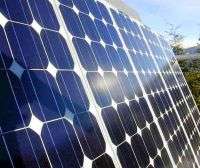
University of New South Wales ARC Photovoltaic Centre of Excellence has reported the first silicon solar cell to achieve the milestone of 25 per cent effiency.
The UNSW ARC Photovoltaic Centre of Excellence already held the world record of 24.7 per cent for silicon solar cell efficiency. Now a revision of the international standard by which solar cells are measured, has delivered the significant 25 per cent record to the team led by Professors Martin Green and Stuart Wenham and widened their lead on the rest of the world.
Centre Executive Research Director, Scientia Professor Martin Green, said the new world mark in converting incident sunlight into electricity was one of six new world records claimed by UNSW for its silicon solar technologies.
Professor Green said the jump in performance leading to the milestone resulted from new knowledge about the composition of sunlight.
"Since the weights of the colours in sunlight change during the day, solar cells are measured under a standard colour spectrum defined under typical operational meteorological conditions," he said.
"Improvements in understanding atmospheric effects upon the colour content of sunlight led to a revision of the standard spectrum in April. The new spectrum has a higher energy content both down the blue end of the spectrum and at the opposite red end with, dare I say it, relatively less green."
The recalibration of the international standard, done by the International Electrochemical Commission in April, gave the biggest boost to UNSW technology while the measured efficiency of others made lesser gains. UNSW's world-leading silicon cell is now six per cent more efficient than the next-best technology, Professor Green said. The new record also inches the UNSW team closer to the 29 per cent theoretical maximum efficiency possible for first-generation silicon photovoltaic cells.
Dr Anita Ho-Baillie, who heads the Centre's high efficiency cell research effort, said the UNSW technology benefited greatly from the new spectrum "because our cells push the boundaries of response into the extremities of the spectrum".
"Blue light is absorbed strongly, very close to the cell surface where we go to great pains to make sure it is not wasted. Just the opposite, the red light is only weakly absorbed and we have to use special design features to trap it into the cell," she said.
Professor Green said: "These light-trapping features make our cells act as if they were much thicker than they are. This already has had an important spin-off in allowing us to work with CSG Solar to develop commercial 'thin-film' silicon-on-glass solar cells that are over 100 times thinner than conventional silicon cells."
ARC Centre Director, Professor Stuart Wenham said the focus of the Centre is now improving mainstream production.
"Our main efforts now are focussed on getting these efficiency improvements into commercial production," he said.
"Production compatible versions of our high efficiency technology are being introduced into production as we speak."
The world-record holding cell was fabricated by former Centre researchers, Dr Jianhua Zhao and Dr Aihua Wang, who have since left the Centre to establish China Sunergy, one of the world's largest photovoltaic manufacturers.
"China was the largest manufacturer of solar cells internationally in 2007 with 70 per cent of the output from companies with our former UNSW students either Chief Executive Officers or Chief Technical Officers", said Professor Green.
Source: University of New South Wales
-
New kind of solar cell could capture significantly more energy than current cells
12 hours ago |
4.8 / 5 (5) |
13
-
New tool for analyzing solar-cell materials
Feb 07, 2012 |
not rated yet |
0
-
Nanoshell whispering galleries improve thin solar panels
Feb 07, 2012 |
4.2 / 5 (5) |
6
-
Photovoltaic panels made from plant material could become a cheap alternative to traditional solar cells
Feb 03, 2012 |
4.8 / 5 (9) |
0
-
UT biosolar breakthrough promises cheap, easy green electricity
Feb 02, 2012 |
4.9 / 5 (8) |
8
-
Engineers build first sub-10-nm carbon nanotube transistor
Feb 01, 2012 |
4.9 / 5 (33) |
30
-
Something old, something new: Evolution and the structural divergence of duplicate genes
Jan 31, 2012 |
4.6 / 5 (7) |
1
-
The hidden nanoworld of ice crystals: Revealing the dynamic behavior of quasi-liquid layers
Jan 30, 2012 |
5 / 5 (5) |
1
-
Stock market network reveals investor clustering
Jan 27, 2012 |
3.9 / 5 (23) |
8
-
Of microchemistry and molecules: Electronic microfluidic device synthesizes biocompatible probes
Jan 26, 2012 |
5 / 5 (2) |
0
-
How to tilt a object
12 hours ago
-
How to calculate total compressibility in liquid porous solid system
17 hours ago
-
Need help reading 3-D
Feb 11, 2012
-
A way to send and receive wireless data
Feb 11, 2012
-
Calling function with no input argument
Feb 10, 2012
-
Force free body diagram problem on gym equipment
Feb 10, 2012
- More from Physics Forums - General Engineering
More news stories
Building a 'blind-friendly' Internet
Rakesh Babu demonstrates how a blind person uses the Internet.
35 minutes ago |
not rated yet |
0
Ethanol mandate not the best option
Many people are willing to pay a premium for ethanol, but not enough to justify the government mandate for the corn-based fuel, a Michigan State University economist argues.
Technology / Energy & Green Tech
21 minutes ago |
not rated yet |
0
Darpa to develop mobile millimeter-wave backhaul networks
Providing high-bandwidth communications for troops in remote forward operating locations is not only critical but also challenging because a reliable infrastructure optimized for remote geographic areas does ...
13 minutes ago |
not rated yet |
0
Thomas Edison inspires the oscar awards you don't see
Thomas Edison's invention of the first motion picture camera in 1891 inspired scientific and technological advances that he never could have imagined.
Technology / Hi Tech & Innovation
1 hour ago |
5 / 5 (1) |
0
Microsoft India retail site down after 'cyber attack'
Microsoft said Monday it was investigating an attack by hackers on its Indian retail website, reportedly carried out by a Chinese group called the "Evil Shadow Team."
2 hours ago |
not rated yet |
0
Manipulating genes with hidden TALENs
(PhysOrg.com) -- A better understanding of gene function in model plant and animal systems could be used to develop useful traits in livestock and crop plants, and might someday lead to developments in stem ...
Alien matter in the solar system: A galactic mismatch
This just in: The Solar System is different from the space just outside it.
Transforming galaxies
(PhysOrg.com) -- Many of the Universe's galaxies are like our own, displaying beautiful spiral arms wrapping around a bright nucleus. Examples in this stunning image, taken with the Wide Field Camera 3 on ...
'Smart' microcapsules in a single step
(PhysOrg.com) -- A new, single-step method of fabricating microcapsules, which have potential commercial applications in industries including medicine, agriculture and diagnostics, has been developed by researchers ...
Tenofovir, leading HIV medication, linked with risk of kidney damage
(Medical Xpress) -- Tenofovir, one of the most effective and commonly prescribed antiretroviral medications for HIV/AIDS, is associated with a significant risk of kidney damage and chronic kidney disease that increases over ...
A continent ablaze in auroral and manmade light
The North American continent is literally set ablaze in a confluence of Auroral and Manmade light captured in spectacular new videos snapped by the astronauts serving aboard the International Space Station ...
Oct 23, 2008
Rank: 4.8 / 5 (8)
Oct 23, 2008
Rank: 2.8 / 5 (5)
They're nearly 100% efficient (take that human scientists!) and they even take care of the CO2 problem for us!
Go hug a tree.™
Oct 23, 2008
Rank: 4.9 / 5 (7)
Oct 23, 2008
Rank: 1 / 5 (4)
Oct 23, 2008
Rank: 5 / 5 (5)
Oct 23, 2008
Rank: 5 / 5 (3)
No. Plants only convert 0.2% to 8% (depending on the plant and which scientist you ask) of solar energy into usable energy.
Oct 23, 2008
Rank: 3 / 5 (1)
Oct 23, 2008
Rank: 3 / 5 (1)
Oct 23, 2008
Rank: 4 / 5 (1)
Oct 23, 2008
Rank: 4 / 5 (2)
Still I hope they are also working on ways of improving the collection of solar energy even if it does not involve silicon.
Why limit ourselves silicon solar panels when by broadening our horizons we open the door to much higher efficiencies?
Oct 23, 2008
Rank: 5 / 5 (3)
Hmm... You are correct. I apologize, I was remembering some article I had seen a while ago toting that figure, but it appears that either I misunderstood it or the reporting wasn't all that spectacular.
Here's some more info on it (which might explain where the 100% figure came from):
From: http://www.life.u...isit.htm
Oct 23, 2008
Rank: 5 / 5 (2)
Oct 24, 2008
Rank: 2.5 / 5 (2)
LMFAO....just try to deploy those arrays on those "vast areas of land" and see how quickly the kooks crawl out of the wood work. You won't even have to file any official paperwork. Just let it get out that you're THINKING of doing something like that and all the NIMBY, Sierra Club, "save the flavor of the month species" people will have 100 friend to the court briefs filed and they won't stop until they get it appealed to the 9th circuit which will promptly grind into the dirt any plans you had to do with any land...especially if it's public land...
Oct 24, 2008
Rank: 5 / 5 (4)
In the past several months I've noticed alot of articles showing advancements in cheap, durable, thin solar panels.
Here is one example. There are several others but I was too lazy to look them all up -.-
http://www.physor...388.html
If thin solar panel tech could be manufactured to be durable and cheap enough to be used in construction materials they could take a big chunk out of peak load. Efficiency wouldn't matter if they were cheap enough to form into shingles or as a skin on siding.
$/watt and storage technology is definately what will drive implementation of massive solar farms. However, researching low efficiency/cheap/practical solar panels for the masses could make its own contribution and shouldn't be over looked.
Oct 25, 2008
Rank: 5 / 5 (2)
cheap, they are doing quite the
opposite: making them more
complex ( = expensive by
definition!) Were available space
for arrays be limiting, yes,
complexity is needed. But space
IS available ... 9th circuit
be damned!
Oct 26, 2008
Rank: 3 / 5 (1)
Oct 26, 2008
Rank: 2 / 5 (1)
Cheaper solar cells isn't very useful unless installation and storage/transmissions similarly becomes cheaper.(swap storage for maintenance in case of solar thermal)
Oct 27, 2008
Rank: 1 / 5 (1)
Solar doesn't need to be stored in "Grid-tied" systems and would relieve a lot of the dependency on transmission. People will make energy where it's needed (or relatively close to it. )