Study: Elderly Women can increase strength but still risk falls
October 23, 2008
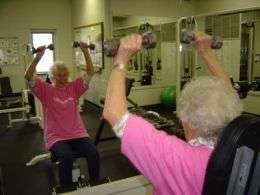
Research subject Ellen Prouty, 80, participates in a strength-building study conducted by Dain LaRoche, assistant professor of exercise science at UNH. Credit: Courtesy Dain LaRoche/UNH
Elderly women can increase muscle strength as much as young women can, a new study from the University of New Hampshire finds, indicating that decline in muscle function is less a natural part of the aging process than due to a decline in physical activity.
The research, published in the journal Medicine & Science in Sports & Exercise, compared strength gains of inactive elderly women and inactive young women after both groups participated in an eight-week training regime. Yet while the two groups increased similar percentages of strength, the older group was far less effective in increasing power, which is more closely related to preventing falls.
"Power is more important than strength for recovery from loss of balance or walking ability," says Dain LaRoche, assistant professor of exercise science at UNH and the lead author of the study. Preventing falls, which occur in 40 percent of people over 65 and are the top reason for injury-related emergency room visits, is the driving force behind LaRoche's research agenda.
LaRoche compared the initial strength of 25 young (18 – 33) and 24 old (65 – 84) inactive women then had both groups participate in resistance training on a machine that targeted knee extensor muscles, which are critical for walking, stair-climbing, or rising from a chair. "They're what let you live on your own," he says.
After eight weeks of training, the older group not only increased their strength by the same percentage as the younger group, they achieved gained strength similar to a control group of young inactive women. But the older group's ability to increase power – force over time – was significantly less than the younger group's; the elderly women saw only a ten percent increase in power versus the younger women's 50 percent increase.
"It's somewhat troublesome that these older individuals had a reduced capacity to increase performance that's so closely associated with falls," says LaRoche. It seems that the key to muscle power in the elderly is to maintain it over the lifespan rather than try to develop it later in life, he says.
Acknowledging that the type or frequency (six sets, three times per week) of his training protocol may have affected the older group's ability to make gains in power, LaRoche is continuing to research older women's capacity to develop muscle power. As baby boomers age, doubling the over-65 population by 2030, research that supports fall prevention and independent living is a growth area. "I tell my students, 'there's room for you in this field,'" says LaRoche.
Of those 40 percent of elderly people who will fall, research has shown that 20 to 30 percent suffer injuries that reduce mobility, independence and longevity. Health care cost of a fall injury totals nearly $20,000, and following a hip fracture, life expectancy is just two years.
LaRoche's own interest in fall prevention in the elderly arose after helping his parents and sister care for his completely sedentary grandmother, helping her stay in her own home until she died at age 93. She broke both hips, lost six inches of height, and had osteoporosis so severe that a caregiver accidently crushed several of her ribs just helping her out of a chair.
"There's a gap between life expectancy and quality of life in older age," LaRoche says. "We can improve that a lot with physical activity."
Source: University of New Hampshire
-
Researchers develop method of directing stem cells to increase bone formation and bone strength
Feb 06, 2012 |
5 / 5 (2) |
0
-
Study: Overweight older women have less leg strength, power
Sep 19, 2011 |
not rated yet |
0
-
Research from Everest: Can leucine help burn fat and spare muscle tissue during exercise?
Aug 28, 2011 |
not rated yet |
1
-
Sleep apnea linked to increased risk of dementia in elderly women
Aug 09, 2011 |
not rated yet |
0
-
Changing trends in hip fracture incidence around the world
Apr 12, 2011 |
not rated yet |
0
-
Engineers build first sub-10-nm carbon nanotube transistor
Feb 01, 2012 |
4.9 / 5 (33) |
30
-
Something old, something new: Evolution and the structural divergence of duplicate genes
Jan 31, 2012 |
4.6 / 5 (7) |
1
-
The hidden nanoworld of ice crystals: Revealing the dynamic behavior of quasi-liquid layers
Jan 30, 2012 |
5 / 5 (4) |
1
-
Stock market network reveals investor clustering
Jan 27, 2012 |
3.9 / 5 (23) |
8
-
Of microchemistry and molecules: Electronic microfluidic device synthesizes biocompatible probes
Jan 26, 2012 |
5 / 5 (2) |
0
-
Classical and Quantum Mechanics via Lie algebras
Apr 15, 2011
- More from Physics Forums - Independent Research
More news stories
Botox developer rues missing out on billions
Botox developer Alan Scott says he rues the day he handed over rights to the best-selling wrinkle-smoothing drug to a US company for just $4.5 million, saying he might have become a billionaire.
Medicine & Health / Medications
2 minutes ago |
not rated yet |
0
Starve a virus, feed a cure? Findings show how some cells protect themselves against HIV
A protein that protects some of our immune cells from the most common and virulent form of HIV works by starving the virus of the molecular building blocks that it needs to replicate, according to research published online ...
14 hours ago |
5 / 5 (3) |
0
|
Overeating may double risk of memory loss
New research suggests that consuming between 2,100 and 6,000 calories per day may double the risk of memory loss, or mild cognitive impairment (MCI), among people age 70 and older. The study was released today and will be ...
Medicine & Health / Neuroscience
10 hours ago |
5 / 5 (2) |
0
|
Declining health-care productivity in England: Who says so?
Reports that the National Health Service in England has been declining in productivity in the last decade appear to have been accepted as fact. However, a Viewpoint published Online First by The Lancet disputes this. The Vi ...
8 hours ago |
1 / 5 (1) |
1
Injured boomers beware: Know when to see doctor
(AP) -- It happened to nurse Jane Byron years after an in-line skating fall, business owner Haralee Weintraub while doing "men's" push-ups, and avid cyclist Gene Wilberg while lifting a heavy box.
15 hours ago |
5 / 5 (1) |
0
Japan's Fukushima reactor may be reheating: operator
Temperature readings at one of the crippled Fukushima nuclear reactors have risen above Japan's stringent new safety standard but there was no immediate danger, its operator said Sunday.
Australian women reject 'I love u' texts
Australian women may have embraced the digital era, but they prefer a face-to-face declaration of affection to an "I love u" text and find men addicted to their mobile phones a major turnoff.
Scientists discover molecular secrets of 2,000-year-old Chinese herbal remedy
For roughly two thousand years, Chinese herbalists have treated Malaria using a root extract, commonly known as Chang Shan, from a type of hydrangea that grows in Tibet and Nepal. More recent studies suggest that halofuginone, ...
New method to examine batteries -- MRI from the inside
There is an ever-increasing need for advanced batteries for portable electronics, such as phones, cameras, and music players, but also to power electric vehicles and to facilitate the distribution and storage of energy derived ...
Google might launch Drive for cloud storage soon
(PhysOrg.com) -- Google's next big move, according to the Wall Street Journal, is a cloud storage service called Drive. Hardly first to the plate, Google is simply catching up to introducing its cloud reposi ...
A mitosis mystery solved: How chromosomes align perfectly in a dividing cell
Although the process of mitotic cell division has been studied intensely for more than 50 years, Whitehead Institute researchers have only now solved the mystery of how cells correctly align their chromosomes during symmetric ...