The Good Vibrations of Nearby Stars
October 23, 2008 The Good Vibrations of Nearby Stars

Enlarge

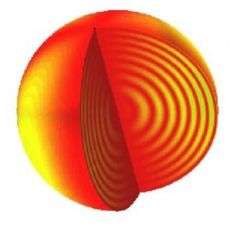
Illustration of a stellar global oscillation shaking the whole star interior and thus carrying information on it. Yellow refers to maximum temperature variations due to oscillations. Image courtesy of Aarhus University/S. Frandsen

Some of the first data collected by the CoRoT space telescope mission, launched in December 2006, provides valuable information about the physical vibrations and surface characteristics of nearby stars that are similar to our Sun, researchers say. This novel information illustrates the great value of space-based observations, and provides astronomers with insights into the interior of our Sun, other stars, and the overall evolution of our galaxy.

The related report will be published by the journal Science on Friday, 24 October, and featured on the cover. Science is the journal of AAAS, the nonprofit science society.

Dr. Eric Michel from the Observatory of Paris-LESIA-CNRS and a large group of colleagues from across Europe and South America analyzed the data from the CoRoT satellite to determine that three nearby stars, all significantly hotter than the Sun, also have larger vibrations, or oscillations, and much finer surface texture, or granulation. With this unprecedented data, the researchers show that the stars' oscillations are about 1.5 times as vigorous as the Sun's, and their granulation is about three times finer. The observed oscillations, though much more intense than the Sun's, are still about 25% weaker than most models predicted.

These landmark results represent the first time researchers have been able to accurately gauge the oscillation amplitudes and granulation signatures of solar bodies in our universe, other than the Sun.

The initial discovery of oscillations in our Sun in the late 1970's led to the creation of "solar seismology," which has since been used to measure the movement and transport of heat around the Sun. Solar seismology led to rapid progress in understanding the Sun's internal structure, but eventually researchers hit a wall. Accurate measurements of solar-like oscillations require the collection of precise data from long, uninterrupted sequences of observations, making ground-based study impossible.

"Although the energy from the Sun is more or less constant over our lifetimes, even very small variability in its output can have important effects," says Brooks Hanson, deputy editor for physical sciences at Science Magazine. "Understanding that small variability is critical, for example, in predicting solar storms and space weather, and for resolving the causes of changes in Earth's climate… These observations [by Michel and colleagues], and more in the future, will provide the essential data for improving our understanding of the interior of the Sun, and stars in general."

The findings presented by Michel and colleagues are based on light curves obtained with the CoRoT satellite over a period of 60 days, and help to refine our understanding of stars and the Sun. These results "allow us to place our Sun within the bigger picture of the evolution of our galaxy and the local universe," says Ian Osborne, senior editor of Science Magazine.

Source: American Association for the Advancement of Science


print this article email this article download pdf blog this article bookmark this article     Stumble it Digg this share on Facebook retweet share on Reddit add to delicious
Rate this story - 4.5 /5 (16 votes)


October 23, 2008 all stories

Comments: 0

4.5 /5 (16 votes)
  • Stumble this up

  • Digg this

  • share this

  • hide
  • Related Stories

  • The CoRoT space mission: Early results
    created Oct 22, 2009 | popularity not rated yet | comments 0
  • The discovery of new Earths is imminent, UD astronomer says
    created Sep 28, 2009 | popularity not rated yet | comments 0
  • World's observatories watching 'cool' star
    created May 15, 2009 | popularity not rated yet | comments 0
  • Scientists find giant solar twists
    created Mar 19, 2009 | popularity not rated yet | comments 0
  • CoRoT discovery challenges the definition of extra-solar planets
    created Oct 07, 2008 | popularity not rated yet | comments 0


  • hide
  • Relevant PhysicsForums posts

  • WR104 Gamma Ray Burst
    created 11 hours ago
  • Spectrometers
    created Dec 22, 2009
  • what accretion disk of BH?
    created Dec 22, 2009
  • Will the Moon escape Earth's orbit in billions of years?
    created Dec 21, 2009
  • More from Physics Forums - General Astronomy

Other News

The Exxon Valdez spilled 11 million gallons of crude into the sea in 1989

Fuel spill at same Alaska reef as Exxon Valdez

Space & Earth / Environment

created 31 minutes ago | popularity not rated yet | comments 0

A tugboat struck the same reef as the Exxon Valdez tanker 20 years ago, spilling diesel into Alaska's Prince William Sound and creating a three-mile-long slick, the US Coast Guard said on Friday.


China defends role at Copenhagen

Space & Earth / Environment

created 4 hours ago | popularity 3 / 5 (2) | comments 0

China has defended its role at this month's climate change talks in Copenhagen, saying Premier Wen Jiabao played a key part in sealing an accord, after critics blamed Beijing for blocking negotiations.


Global warming likely to be amplified by slow changes to Earth systems

Global warming likely to be amplified by slow changes to Earth systems

Space & Earth / Earth Sciences

created Dec 20, 2009 | popularity 2.7 / 5 (41) | comments 48

Researchers studying a period of high carbon dioxide levels and warm climate several million years ago have concluded that slow changes such as melting ice sheets amplified the initial warming caused by greenhouse ...


A man walks his dog in the snow in the East Village

Polluting pets: the devastating impact of man's best friend

Space & Earth / Environment

created Dec 21, 2009 | popularity 1.7 / 5 (26) | comments 26

Man's best friend could be one of the environment's worst enemies, according to a new study which says the carbon pawprint of a pet dog is more than double that of a gas-guzzling sports utility vehicle.


Scientists map speed of climate change

Space & Earth / Environment

created Dec 23, 2009 | popularity 3 / 5 (21) | comments 18

New study finds that the average ecosystem will need to shift about a quarter mile per year to keep pace with global climate change.