GOCE satellite launch delayed until 2009
October 24, 2008 GOCE launch delayed until 2009

Enlarge

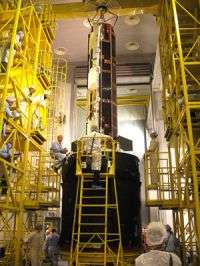
GOCE mounted onto the Breeze-KM Upper Stage. Credits: ESA

(PhysOrg.com) -- The Russian authorities responsible for the Rockot launcher that shall carry ESA's GOCE Earth Explorer satellite into orbit have completed the investigation of a failure in the guidance and navigation system of the launcher's Upper Stage (Breeze KM).

The anomaly was discovered during the spacecraft's launch preparation tests on 7 September 2008 in Plesetsk, which subsequently led to the postponement of the launch.

The cause of the anomaly in the guidance and navigation system has meanwhile been identified and reproduced. The necessary hardware changes will require a minimum of two months of additional work by the manufacturer.

As a consequence, the launch of GOCE cannot take place earlier than February 2009; however, the exact launch date will only be decided at a later stage once the corrective measures have been fully implemented and validated.

Provided by European Space Agency


print this article email this article download pdf blog this article bookmark this article     Stumble it Digg this share on Facebook retweet share on Reddit add to delicious
Rate this story - 3.5 /5 (2 votes)


October 24, 2008 all stories

Comments: 0

3.5 /5 (2 votes)
  • Stumble this up

  • Digg this

  • share this

  • hide
  • Related Stories

  • March launch planned for GOCE gravity mission (Video)
    created Feb 04, 2009 | popularity not rated yet | comments 0
  • GOCE team gearing up for new launch date
    created Oct 02, 2008 | popularity not rated yet | comments 0
  • Launch of GOCE Satellite delayed
    created Sep 08, 2008 | popularity not rated yet | comments 0
  • Final launch of Ariane 5 GS completes busy year
    created Dec 21, 2009 | popularity not rated yet | comments 0
  • WISE Launch Delayed 24 Hours
    created Dec 10, 2009 | popularity not rated yet | comments 0


  • hide
  • Relevant PhysicsForums posts

  • Spectrometers
    created Dec 22, 2009
  • what accretion disk of BH?
    created Dec 22, 2009
  • Will the Moon escape Earth's orbit in billions of years?
    created Dec 21, 2009
  • How do I calculate light years to years?
    created Dec 21, 2009
  • More from Physics Forums - General Astronomy

Other News

Iran to unveil new home-built satellite: report

Space & Earth / Space Exploration

created 2 hours ago | popularity not rated yet | comments 1

Iran will unveil a new home-built satellite in February, a newspaper reported Thursday, amid Western concerns that Tehran is using its nuclear and space industries to develop atomic and ballistic weapons.


Scientists map speed of climate change

Space & Earth / Environment

created 18 hours ago | popularity 3.4 / 5 (14) | comments 13

New study finds that the average ecosystem will need to shift about a quarter mile per year to keep pace with global climate change.


Mendenhall Glacier

Glacier melt adds ancient edibles to marine buffet

Space & Earth / Earth Sciences

created 16 hours ago | popularity 3.9 / 5 (10) | comments 4

Glaciers along the Gulf of Alaska are enriching stream and near shore marine ecosystems from a surprising source - ancient carbon contained in glacial runoff, researchers from four universities and the U.S. ...


Keck Telescopes Take Deeper Look at Planetary Nurseries

Keck Telescopes Take Deeper Look at Planetary Nurseries

Space & Earth / Astronomy

created 15 hours ago | popularity 4.8 / 5 (4) | comments 0

(PhysOrg.com) -- Astronomers using the W. M. Keck Observatory have peered far into a young planetary system, giving an unprecedented view of dust and gas that might eventually form planets similar to Jupiter, ...


The Formation of Blue Stragglers

Vampires and collisions rejuvenate stars

Space & Earth / Astronomy

created 18 hours ago | popularity 4.3 / 5 (6) | comments 2

Stars in globular clusters are generally extremely old, with ages of 12-13 billion years. However, a small fraction of them appear to be significantly younger than the average population and, because they ...