Successful first test for Vega's Zefiro 9-A solid-fuel rocket motor
October 24, 2008
Successful first test for Vega's Zefiro 9-A solid-fuel rocket motor

Enlarge

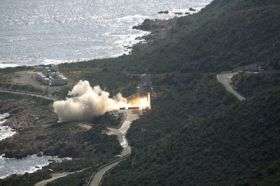
On 23 October, the Zefiro 9-A motor successfully completed its first firing test at the Salto di Quirra Inter-force Test Range in Sardinia (Italy). This test is a significant step towards the Vega launcher’s qualification flight, scheduled to take place by the end of 2009. After a nominal 120-second burn time, during which a maximum combustion pressure of 75 bar was reached, the roar of the motor stopped as expected. The first results confirm the expected performance increase for this enhanced version of the motor, as well as the robustness of the modifications introduced in the nozzle design. Credits: Avio SpA (Italy)

Yesterday, the Zefiro 9-A motor successfully completed its first firing test at the Salto di Quirra Inter-force Test Range in Sardinia (Italy). This was the penultimate firing test for the engine prior to the Vega launcher’s qualification flight, scheduled to take place by the end of 2009.

The Zefiro 9-A (Z9-A) solid-fuel rocket motor, which will power the Vega launch vehicle’s third stage, left the production facility of Avio, in Colleferro (Italy), at the end of September and was installed at the test site over the last three weeks.

After a nominal 120-second burn time, during which a maximum combustion pressure of 75 bar was reached, the roar of the motor stopped as expected. The first results confirm the expected performance increase for this enhanced version of the motor, as well as the robustness of the modifications introduced in the nozzle design.

Improved design

This improved version of the Z9, with its new nozzle design and an optimised propellant loading, is fully flight-representative of the Vega third-stage motor – the only exception being the use of a truncated nozzle in order to partially adapt the motor to sea-level conditions.

The Zefiro 9-A motor, with an overall height of 3.17 m and a diameter of 1.92 m, contains 10.5 tonnes of propellant and provides a maximum thrust of 320 kN (about 32.6 tonnes-force), in vacuum. The Z9-A has the highest propellant-mass to inert-mass ratio of any space-transportation solid-propellant rocket motor ever fired.

Some 400 sensors fitted to the motor allowed monitoring of its behaviour during and after the firing test. The data collected will enable engineers from ELV SpA (Italy), the Vega launch vehicle prime contractor, and Avio SpA (Italy), in charge of the motor development and qualification, to check its performance, in particular:

-- ballistic performance (pressure and thrust curves)
-- internal thermal-protection efficiency
-- thrust-vector control performance
-- induced thermal and dynamic environment

Following the test firing, the motor will be shipped back to Colleferro, for detailed inspection.

Towards flight qualification

A second qualification test for the Zefiro 9-A is planned for February 2009. This will complete the qualification process of the Vega solid rocket motors. The P80 first-stage motor and the Z23 second-stage motor, both of which also use solid propellant, have already completed successful qualification firing tests.

The Vega launcher qualification flight is scheduled to take place before the end of 2009, from Europe’s spaceport at Kourou, in French Guiana.

Vega is a single-body launcher composed of three solid-propellant stages and a liquid-propellant upper module. It is approximately 30 m high, and weighs a total of 137 tonnes at lift-off. The reference mission for Vega’s launch capacity is to carry 1500 kg into a 700km-altitude polar orbit, but Vega will be able to launch a wide range of scientific and Earth-observation missions.

Provided by ESA

4.3 /5 (4 votes)  

Rank 4.3 /5 (4 votes)
Related Stories
Relevant PhysicsForums posts
  • Never ending outer space.....
    createdFeb 11, 2012
  • Neutron Star fragments?
    createdFeb 11, 2012
  • stationary or not?
    createdFeb 11, 2012
  • Scale of the Universe
    createdFeb 10, 2012
  • Titan's lack of impact craters
    createdFeb 09, 2012
  • Real pictures of black hole eating a star?
    createdFeb 08, 2012
  • More from Physics Forums - General Astronomy

More news stories

Salvage workers begin pumping fuel from Italian shipwreck

Salvage workers Sunday began pumping fuel from the shipwrecked Italian cruise liner Costa Concordia, a day ahead of schedule, officials said.

Space & Earth / Environment

created 9 hours ago | popularity 5 / 5 (1) | comments 0

Latin America mining boom clashes with conservation

Latin America is experiencing a mining boom as prices rise fuelled by a hike in global demand, but the region is also being hit by a wave of violent protests, strikes and rallies by environmentalists.

Space & Earth / Environment

created 17 hours ago | popularity 5 / 5 (1) | comments 1

Political leaders play key role in how worried Americans are by climate change: study

More than extreme weather events and the work of scientists, it is national political leaders who influence how much Americans worry about the threat of climate change, new research finds.

Space & Earth / Environment

created Feb 06, 2012 | popularity 5 / 5 (7) | comments 73

NASA budget will axe Mars deal with Europe: scientists

US President Barack Obama's budget proposal to be submitted next week for 2013 will cut NASA's budget by 20 percent and eliminate a major partnership with Europe on Mars exploration, scientists said Thursday.

Space & Earth / Space Exploration

created Feb 10, 2012 | popularity 5 / 5 (3) | comments 58

Humans may have helped the decline of African rainforests 3000 years ago

(PhysOrg.com) -- Large areas of rainforests in Central Africa mysteriously disappeared over three thousand years ago, to be replaced by savannas. The prevailing theory has been that the cause was a change ...

Space & Earth / Environment

created Feb 10, 2012 | popularity 4.1 / 5 (14) | comments 21 | with audio podcast report


Scientists discover molecular secrets of 2,000-year-old Chinese herbal remedy

For roughly two thousand years, Chinese herbalists have treated Malaria using a root extract, commonly known as Chang Shan, from a type of hydrangea that grows in Tibet and Nepal. More recent studies suggest that halofuginone, ...

New method to examine batteries -- MRI from the inside

There is an ever-increasing need for advanced batteries for portable electronics, such as phones, cameras, and music players, but also to power electric vehicles and to facilitate the distribution and storage of energy derived ...

Google might launch Drive for cloud storage soon

(PhysOrg.com) -- Google's next big move, according to the Wall Street Journal, is a cloud storage service called Drive. Hardly first to the plate, Google is simply catching up to introducing its cloud reposi ...

A mitosis mystery solved: How chromosomes align perfectly in a dividing cell

Although the process of mitotic cell division has been studied intensely for more than 50 years, Whitehead Institute researchers have only now solved the mystery of how cells correctly align their chromosomes during symmetric ...

Lab study raises questions over nano-particle impact

Tests involving chickens have raised questions about the impact on health from engineered nano-particles, the ultra-fine grains commonly used in drugs and processed foods, scientists said on Sunday.

Starve a virus, feed a cure? Findings show how some cells protect themselves against HIV

A protein that protects some of our immune cells from the most common and virulent form of HIV works by starving the virus of the molecular building blocks that it needs to replicate, according to research published online ...