Answering the Question:'Which Drug Therapy Is Right for Me?'
October 24, 2008 By Karin Lorentzen
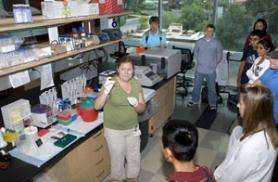
Graduate assistant Alicia Bolt demonstrates the preparation of microarrays measuring human genome expression to pharmacogenomics students.
(PhysOrg.com) -- UA pharmacy researchers aim to unravel a mystery: why do genetically similar people react differently to the same drug.
In the world of pharmaceutical science, the question of why two very similar individuals can react differently to a drug is the subject of intense interest.
At The University of Arizona College of Pharmacy, researchers are striving to find answers to seemingly simple questions asked by patients, such as, "Why did I have to try three different high blood pressure medications before my doctor found one that worked for me?" and "Why did my cancer stay in remission with drug treatment, but my friend who had the same treatment was not so fortunate?"
At the basis of the answers to these questions is a field of study called pharmacogenomics, the analysis of how the expression of the human genome, the DNA code that instructs the making of the machinery of a cell, is key to the body's response to drugs.
"Importantly," said Walt Klimecki, assistant professor at UA College of Pharmacy, "pharmacogenomics helps us understand why two apparently similar individuals could have very different responses to the same drug. It holds the promise that drugs might one day be tailor-made for individuals and adapted to each person's own particular makeup."
In his lab at the UA's BIO5 Institute, Klimecki and Alicia Bolt, a graduate student in pharmacology and toxicology, are conducting pharmacogenomic research on a collection of white blood cells taken from about 200 healthy individuals from diverse global populations in the United States, China and Africa. The cells have been manipulated experimentally so that they can easily be grown in a plastic flask with growth media. Klimecki stores stocks of these individuals' cells in a lab freezer at the BIO5 Institute – a "town in a tube," he said.
This system allows Klimecki and Bolt to explore the diversity of individual variation in drug response in a much more controlled way than could be possible with the short-lived samples taken directly from human study participants.
In the lab, Klimecki and Bolt expose the white blood cells to arsenic trioxide, a relatively recent addition to the cancer-treatment arsenal in the United States, to measure how different expression patterns of the genome can predict response to this anti-cancer drug.
To measure differences in drug response, they use a technology called microarrays, a highly miniaturized analysis technology that allows scientists to measure the levels of each and every product contained in the master recipe book that is the human genome. For example, on one typical microscope slide, 44,000 such products can be measured four separate times.
Bolt reported he results of the research this month at the Mountain West Society of Toxicology meeting. In her abstract, Bolt states that a frequent observation in humans is the scenario of a relatively uniform toxicant exposure that is associated with a variable response. "The results are exciting," said Bolt. "Our observations suggest that this cell line model reproduces the inter-individual variation seen in arsenic-induced cell-killing observed in humans."
"Our research to date is encouraging," Klimecki said, "but these are complicated problems to solve. We need to study the effects of both genetics and the environment. The long-term solutions to these complex problems are going to involve multidisciplinary teams that include pharmacist-scientists, pharmacologists, toxicologists, chemists and computational/statistical scientists. But the results will be worth the work. These approaches and tools are an important part of the movement away from ‘trial-and-error' drug selection to the more individually targeted drug choices that are on the horizon."
Provided by University of Arizona
-
Engineers build first sub-10-nm carbon nanotube transistor
Feb 01, 2012 |
4.9 / 5 (31) |
30
-
Something old, something new: Evolution and the structural divergence of duplicate genes
Jan 31, 2012 |
4.6 / 5 (7) |
1
-
The hidden nanoworld of ice crystals: Revealing the dynamic behavior of quasi-liquid layers
Jan 30, 2012 |
5 / 5 (3) |
1
-
Stock market network reveals investor clustering
Jan 27, 2012 |
3.9 / 5 (23) |
8
-
Of microchemistry and molecules: Electronic microfluidic device synthesizes biocompatible probes
Jan 26, 2012 |
5 / 5 (1) |
0
-
Is Everyday Technology Killing Us?
Feb 08, 2012
-
Exercise and weight loss
Feb 08, 2012
-
Why do we have head aches? Our brains can't feel anything.
Feb 07, 2012
-
"The end of diseases" by David Agus, interview from Daily Show with Jon Stewart
Feb 04, 2012
-
Oncolytic adenovirus
Feb 04, 2012
-
Nutrition label stuffs and diets
Feb 02, 2012
- More from Physics Forums - Medical Sciences
More news stories
Complex wiring of the nervous system may rely on a just a handful of genes and proteins
Researchers at the Salk Institute have discovered a startling feature of early brain development that helps to explain how complex neuron wiring patterns are programmed using just a handful of critical genes. ...
11 hours ago |
4.9 / 5 (9) |
1
|
Team isolates nerve cells involved in storing long term memory and gene proteins associated with them
(Medical Xpress) -- A research team in Taiwan has succeeded in isolating two nerve cells in fruit fly brains that are believed to be the major players in allowing for the formation of long term memories. Furthermore, ...
Seeing colors in music, tasting flavors in shapes may happen in life's early months
Famed violinist Itzhak Perlman sees a deep forest green whenever he plays a B-flat on his Stradivarius' G string. The A on the E string is red.
Medicine & Health / Psychology & Psychiatry
18 hours ago |
4.5 / 5 (2) |
2
|
Both maternal and paternal age linked to autism
Older maternal and paternal age are jointly associated with having a child with autism, according to a recently published study led by researchers at The University of Texas Health Science Center at Houston (UTHealth).
Medicine & Health / Psychology & Psychiatry
15 hours ago |
4.3 / 5 (3) |
0
|
New understanding of DNA repair could eventually lead to cancer therapy
A research group in the Faculty of Medicine & Dentistry at the University of Alberta is hoping its latest discovery could one day be used to develop new therapies that target certain types of cancers.
15 hours ago |
4.8 / 5 (6) |
0
|
Anonymous knocks CIA website offline (Update)
The website of the Central Intelligence Agency was inaccessible on Friday after the hacker group Anonymous claimed to have knocked it offline.
New error-correcting codes guarantee the fastest possible rate of data transmission
Error-correcting codes are one of the triumphs of the digital age. Theyre a way of encoding information so that it can be transmitted across a communication channel such as an optical fiber o ...
Humans may have helped the decline of African rainforests 3000 years ago
(PhysOrg.com) -- Large areas of rainforests in Central Africa mysteriously disappeared over three thousand years ago, to be replaced by savannas. The prevailing theory has been that the cause was a change ...
Google users warned of threat to smartphone wallets
Users of Google smartphone wallets were being warned on Friday that there is a way to crack pass codes intended to thwart thieves from going on illicit shopping sprees.
New power source discovered
(PhysOrg.com) -- Researchers at the Massachusetts Institute of Technology (MIT) and RMIT University have made a breakthrough in energy storage and power generation.
The power of estrogen -- male snakes attract other males
A new study has shown that boosting the estrogen levels of male garter snakes causes them to secrete the same pheromones that females use to attract suitors, and turned the males into just about the sexiest ...