Purple tomatoes: The richness of antioxidants against tumors
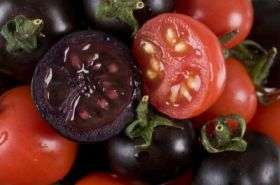
October 26, 2008 Purple Tomatoes (Cut)

Enlarge

Purple, high anthocyanin tomatoes and red wild-type tomatoes. Credit: John Innes Centre

Researchers from the John Innes Centre in Norwich, Great Britain, in collaboration with other European centres participating to the FLORA project, have obtained genetically modified tomatoes rich in anthocyanins, a category of antioxidants belonging to the class of flavonoids. These tomatoes, added to the diet of cancer-prone mice, showed a significant protective effect by extending the mice lifespan. The research has been published in the 26 October issue of Nature Biotechnology.

It is a remarkable step ahead in the study on antioxidants, particularly flavonoids, widely considered as a useful tool for preventing a large number of diseases, from cardiovascular disease to certain types of can-cer. The diet followed by the majority of people living in the Western world does not appear to be suffi-cient to guarantee an adequate intake of these substances, present in many fruits and vegetables such as berries. That is why the FLORA project aims at understanding their mechanisms trying to find new ways to increase their consumption.

Researchers from the John Innes Centre, coordinated by Cathie Martin, tried to step on it by putting on the lab bench a naturally anthocyanins-free product as tomato and engineering it to enhance its flavonoid content. In this way researchers have obtained an ideal model to study the effect of anthocyanins.

In order to obtain fruit particularly rich in anthocyanins, that has conferred a peculiar purple colour to the tomatoes, the British team has used two genes from the snapdragon flower: Delila and Rosea1. "Our insti-tute has a long standing interest in this plant that we use as a model to study flower development- says lead author Eugenio Butelli- The two genes we have isolated are responsible for flower pigmentation and, when introduced in other plants, turned out to be the perfect combination to produce anthocyanins, the same phytochemical found in blueberries. At a closer chemical analysis it comes out that our purple tomato has a very high antioxidant activity, almost tripled in comparison to the natural fruit thus it is very useful to study the effect of anthocyanins".

Subsequently, scientists have fed knockout mice lacking p53 gene, commonly known as the "genome guardian", with a powder obtained from purple tomatoes.

P53 is a key gene in the tumorigenesis process. Mice lacking p53 develop different types of tumours, es-pecially lymphomas and die at a very young age.

Mice used in the experiment have been divided into three groups, fed three different diets: the first one has received a standard diet, while the second group was fed diet supplemented with 10% powder from freeze-dried red tomatoes and the last one with 10% powder from purple tomatoes. "We have not re-corded significant differences between the first two groups- argues Marco Giorgio from the European In-stitute of Oncology who followed the experimental phase on mice- But mice fed with purple tomatoes showed a significant increase of lifespan". The last group has reported an average lifespan of 182 days in comparison to the 142 recorded for mice fed standard diet.

However promising results appear to be, researchers prefer to be pretty cautious. "Actually- Giorgio con-tinues- it is a pilot test, a preliminary study useful to validate the hypothesis of obtaining health benefits from diet supplementation with modified food. Although mice's lifespan has significantly increased once fed on purple tomatoes we still don't know how it works. It is not likely everything can be explained on antioxidants basis alone. Moreover, we have to consider that in this study we have not taken into account any possible toxicity so I shall say we're far from considering a human trial. Next step is to investigate the effect of purple tomatoes on different kinds of tumor models and define the mechanism of action".

Nevertheless, FLORA researchers do believe we may start to do something. "The study- says Cathie Mar-tin, FLORA project coordinator- confirms the latest research trends arguing that we can obtain significant beneficial effects by simple changes in our daily diet. We are not talking of pills or supplements but only food. It is worthy of notice that recommendations by worldwide governments risk to be unaccepted. The 5-a-day program promoted by the American National Cancer Institute 20 years ago does not seem to be very incisive and not just because of the lack of time. Financial crisis is giving an hand to the failure of good intentions mainly due to the expensive costs of fruits and vegetables. Research has to do something, has to find new ways to face the challenge. A solution may rely on concentrating in few but selected products the largest part of nutrients we should intake during the whole day".

Source: Catholic University


print this article email this article download pdf blog this article bookmark this article     Stumble it Digg this share on Facebook retweet share on Reddit add to delicious
Rate this story - 4.6 /5 (36 votes)

Rank Filter

Move the slider to adjust rank threshold, so that you can hide some of the comments.


Display comments: newest first

  • dirk_bruere - Oct 26, 2008
    • Rank: 2.5 / 5 (2)
    And not a single researcher took a small bite to see what it tasted like?
  • Soylent - Oct 26, 2008
    • Rank: 3 / 5 (2)
    And not a single researcher took a small bite to see what it tasted like?


    Anthocyanins are fairly big molecules; they may well have taste(salt, sour, bitter, sweet or umami) but I doubt they evaporate fast enough to have any significant aroma.
  • Duude - Oct 26, 2008
    • Rank: 3.5 / 5 (2)
    Europeans are the ones most complaining about genetically modified food. I suppose they believe it may be carcinogenic. So what's this about?
  • jeffsaunders - Oct 26, 2008
    • Rank: 2.5 / 5 (2)
    Here we go. Let us all live further from the land and create more varieties of food in smaller numbers.

    By that I mean we grow crops of modified food from things we have always had and let other things just go extinct.

    Project forward in time and we have a single crop coming in a variety of colours, flavours, textures and whatever medical and health requirements we decide on.

    It seems we can all be kept in the dark and fed on B.S indefinitely.
  • derricka - Oct 27, 2008
    • Rank: 3.5 / 5 (2)
    Some heirloom varieties of tomatoes, like the Black Prince or Purple Prince, have a natural purple color. Not sure if this is due to high levels of anthocyanins, but somehow, it wouldn't surprise me if scientists have genetically engineered in a trait that had been bred out ages ago-probably to make tomatoes "redder" and look more appealing to buyers. I ate a Purple Prince tomato once, and it had nearly twice the flavour of most supermarket tomatoes. Delicious but ugly.
  • Soylent - Oct 27, 2008
    • Rank: 1 / 5 (1)
    Europeans are the ones most complaining about genetically modified food. I suppose they believe it may be carcinogenic.


    No, some crazy, loud-mouthed "environmentalists" believe that somehow when you make purposeful and well understood changes to the genome of a plant it will turn into an evil frankensteins monster and Monsanto will enslave humanity.

    Which is ironic since they consider natural breeding and mutation breeding(with carcinogens or gamma rays to induce mutations) somehow safer or more predictable even though your just mucking about at random and selecting post-fact the most promising offspring for further breeding. You have no idea what changes where actually made (apart from size, colour and other obvious characteristics) or whether they are harmful to human health or the environment.

    The sterile seed issue is equally silly; much of the seedstock already produce plants with sterile seeds(due to the use of conventional non-GM hybridization techniques) and most farmers would never consider reusing last years seeds anyway because they want high quality seeds grown under tightly controlled conditions that can be guaranteed pest and disease free.
  • Lord_jag - Oct 27, 2008
    • Rank: 3.7 / 5 (3)
    Some heirloom varieties of tomatoes, like the Black Prince or Purple Prince, have a natural purple color. Not sure if this is due to high levels of anthocyanins, but somehow, it wouldn't surprise me if scientists have genetically engineered in a trait that had been bred out ages ago-probably to make tomatoes "redder" and look more appealing to buyers. I ate a Purple Prince tomato once, and it had nearly twice the flavour of most supermarket tomatoes. Delicious but ugly.


    Try eating ANY tomatoe that is vine ripened and it will have twice the flavor of the garbage-food they sell in supermarkets.

    The reason is the supermarkets pick tomatoes when they are VERY green and expect them to ripen on the way to the shelf. They never have a source of nutrients as they mature because they have already been picked.

    Get a planter pot and grow some tomatoes in a window. It will likely need support and will grow about 3 ft tall. Try one of those that ripen on the vine and you'll be shocked to find out what a tomatoe tastes like.

October 26, 2008 all stories

Comments: 7

4.6 /5 (36 votes)
  • Stumble this up

  • Digg this

  • share this

  • hide
  • Related Stories

  • GSU professor develops new method to help keep fruit, vegetables and flowers fresh
    created Oct 20, 2009 | popularity not rated yet | comments 0
  • Inflammation in colon may get doused before fueling cancer development
    created Feb 02, 2009 | popularity not rated yet | comments 0
  • Women double fruit, veggie intake with switch to Mediterranean diet plan
    created Dec 17, 2008 | popularity not rated yet | comments 0
  • Bugs put the heat in chili peppers
    created Aug 11, 2008 | popularity not rated yet | comments 0
  • Watermelon may have Viagra-effect
    created Jun 30, 2008 | popularity not rated yet | comments 0


Other News

Fish food fight: Fish don't eat trees after all, says new study

Fish food fight: Fish don't eat trees after all, says new study

Biology / Ecology

created 1hour ago | popularity not rated yet | comments 0

(PhysOrg.com) -- What constitutes fish food is a matter of debate. A high-profile study a few years ago suggested that fish get almost 50 percent of their carbon from trees and leaves, evidence for a very ...


Computational microscope peers into the working ribosome

Computational microscope peers into the working ribosome (w/ Video)

Biology / Cell & Microbiology

created 21 hours ago | popularity 4.9 / 5 (8) | comments 0

Two new studies reveal in unprecedented detail how the ribosome interacts with other molecules to assemble new proteins and guide them toward their destination in biological cells. The studies used molecular ...


New chameleon species discovered in East Africa

New chameleon species discovered in East Africa (w/ Podcast)

Biology / Plants & Animals

created 23 hours ago | popularity 5 / 5 (1) | comments 0

A new species of chameleon has been discovered in Tanzania by a team of scientists.


Spider secrets decoded in world-first database

Biology / Plants & Animals

created 16 hours ago | popularity not rated yet | comments 0

(PhysOrg.com) -- Queensland scientists have developed a world-first database that catalogues the venom components from hundreds of spiders.


A year after discovery, Congo's 'mother lode' of gorillas remains vulnerable

A year after discovery, Congo's 'mother lode' of gorillas remains vulnerable

Biology / Plants & Animals

created 19 hours ago | popularity 5 / 5 (1) | comments 0

A new study by the Wildlife Conservation Society says that western lowland gorillas living in a large swamp in the Republic of Congo—part of the "mother lode" of more than 125,000 gorillas discovered last ...