Solar System's Young Twin Has Two Asteroid Belts
October 27, 2008
Solar System's Young Twin Has Two Asteroid Belts

Enlarge

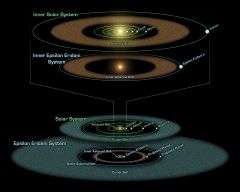
This artist´s diagram compares the Epsilon Eridani system to our own solar system. The two systems are structured similarly, and both host asteroids (brown), comets (blue) and planets (white dots). Epsilon Eridani´s inner asteroid belt is located at about the same position as ours, approximately three astronomical units from its star (an astronomical unit is the distance between Earth and the sun.). The system´s second, denser belt lies at about the same place where Uranus orbits in our solar system, or 20 astronomical units from the star. Epsilon Eridani is thought to have planets orbiting near the rims of its two belts. The first of these planets was identified in 2000 via the radial velocity technique. The second planet orbiting near the rim of the outer asteroid belt at 20 astronomical units was inferred when Spitzer discovered the belt. A third planet might orbit in Epsilon Eridani at the inner edge of its outermost comet ring, which lies between 35 and 90 astronomical units. This planet was first hinted at in 1998 due to observed lumpiness in the comet ring. Credit: NASA/JPL-Caltech

(PhysOrg.com) -- Astronomers have discovered that the nearby star Epsilon Eridani has two rocky asteroid belts and an outer icy ring, making it a triple-ring system. The inner asteroid belt is a virtual twin of the belt in our solar system, while the outer asteroid belt holds 20 times more material. Moreover, the presence of these three rings of material implies that unseen planets confine and shape them.

The star Epsilon Eridani is slightly smaller and cooler than the Sun. It is located about 10.5 light-years from Earth in the constellation Eridanus. (A light-year is the distance light travels in one year, or about 6 trillion miles.) Epsilon Eridani is the ninth closest star to the Sun and is visible to the unaided eye. It is also younger than the Sun, with an approximate age of 850 million years.

Epsilon Eridani and its planetary system show remarkable similarities to our solar system at a comparable age.

"Studying Epsilon Eridani is like having a time machine to look at our solar system when it was young," said Smithsonian astronomer Massimo Marengo (Harvard-Smithsonian Center for Astrophysics). Marengo is a co-author of the discovery paper, which will appear in the Jan. 10 issue of The Astrophysical Journal.

Lead author Dana Backman (SETI Institute) agreed, saying, "This system probably looks a lot like ours did when life first took root on Earth."

Our solar system has a rocky asteroid belt between Mars and Jupiter, about 3 astronomical units from the Sun. (An astronomical unit equals the average Earth-Sun distance of 93 million miles.) In total, it contains about 1/20 the mass of Earth's Moon. Using NASA's Spitzer Space Telescope, the team of astronomers found an identical asteroid belt orbiting Epsilon Eridani at a similar distance of 3 astronomical units.

They also discovered a second asteroid belt 20 astronomical units from Epsilon Eridani (about where Uranus is located in our solar system). The second asteroid belt contains about as much mass as Earth's Moon.

A third, icy ring of material seen previously extends about 35 to 100 astronomical units from Epsilon Eridani. A similar icy reservoir in our solar system is called the Kuiper Belt. However, Epsilon Eridani's outer ring holds about 100 times more material than ours.

When the Sun was 850 million years old, theorists calculate that our Kuiper Belt looked about the same as that of Epsilon Eridani. Since then, much of the Kuiper Belt material was swept away, some hurled out of the solar system and some sent plunging into the inner planets in an event called the Late Heavy Bombardment. (The Moon shows evidence of the Late Heavy Bombardment - giant craters that formed the lunar seas of lava called mare.) It is possible that Epsilon Eridani will undergo a similar dramatic clearing in the future.

"Epsilon Eridani looks a lot like the young solar system, so it's conceivable that it will evolve similarly," said Marengo.

The Spitzer data show gaps between each of the three rings surrounding Epsilon Eridani. Such gaps are best explained by the presence of planets that gravitationally mold the rings, just as the moons of Saturn constrain its rings.

"Planets are the easiest way to explain what we're seeing," stated Marengo.

Specifically, three planets with masses between those of Neptune and Jupiter would fit the observations nicely. A candidate planet near the innermost ring already has been detected by radial velocity studies. Those studies suggested that it orbited Epsilon Eridani on a highly elliptical path, characterized by an eccentricity of 0.7. The new finding rules out such an orbit, because the planet would have cleared out the inner asteroid belt long ago through gravitational disruption.

A second planet must lurk near the second asteroid belt, and a third at about 35 astronomical units near the inner edge of Epsilon Eridani's Kuiper Belt. Future studies may detect these currently unseen worlds, as well as any terrestrial planets that may orbit inside the innermost asteroid belt.

Provided by Harvard-Smithsonian Center for Astrophysics

4.4 /5 (35 votes)  

Filter


Move the slider to adjust rank threshold, so that you can hide some of the comments.


Display comments: newest first

yyz
Oct 27, 2008

Rank: 4.7 / 5 (3)
Epsilon Eridani's young stellar age is also accompanied by a faster rotation, more of a variable flare and magnetospheric activity and a mass loss 30-fold our own Sol, resulting in an astrosphere extending 8000 AU from the star and a bow shock extending 1800 AU from the primary resulting in an apparent size of 42 arcminutes from a planet orbiting at Earths' distance from our sun (1 AU ). Wikipedia has a thorough and extensive listing of the Epsilon Eridani system athttp://en.wikiped...Eridani. Clearly many similarities exist between our solar system & Epsilon Eri, although many differences also exist between the two stellar systems.
yyz
Oct 27, 2008

Rank: not rated yet
Try the Wiki link at http://en.wikiped..._Eridani for detailed info on this system.
Quantum_Conundrum
Oct 27, 2008

Rank: 4.3 / 5 (3)
Excellent candidate for the first space probes powered by nuclear or anti-matter drives.
yyz
Oct 28, 2008

Rank: not rated yet
The full paper by D. Bachman et can be found posted at the arXiv.org site for Oct. 28, 2008 @arXiv:0810.4564.Detailed info gleaned by Spitzer and the California Submillimeter Observatory (CSO)on the Epsilon Eridani system can be found here.
Rank 4.4 /5 (35 votes)
Related Stories
Relevant PhysicsForums posts
  • Titan's lack of impact craters
    createdFeb 09, 2012
  • Real pictures of black hole eating a star?
    createdFeb 08, 2012
  • Hypothetical way to travel faster than light, but not technically exceed lightspeed
    createdFeb 06, 2012
  • How do scientists monitor the Sun's activity?
    createdFeb 05, 2012
  • Search patterns in observational studies
    createdFeb 05, 2012
  • Derivation of Pogson's law
    createdFeb 03, 2012
  • More from Physics Forums - General Astronomy

More news stories

Humans may have helped the decline of African rainforests 3000 years ago

(PhysOrg.com) -- Large areas of rainforests in Central Africa mysteriously disappeared over three thousand years ago, to be replaced by savannas. The prevailing theory has been that the cause was a change ...

Space & Earth / Environment

created 11 hours ago | popularity 5 / 5 (4) | comments 10 | with audio podcast report

Could Venus be shifting gear?

(PhysOrg.com) -- ESA’s Venus Express spacecraft has discovered that our cloud-covered neighbour spins a little slower than previously measured. Peering through the dense atmosphere in the infrared, the ...

Space & Earth / Space Exploration

created 7 hours ago | popularity 5 / 5 (5) | comments 7 | with audio podcast

Mars Science Laboratory computer issue resolved

(PhysOrg.com) -- Engineers have found the root cause of a computer reset that occurred two months ago on NASA's Mars Science Laboratory and have determined how to correct it.

Space & Earth / Space Exploration

created 8 hours ago | popularity 5 / 5 (5) | comments 3 | with audio podcast

Clam fields found at deep, low-temperature Mariana vents

(PhysOrg.com) -- Scientists have marveled at the unusual life forms thriving at high temperature hydrothermal vents of the deep ocean.

Space & Earth / Earth Sciences

created 7 hours ago | popularity not rated yet | comments 0 | with audio podcast

Two new moons for Jupiter

Advances in technology have lead to the discovery of new planets outside of our Solar System, and now even new moons in our own backyard.

Space & Earth / Space Exploration

created 7 hours ago | popularity not rated yet | comments 5


Complex wiring of the nervous system may rely on a just a handful of genes and proteins

Researchers at the Salk Institute have discovered a startling feature of early brain development that helps to explain how complex neuron wiring patterns are programmed using just a handful of critical genes. ...

CIA website offline, Anonymous takes credit

The website of the Central Intelligence Agency was unresponsive on Friday after the hacker group Anonymous claimed to have knocked it offline.

Q&A: Obama and the birth control controversy

(AP) -- What birth control debate? A half-century after the introduction of the pill, acceptance of birth control by American women is virtually universal.

The power of estrogen -- male snakes attract other males

A new study has shown that boosting the estrogen levels of male garter snakes causes them to secrete the same pheromones that females use to attract suitors, and turned the males into just about the sexiest ...

New error-correcting codes guarantee the fastest possible rate of data transmission

Error-correcting codes are one of the triumphs of the digital age. They’re a way of encoding information so that it can be transmitted across a communication channel — such as an optical fiber o ...

Both maternal and paternal age linked to autism

Older maternal and paternal age are jointly associated with having a child with autism, according to a recently published study led by researchers at The University of Texas Health Science Center at Houston (UTHealth).