Earthworm activity can alter forests' carbon-carrying capabilities
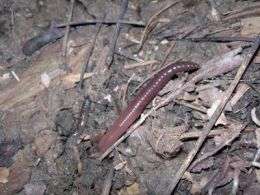
Earthworms can change the chemical nature of the carbon in North American forest litter and soils, potentially affecting the amount of carbon stored in forests, according to Purdue University researchers.
The Purdue scientists, along with collaborators from the Smithsonian Institution and Johns Hopkins University, study the habits of earthworms originally brought to North America from Europe. They want to determine the earthworms' effect on forest chemistry by comparing carbon composition in forests that vary in earthworm activity.
Some earthworms eat fallen leaves and other plant material - the litter of the forest floor - while others eat roots or soil organic matter. This begins a decomposition process in which organic materials pass through the animals' digestive tracts and back into the soil.
The research team found that forests with greater numbers of invasive earthworms tend to have litter and soil organic matter enriched in the plant material lignin, which is typically harder for bacteria to decompose, said Purdue biogeochemist Timothy Filley. Sites with low numbers of these earthworms accumulate plant carbon in forms more easily degraded by bacteria.
Overall, the amount of carbon in the litter and duff layer, which is the surface mat of decaying organic matter and roots, decreases because of earthworm activity. However, the change in carbon chemistry may make it harder for soil organisms to decompose the carbon remains. After earthworms feed on forest litter, they take the carbon down into the soil and mix it in, potentially leading to a buildup of carbon in the soil.
"If the litter just stays on the surface of the soil, then it's likely that normal oxidation of organic matter happens and a lot of that carbon will just go into the atmosphere," said Cliff Johnston, a Purdue environmental chemist and professor of agronomy. "However, if carbon can bind to the soil particles, such as clay, it might be a long-term way of stabilizing carbon."
Another way earthworm activity may affect the fate of carbon and the environment is in the thickness of layers of leaves and debris left on forest floors. Bare soil is generally very dark, absorbing more sunlight, which may dry it out quickly. A layer of lightly colored leaves is moderately reflective and holds moisture near the soil. Either condition may affect factors such as the warming of forest soil and the timing of snowmelt.
"Ultimately, we will look at such things to determine the potential invasive earthworms have in changing the flux of CO2 out of the forest and how much that could impact climate change," said Filley, who also is an associate professor of earth and atmospheric sciences.
The earthworms that the team studies were brought to North America by early European colonists, probably in the ships' ballasts or in plant soil. In northern North American forests the settlers found land devoid of such creatures because the worms never reoccupied soils formed when the glaciers melted.
In addition, earthworms don't move very fast. It's estimated they have migrated under their own power only about 100-200 kilometers in the past 10,000 years since the glaciers.
"In some forests, such as ones we are working at in northern Minnesota, we find soils where earthworms are only now being introduced." Filley said. "The main agents of introduction in such areas are discarded fishing bait in nearby lakes, transport between forest sites in tire treads and the movement of soil."
The research team reported findings of their ongoing study in a recent issue of the Journal of Geophysical Research. The National Science Foundation has provided funds to continue the work.
For this study, Filley, Johnston and their collaborators monitor earthworm activity at the Smithsonian Environmental Research Center forest area in Maryland. The scientists set up plots in which they manipulate the amount of litter on the ground and watch how fast the worms remove it.
In some areas of the forest, more than 350 worms can be found in one square meter.
"The impact of that many worms is huge for the forest ecosystem as from spring to fall they actively consume litter and mix it into the soil, leaving only a bare surface by year's end." Filley said.
In contrast, sites that have no earthworms have many years of accumulated litter and organic matter above the soil. This has implications for plant seed germination, water holding capacity and infiltration of the forest floor, among other things.
"The earthworms fundamentally change how the microbial community is decomposing," Filley said. "When they eat roots, they also eat other organisms that help to distribute nutrients between plants. Worms may throw off the timing of nutrient delivery."
Source: Purdue University


