First images of barnacle larva's footprint
October 27, 2008 First images of barnacle larva's footprint

Enlarge

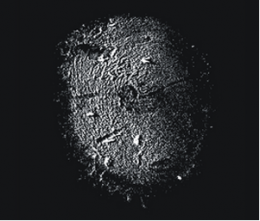
The footprint of the barnacle cyprid larva of approximately 30 micrometre, revealed by an Atomic Force Microscope.

(PhysOrg.com) -- The fouling or growth of sea organisms, such as barnacles, on ships’ hulls causes damage costing many billions of euros annually. In order to prevent this fouling, In Yee Phang of the University of Twente (Netherlands) used nanotechnology to investigate how barnacles colonize a surface. This is the first time that the existence of barnacle cyprid larvae ‘footprints’ has been demonstrated. Phang will be awarded his doctorate on 24 October at the faculty of Science and Technology.

In order to be able to prevent barnacle adhesion to ships, we have to know how they attach themselves to surfaces. In Yee Phang therefore investigated the colonization process of barnacles. This process begins in the early stages of development when the larvae are still able to move freely.

Barnacle larvae are about a half a millimetre in size and do not yet have a shell. They can swim, but they can also move over a surface. They do so by temporarily clamping themselves to the surface in question by exuding a sticky substance, a sort of protein-based biological cement. The mark left by this cement on a surface is known as a ‘footprint’. This footprint contains chemical substances that attract other larvae. The first footprint on a surface is therefore the first step in the colonization of the surface concerned.

Scientists have suspected the existence of a larval footprint for some time, but this had not yet been directly demonstrated. Using nanotechnology, Phang was able to reveal footprints measuring approximately 30 micrometre for the first time. He achieved this using an Atomic Force Microscope (AFM). This is a microscope that explores a surface and ascertains differences in height with a miniscule needle. Not only does this enable one to observe extremely small objects, but this research can also be carried out in the original environment, in this case, seawater.

Barnacles are hermaphroditic animals that are about a centimetre in size with a calcium carbonate skeleton that looks like a shell. They anchor themselves to surfaces just like mussels. The adhesion of barnacles to ships’ hulls causes damage costing many billions of euros annually. The shells increase the friction between the hull and water so that the ship uses more fuel. Furthermore, it is difficult, and consequently expensive, to remove the shells from ships’ hulls.

Provided by University of Twente


print this article email this article download pdf blog this article bookmark this article     Stumble it Digg this share on Facebook retweet share on Reddit add to delicious
Rate this story - 3.6 /5 (5 votes)

Rank Filter

Move the slider to adjust rank threshold, so that you can hide some of the comments.


Display comments: newest first

  • cowfy - Oct 28, 2008
    • Rank: not rated yet
    yee phang solvng ye old sea problem.

October 27, 2008 all stories

Comments: 1

3.6 /5 (5 votes)
  • Stumble this up

  • Digg this

  • share this

  • hide
  • Related Stories

  • Janus particles: particles with two faces
    created Sep 18, 2009 | popularity not rated yet | comments 0
  • Seaglider sets new underwater endurance and range records
    created Sep 10, 2009 | popularity not rated yet | comments 0
  • Scientists find 'great Pacific Ocean garbage patch'
    created Aug 27, 2009 | popularity not rated yet | comments 0
  • Autonomous underwater robot reduces ship fuel consumption (w/ Video)
    created Aug 24, 2009 | popularity not rated yet | comments 0
  • Trans-Atlantic Glider Passes Spot Where Predecessor Sank
    created Aug 03, 2009 | popularity not rated yet | comments 0


  • hide
  • Relevant PhysicsForums posts

  • Mass of blood cells
    created 11 hours ago
  • Are human beings done evolving?
    created 11 hours ago
  • Glucose effectiveness and insulin sensitivity
    created Dec 02, 2009
  • Conflict about classifying Protist?
    created Dec 01, 2009
  • More from Physics Forums - Biology

Other News

Single-atom transistor discovered

Scientists build 'single-atom transistor'

Nanotechnology / Nanophysics

created 17 hours ago | popularity 5 / 5 (24) | comments 2

(PhysOrg.com) -- Researchers from Helsinki University of Technology (Finland), University of New South Wales (Australia), and University of Melbourne (Australia) have succeeded in building a working transistor, ...


A window that washes itself?

A (nano-) window that washes itself?

Nanotechnology / Nanomaterials

created Dec 03, 2009 | popularity 4.5 / 5 (8) | comments 8

A coating on windows or solar panels that repels grime and dirt? Expanded battery storage capacities for the next electric car? New Tel Aviv University research, just published in Nature Nanotechnology, detail ...


Snowman

Scientists Create World's Smallest Snowman (w/ Video)

Nanotechnology / Nanophysics

created Dec 04, 2009 | popularity 3.5 / 5 (17) | comments 5

(PhysOrg.com) -- David Cox, a scientist in the Quantum Detection group at the National Physical Laboratory in the UK, is an expert in nanofabrication techniques. Recently, using the tools of his trade and ...


Lasers used to make first boron-nitride nanotube yarn

Lasers used to make first boron-nitride nanotube yarn (w/ Video)

Nanotechnology / Nanomaterials

created Dec 02, 2009 | popularity 4.8 / 5 (13) | comments 2

(PhysOrg.com) -- Researchers have used lasers to create the first practical macroscopic yarns from boron nitride fibers, opening the door for an array of applications, from radiation-shielded spacecraft to ...


Researchers Design Triple Quantum Dot for Quantum Information Applications

Researchers Design Triple Quantum Dot for Quantum Information Applications

Nanotechnology / Nanophysics

created Nov 30, 2009 | popularity 4.7 / 5 (17) | comments 0

(PhysOrg.com) -- While quantum dots have existed since the 1980s, only in the past decade have physicists successfully created lateral few-electron single quantum dots. These quantum dots enable physicists ...