'Digital dark age' may doom some data
October 27, 2008
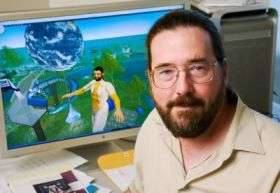
Jerome P. McDonough says an unintended consequence of our rapidly digitizing world is the potential of a "digital dark age." Photo by L. Brian Stauffer, U. of I. News Bureau
What stands a better chance of surviving 50 years from now, a framed photograph or a 10-megabyte digital photo file on your computer's hard drive?
The framed photograph will inevitably fade and yellow over time, but the digital photo file may be unreadable to future computers – an unintended consequence of our rapidly digitizing world that may ultimately lead to a "digital dark age," says Jerome P. McDonough, assistant professor in the Graduate School of Library and Information Science at the University of Illinois at Urbana-Champaign.
According to McDonough, the issue of a looming digital dark age originates from the mass of data spawned by our ever-growing information economy – at last count, 369 exabytes worth of data, including electronic records, tax files, e-mail, music and photos, for starters. (An exabyte is 1 quintillion bytes; a quintillion is the number 1 followed by 18 zeroes.)
The concern for archivists and information scientists like McDonough is that, with ever-shifting platforms and file formats, much of the data we produce today could eventually fall into a black hole of inaccessibility.
"If we can't keep today's information alive for future generations," McDonough said, "we will lose a lot of our culture."
Contrary to popular belief, electronic data has proven to be much more ephemeral than books, journals or pieces of plastic art. After all, when was the last time you opened a WordPerfect file or tried to read an 8-inch floppy disk?
"Even over the course of 10 years, you can have a rapid enough evolution in the ways people store digital information and the programs they use to access it that file formats can fall out of date," McDonough said.
Magnetic tape, which stores most of the world's computer backups, can degrade within a decade. According to the National Archives Web site by the mid-1970s, only two machines could read the data from the 1960 U.S. Census: One was in Japan, the other in the Smithsonian Institution. Some of the data collected from NASA's 1976 Viking landing on Mars is unreadable and lost forever.
From a cultural perspective, McDonough said there's a "huge amount" of content that's only being developed or is available in a digital-only format.
"E-mail is a classic example of that," he said. "It runs both the modern business world and government. If that information is lost, you've lost the archive of what has actually happened in the modern world. We've seen a couple of examples of this so far."
McDonough cited the missing White House e-mail archive from the run-up to the Iraq War, a violation of the Presidential Records Act.
"With the current state of the technology, data is vulnerable to both accidental and deliberate erasure," he said. "What we would like to see is an environment where we can make sure that data does not die due to accidents, malicious intent or even benign neglect."
McDonough also cited Barack Obama's political advertising inside the latest editions of the popular videogames "Burnout Paradise" and "NBA Live" as an example of something that ought to be preserved for future generations but could possibly be lost because of the proprietary nature of videogames and videogame platforms.
"It's not a matter of just preserving the game itself. There are whole parts of popular and political culture that we won't be able to preserve if we can't preserve what's going on inside the gaming world."
McDonough believes there would also be an economic effect to the loss of data from a digital dark age.
"We would essentially be burning money because we would lose the huge economic investment libraries and archives have made digitizing materials to make them accessible," he said. "Governments are likewise investing huge sums to make documents available to the public in electronic form."
To avoid a digital dark age, McDonough says that we need to figure out the best way to keep valuable data alive and accessible by using a multi-prong approach of migrating data to new formats, devising methods of getting old software to work on existing platforms, using open-source file formats and software, and creating data that's "media-independent."
"Reliance on open standards is certainly a huge part, but it's not the only part," he said. "If we want information to survive, we really need to avoid formats that depend on a particular media type. Commercial DVDs that employ protection schemes make it impossible for libraries to legally transfer the content to new media. When the old media dies, the information dies with it."
Enthusiasm for switching from proprietary software such as Microsoft's Office suite to open-source software such as OpenOffice has only recently begun to gather momentum outside of information technology circles.
"Software companies have seen the benefits of locking people into a platform and have been very resistant to change," McDonough said. "Now we are actually starting to see some market mandates in the open direction."
McDonough cites Brazil, the Netherlands and Norway as examples of countries that have mandated the use of non-proprietary file formats for government business.
"There has been quite a movement, particularly among governments, to say: 'We're not going to buy software that uses proprietary file formats exclusively. You're going to have to provide an open format so we can escape from the platform,' " he said. "With that market demand, you really did see some more pressure on vendors to move to something open."
Source: University of Illinois at Urbana-Champaign
-
Will Facebook deliver an IPO surprise?
17 hours ago |
2 / 5 (5) |
2
-
Brain capacity limits exponential online data growth
8 hours ago |
1 / 5 (1) |
5
-
Matching fans to music tops record industry agenda
5 hours ago |
not rated yet |
0
-
Harnessing the predictive power of virtual communities
Jan 30, 2012 |
5 / 5 (1) |
1
-
Investors clamor for Facebook's IPO
Jan 27, 2012 |
5 / 5 (3) |
0
-
Engineers build first sub-10-nm carbon nanotube transistor
Feb 01, 2012 |
4.9 / 5 (29) |
30
-
Something old, something new: Evolution and the structural divergence of duplicate genes
Jan 31, 2012 |
4.6 / 5 (7) |
1
-
The hidden nanoworld of ice crystals: Revealing the dynamic behavior of quasi-liquid layers
Jan 30, 2012 |
5 / 5 (3) |
1
-
Stock market network reveals investor clustering
Jan 27, 2012 |
4 / 5 (22) |
8
-
Of microchemistry and molecules: Electronic microfluidic device synthesizes biocompatible probes
Jan 26, 2012 |
5 / 5 (1) |
0
-
Strange indexing in Fortran Code
6 hours ago
-
Car Port post load calculation
7 hours ago
-
attempting to spin-cast parabola
18 hours ago
-
Flow around a reducing bend - effect on pumping work
Feb 06, 2012
-
Formula for deflection of 6061 T6 hollow tube, please help.
Feb 06, 2012
-
Help to make a Unit Hydrograph of Reservoir Level - Storage Curve for a Dam
Feb 06, 2012
- More from Physics Forums - General Engineering
More news stories
2.1 million viewers live stream Super Bowl online
(AP) -- The first live stream of the Super Bowl drew 2.1 million unique viewers, NBC said Thursday.
25 minutes ago |
not rated yet |
0
Japan electronic giants eye chip merger: reports
Three of Japan's biggest electronics companies are to join forces in a chip-making venture, according to reports, days after a swathe of dire results from a sector struggling to compete globally.
3 minutes ago |
not rated yet |
0
Baseball legend fields fantasy world video game
Electronic Arts has released a much-anticipated "Kingdoms of Amalur: Reckoning" video game created by an all-star team put together by World Series champion pitcher Curt Schilling.
19 minutes ago |
not rated yet |
0
Taiwan's Acer sues ex-CEO over Lenovo job
Taiwan's leading personal computer maker Acer said Wednesday it has filed a lawsuit against former chief executive Gianfranco Lanci after he joined Chinese rival Lenovo.
15 minutes ago |
not rated yet |
0
Brazil files suits against Twitter on police traps
The Brazilian government has filed a lawsuit against Twitter and its users in a bid to stop publication of messages alerting drivers to police speed traps and drunk-driving checkpoints.
13 minutes ago |
not rated yet |
0
Scared of a younger rival? Not for some male songbirds
When mature male white-crowned sparrows duel to win a mate or a nesting territory, a young bird just doesn't get much respect.
Tiny primate 'talks' in ultrasound
One of the world's smallest primates, the Philippine tarsier, communicates in a range of ultrasound inaudible to predator and prey alike, according to a study published on Wednesday.
Playing school sports affects youths' smoking
Young people's choices about using drugs and alcohol are influenced by peersnot only close friends, but also sports teammates. A new study of middle schoolers and their social networks has found that teammates' smoking ...
New study: Adolescents suffering from depression more likely to be bullied
A new study provides evidence that adolescents who suffer from depression are more likely to develop difficulty in peer relationships including being bullied at school.
Preventing bacteria from falling in with the wrong crowd could help stop gum disease
Stripping some mouth bacteria of their access key to gangs of other pathogenic oral bacteria could help prevent gum disease and tooth loss. The study, published in the journal Microbiology suggests that t ...
New study sheds light on genetics of rice metabolism
A large-scale study analyzing metabolic compounds in rice grains conducted by researchers at the RIKEN Plant Science Center (PSC) and their collaborators has identified 131 rice metabolites and clarified the ...
Oct 27, 2008
Rank: 4.4 / 5 (5)
on acid-based paper which will fall
apart in 50 years. Films-same problem.
CDs-ditto. Nothing lasts forever.
Oct 27, 2008
Rank: 2 / 5 (3)
Oct 28, 2008
Rank: 1.7 / 5 (3)
Oct 28, 2008
Rank: 2.1 / 5 (9)
The only way you can store information throughout generations is to pass it along verbally from one generation to the next. The human brain is the one medium which will NOT change.
Finally, and here's a sobering fact...the only written history which has survived for thousands and thousands of years was transcribed by cavemen!
Oct 28, 2008
Rank: 3.8 / 5 (8)
369 exabytes... what nonsense. How many of that is the 2 billion copies of Windows that every computer comes installed with? I'll bet if you look at original data, and delete all the copies you'd likely bring that down quite considerably.
All you'd need is a million people with a Terabyte drive and you'd store all that info copied twice over again!
I worked for a place that had data on 3 1/2" magnetic tapes. We hired a highschool student to read all the tapes and copy the data onto a hard drive. After 8 months of work, he finished and all the data barely filled a CD-ROM. In a few years it will be copied to a blue ray, with a lot of other disks, and will probably never have been looked at.
Oct 28, 2008
Rank: 4.3 / 5 (3)
Even if we managed to keep all human data electronically, we still have to maintain it in a way that allows us to take it with us through time. Not only that, we have to store it in a way that is invulnerable to disasters, both man-made or natural. Much of the data from the past was lost because the storage media was either frail, or susceptible to disasters or war. And as advanced as we perceive ourselves to be, our information is still vulnerable to these factors. If, heaven forbid, a catastrophic new disease were to begin spreading tomorrow morning that quickly takes out most of mankind in a global pandemic, most of our data will eventually disappear. In the ensuing panic and chaos, the survivors will neglect to secure our history and knowledge for the sake of survival. Most of our digitized electronic data would eventually corrode due to neglect and many of our books of knowledge and technology would become useless because there would be few left who could understand and use any of it or even to secure it. Society's most knowledgeable people tend to be older ones, and these are among the less resilient to disease. Doctors and medical experts would be at the front line of such a disaster and most would become casualties early on. In the end, what we would likely have is a smaller, younger,less knowledgeable population more concerned about individual survival than preserving the data needed to continue to advance our civilization. And there would be few left who are capable of teaching any of it to anyone.
I know it sounds bleak, but i think its important that we realize just how vulnerable our way of life is to catastrophe as long as we remain incapable of securing our knowledge data against absolutely anything that can cause the human race to stumble and fall. As long as the burden of advancement of humankind remains with a small minority of highly educated people across the globe, the human race will be absolutely vulnerable to massive data losses in the face of a major global disaster unless we develop some real protection against this possibility.
Oct 28, 2008
Rank: 4 / 5 (4)
Oct 28, 2008
Rank: 4.5 / 5 (2)
Oct 29, 2008
Rank: 4.5 / 5 (2)
Not exactly. There is the Bible, there is egyptian writings in their various temples, cities, and pyramids. There is various clay tablets and scrolls from the ancient world.
People always use the word "Caveman" in a derogatory way.
Well, lets take your typical "caveman" from 5 thousand years ago, and set him down in the Amazon rain forest...
Then lets take any one of you people reading this thread, and do the same to you.
See who survives...
I'll put one dollar on the caveman.
Oct 29, 2008
Rank: 5 / 5 (4)
On stone tablets.
Oct 30, 2008
Rank: 3 / 5 (1)
The drawings on cave-walls are still viewable to this day, and depict daily life for those who created them...unlike the Bible, whose content has been skewed by the different religions "du jour". And that is really the point, that we need a way to store information in a way that cannot be modified, but which can be read by anybody with eyes.
Stone tablets seem to fit that bill, for the time being anyways :)