New Process Promises Bigger, Better Diamond Crystals
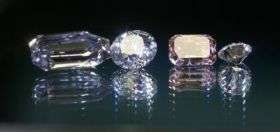
(PhysOrg.com) -- Researchers at the Carnegie Institution have developed a new technique for improving the properties of diamonds—not only adding sparkle to gemstones, but also simplifying the process of making high-quality diamond for scalpel blades, electronic components, even quantum computers. The results are published in the October 27-31 online edition of the Proceedings of the National Academies of Science.
A diamond may be forever, but the very qualities that make it a superior material for many purposes—its hardness, optical clarity, and resistance to chemicals, radiation, and electrical fields― can also make it a difficult substance with which to work. Defects can be purged by a heating process called annealing, but this can turn diamond to graphite, the soft, grey form of carbon used in pencil leads. To prevent graphitization, diamond treatments have previously required high pressures (up to 60,000 times atmospheric pressure) during annealing, but high pressure/high temperature annealing is expensive and there are limits on the size and quantities of diamonds that can be treated.
Yu-fei Meng, Chih-shiue Yan, Joseph Lai, Szczesny Krasnicki, Haiyun Shu, Thomas Yu, Qi Liang, Ho-kwang Mao, and Russell Hemley of the Carnegie Institution's Geophysical Laboratory used a method called chemical vapor deposition (CVD) to grow synthetic diamonds for their experiments. Unlike other methods, which mimic the high pressures deep within the earth where natural diamonds are formed, the CVD method produces single-crystal diamonds at low pressure. The resulting diamonds, which can be grown very rapidly, have precisely controlled compositions and comparatively few defects.
The Carnegie team then annealed the diamonds at temperatures up to 2000° C using a microwave plasma at pressures below atmospheric pressure. The crystals, which are originally yellow-brown if produced at very high growth rates, turned colorless or light pink. Despite the absence of stabilizing pressure there was minimal graphitization. Using analytical methods such as photoluminescence and absorption spectroscopy, the researchers were also able to identify the specific crystal defects that caused the color changes. In particular, the rosy pink color is produced by structures called nitrogen-vacancy (NV) centers, where a nitrogen atom takes the place of a carbon atom at a position in the crystal lattice next to a vacant site..
"This low-pressure/high-temperature annealing enhances the optical properties of this rapid-grown CVD single crystal diamond." says Meng. "We see a significant decrease in the amount of light absorbed across the spectrum from ultraviolet to visible and infrared. We were also able to determine that the decrease arises from the changes in defect structure associated with hydrogen atoms incorporated in the crystal lattice during CVD growth."
"It is striking to see brown CVD diamonds transformed by this cost-efficient method into clear, pink-tinted crystals," says Yan. And because the researchers pinpointed the cause of the color changes in their diamonds, "Our work may also help the gem industry to distinguish natural from synthetic diamond."
"The most exciting aspect of this new annealing process is the unlimited size of the crystals that can be treated. The breakthrough will allow us to push to kilocarat diamonds of high optical quality" says coauthor Ho-kwang Mao. Because the method does not require a high pressure press, it promises faster processing of diamonds and more types of diamonds to be de-colored than current high-pressure annealing methods. There is also no restriction on the size of crystals or the number of crystals, because the method is not limited by the chamber size of a high pressure press. The microwave unit is also significantly less expensive than a large high-pressure apparatus.
"The optimized process will produce better diamond for new-generation high pressure devices and window materials with improved optical properties in the ultraviolet to infrared range." concludes laboratory director Russell Hemley. "It has the advantage of being applicable in CVD reactors as a subsequent treatment after growth."
The high-quality, single crystal diamond made possible by the new process has a wide variety of applications in science and technology, such as the use of diamond crystals as anvils in high-pressure research and in optical applications that take advantage of diamond's exceptional transparency. Among the more exotic future applications of the pink diamonds made in this way is quantum computing, which could use the diamonds' NV centers for storing quantum information.
Source: Carnegie Institution


