Inland ants prefer salty snacks to sweet
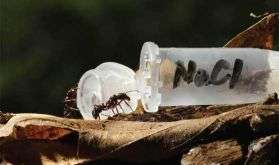
(PhysOrg.com) -- Ants prefer salty snacks to sugary ones, at least in inland areas that tend to be salt-poor, according to a new study published this week in the journal Proceedings of the National Academy of Sciences.
Ecologists from the University of California, Berkeley, the University of Arkansas at Little Rock (UALR) and the University of Oklahoma tested the salt versus sugar preferences of ants from North, Central and South America, using ant populations at varying distances from the ocean. While ocean spray and storms can spread salt tens of miles from the coast, areas farther inland are often deprived of salt, and the researchers suspected they might find different taste choices between coastal and inland ants.
In fact, they found that ants living more than 60 miles inland often preferred a 1 percent salt solution over a sugar solution 10 times more concentrated. This was true primarily for plant-eating ants, however. Carnivorous ants, such as fire ants, apparently get enough salt from their prey. For similar reasons, grazing animals such as bison and deer seek out salt licks to complement their salt-poor vegetarian diet, while carnivores like mountain lions and wolves get all the salt they need from bloody meat.
"Attractiveness to salt increases with distance from the ocean," said co-author Robert Dudley, UC Berkeley professor of integrative biology. "It's really fascinating that we see a pattern on this grand, continental scale."
"Ants will always go for the sugar because they need sugar to provide the basic energy for life and for their activity," said co-author Steve Yanoviak, an assistant professor of biology at UALR. "But when you see ants spending increasing amounts of time or employing increasingly large numbers of individuals foraging for salt, it suggests that salt is a resource that is limiting to them. Their ability to be competitive and maintain themselves in different environments could be limited by a resource like salt."
What holds true for ants may well be true of all insects and even microbes, the researchers argue, pointing to a role for salt, or sodium chloride, in the ecosystem that has not been recognized before.
"One implication of this study is that even basic ecosystem processes, like the whole carbon cycle, may be influenced by the availability of sodium," said ant ecologist and lead author Michael E. Kaspari of the University of Oklahoma in Norman. "If you want to have a nice lawn or grow vegetables, you add the big-three nutrients: nitrogen, phosphorous and potassium. Salt is almost like fertilizer for animals."
Kaspari plans to test whether spraying salt on the litter of the forest floor cranks up ecosystem activity and decomposition, releasing more carbon dioxide, in the same way salty Gatorade improves the performance of sports teams.
Dudley, Yanoviak and Kaspari instigated the study after spending several "intolerable" days doing research on insects in the treetops of Peru, near the headwaters of the Amazon River and far from the Pacific Ocean - an area that contrasts starkly with the relatively pest-free treetop conditions in Panama, where no place is more than 25 kilometers from the ocean. The three researchers were tossing ants from the tree canopy to study the insects' ability to glide.
"We were working up in the trees in the Western Amazon on hot, still days, and tiny sweat bees were swarming all around and flying up our noses, something I hadn't noticed in Panama," he said. "Why were there so many?"
Because ants are easier to study than bees, Kaspari designed a "cafeteria experiment" that offered ants a choice between salt and sugar. The researchers tested not only Peruvian and Panamanian ants, but also ants from Costa Rica, Arkansas, Oklahoma, Arizona and Florida. In all, they conducted experiments at 17 sites, ranging from rainforest trails in the Amazon to Kaspari's front yard.
"What makes this experiment so elegant is Mike's simple design: fill up vials with sugar or salt and drop them along the trail in the forest," Yanoviak said. "What we didn't realize was how tiring it is to bend over and pick up more than a hundred vials."
By merely counting the ant species attracted to cotton balls soaked in salt or sucrose (table sugar) solutions, they discovered that herbivorous or omnivorous species more than 10-100 kilometers (6-60 miles) from the ocean preferred salt over sugar, and the farther inland, the greater the preference for salt. Ants living mostly on green vegetation had a greater preference for salt than did those living among the decaying leaves of the forest floor, while carnivorous ants had little preference for salt over sugar.
Activity at sugar baits was highest between 10 and 100 kilometers from the shore, suggesting that this near-coastal belt may be a sweet spot for animals with "just enough salt to meet requirements, but not enough to be toxic or inhibit the plants they feed on," Kaspari said.
Animals' need for salt stems from the high sodium concentrations needed to maintain the body's nerve and muscle activity and water balance, Dudley said. Animal blood and fluids, including those of humans, are 100 to 1,000 times saltier than the average salt concentration - 1 milligram of sodium per kilogram of weight - in terrestrial plants.
Meat eaters get adequate salt in the diet, but animals that rely primarily on plants for food must seek out environmental sources: human settlements have historically been near supplies of salt; grazing animals require natural or human-supplied salt licks; gorillas look for salt in decaying logs; butterflies cluster around evaporating pools of urine to obtain salt; and some crickets are known to cannibalize their brethren for salt.
Similarly, carnivorous ants appear to get sufficient salt from their diet of termites, mites and other forest-floor creatures. Those in the genus Formica, however, which feed on pollen, nectar and plant exudates, show increased attraction to salt with increasing distance from the ocean. In Oklahoma, Kaspari found that carpenter ants preferred sodium chloride over sugar; in Peru and Panama, the gliding ants in the genus Cephalotes showed increasing preference for salt the farther inland they lived.
"One of the most effective ways to attract ants is to put out a Pecan Sandy™, a shortbread cookie. It turns out this is effective not only because they're packed with fat, protein, carbohydrates and sugar, but because they're one of the saltiest cookies out there," Kaspari said.
Dudley noted that the salt content of a specific environment depends on soil, rainfall and other conditions in addition to distance from the ocean, but the new findings show the importance of micronutrients in determining the distribution of animals.
"Here, we've established that salt puts limits on an ecosystem, and show that micronutrients can be just as important as macronutrients in some cases," he said.
The researchers are continuing their study of salt limitations, including experiments to determine whether it is the sodium or the chloride in salt that is essential to the well-being of ants, and possibly to that of other animals.
Provided by University of California - Berkeley


