NEC Develops E-paper Enabling A3 and A4 Screen Displays with Multitiling
October 27, 2008 NEC LCD Technologies Develops E-paper Enabling Large Screen Displays with Multitiling

Enlarge

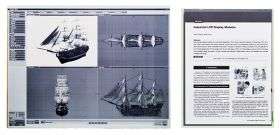
A3 and A4 e-paper module

NEC LCD Technologies today announced the successful development of multiple sizes (A3 and A4 equivalent) of electronic paper (e-paper) modules using the microcapsule electrophoresis system (see note 1).

The new e-paper modules boast higher visibility and gradation when compared to general newspapers, and leverage NEC LCD Technologies' experience and with TFT active matrix to secure 16 step grayscale, white reflectivity of 43% and a contrast ratio of 10:1.

Additionally, e-paper modules can be used to form large screen displays by combining up to eight modules, which incorporate the company's original multi-tiling controller. The A3 e-paper module is composed of especially narrow frames, with two sides measuring just 1mm, which enables the creation of large screens that feature effective multi-tiling.

E-paper's display utilizes reflected light and paper to produce wide viewing angles, provide high visibility under direct sunlight and reduce strain on the eyes of viewers. Moreover, e-paper minimizes electricity needs by maintaining display information without using power, and requires only low power to perform screen rewriting. Furthermore, thanks to its slim design and light weight, e-paper is subject to few location restrictions and is ideal for portable equipment. In recent years, due to these exceptional features, expectations for e-paper as a next generation display device have been rapidly increasing in both the consumer and industrial fields.

NEC LCD Technologies recognized the potential of e-paper. A3 and A4 e-paper modules have drawn particular attention due to consumer's existing daily use of similarly sized paper.

Both new e-paper modules will be showcased at "FPD International 2008," which is being held from October 29 to 31 in Pacifico Yokohama, Japan.

Notes:

1. Electrophoresis system developed by E Ink Corporation (USA). The system contains white pigment particles electrified with positive electrodes, and black pigment particles electrified with negative electrodes. Each pigment particle is contained in a clear microcapsule that is moved by applying voltage, which thereby creates a visible display. The prototype uses E Ink's "Vizplex Imaging Film."

Provided by NEC


print this article email this article download pdf blog this article bookmark this article     Stumble it Digg this share on Facebook retweet share on Reddit add to delicious
Rate this story - 5 /5 (3 votes)


October 27, 2008 all stories

Comments: 0

5 /5 (3 votes)
  • Stumble this up

  • Digg this

  • share this

  • hide
  • Related Stories


  • hide
  • Relevant PhysicsForums posts

Other News

Microsoft websites were the most visited in September

Microsoft websites top spots in September: comScore

Technology / Internet

created 18 hours ago | popularity 2.3 / 5 (3) | comments 0

Industry tracker comScore on Friday released a study showing that Internet users in September spent more time at Microsoft websites that at any other online properties.


Brazil blackouts result of cyber hacking: report

Technology / Internet

created 18 hours ago | popularity 3 / 5 (3) | comments 0

Massive power outages in Brazil in 2005 and 2007 that impacted millions were caused by cyber hackers attacking control systems, the US television network CBS said Sunday.


airpod

Car That Runs on Compressed Air Questioned by Critics (w/ Video)

Technology / Energy

created Nov 03, 2009 | popularity 3.8 / 5 (18) | comments 26

(PhysOrg.com) -- As electric cars begin breaking into the short-distance vehicle market, one French company thinks that it has an alternative to the electric vehicle: a car that runs on compressed air. Motor ...


Sahara

Will Europe Be Powered by the Sahara

Technology / Energy

created Nov 04, 2009 | popularity 4.1 / 5 (19) | comments 24

(PhysOrg.com) -- Europe has long been interested in developing alternative energy sources. And, one of the more interesting places that some Europeans are looking for solar power is the Sahara. With the vast ...


Dartmouth professor finds that iconic Oswald photo was not faked

Professor finds that iconic Oswald photo was not faked (w/ Video)

Technology / Computer Sciences

created Nov 05, 2009 | popularity 3.8 / 5 (9) | comments 20

(PhysOrg.com) -- Dartmouth Computer Scientist Hany Farid has new evidence regarding a photograph of accused John F. Kennedy assassin Lee Harvey Oswald. Farid, a pioneer in the field of digital forensics, digitally ...