World's smallest hand-held instrument for detecting health and safety threats
October 27, 2008 Spectrometer

Enlarge

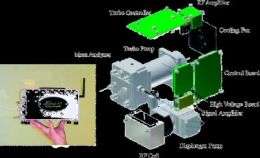
Chemists have developed the world's smallest mass spectrometer, the Mini 11, which could be used to detect hidden explosives or bioterrorism agents. Credit: American Chemical Society

Researchers in Indiana are describing development of the world's smallest complete mass spectrometer (MS), a miniature version of a standard lab device — some of which would dominate a living room — to identify tiny amounts of chemicals in the environment. The hand-held MS, about the size of a shoebox, could speed the detection of bioterrorism agents, hidden explosives, and other threats, the researchers say. Their study is scheduled for the current issue of ACS' Analytical Chemistry.

R. Graham Cooks, Zheng Ouyang, and colleagues note that scientists have developed several different versions of portable mass spectrometers over the past few decades. However, the instruments' large size, weight, and inability to analyze a wide variety of different target molecules have limited their practical use.

The scientists responded to the need for a small but sensitive MS by developing the Mini 11. About the size of a small shoebox, it weighs only 9 pounds (half the weight of other portable MSs), and can be operated by remote control. Laboratory tests showed that the Mini 11 could accurately identify the chemical composition of three commonly used commercial drugs within just one minute using tandem mass spectrometry. Unlike previous portable mass specs, this new instrument is capable of analyzing a wider variety of molecules, including large proteins, the scientists say.

Article: "Design and Characterization of a Multisource Hand-Held Tandem Mass Spectrometer" http://dx.doi.org/10.1021/ac801275x

Source: ACS


print this article email this article download pdf blog this article bookmark this article     Stumble it Digg this share on Facebook retweet share on Reddit add to delicious
Rate this story - 4.5 /5 (8 votes)


October 27, 2008 all stories

Comments: 0

4.5 /5 (8 votes)
  • Stumble this up

  • Digg this

  • share this

  • hide
  • Related Stories


Other News

Research sheds light on workings of anti-cancer drug

Chemistry / Analytical Chemistry

created 10 hours ago | popularity not rated yet | comments 0

(PhysOrg.com) -- The copper sequestering drug tetrathiomolybdate (TM) has been shown in studies to be effective in the treatment of Wilson disease, a disease caused by an overload of copper, and certain metastatic cancers. ...


New chemical reaction offers opportunities for drug development

Chemistry / Biochemistry

created 13 hours ago | popularity not rated yet | comments 0

Researchers led by Conway Fellow, Professor Pat Guiry have solved a chemistry problem that has stumped researchers worldwide for more than a decade. The results have earned the group the cover story of the leading scientific ...


Sandia CR5

Machine Converts CO2 into Gasoline, Diesel, and Jet Fuel

Chemistry / Biochemistry

created Nov 23, 2009 | popularity 4.6 / 5 (30) | comments 20

(PhysOrg.com) -- Researchers at Sandia National Laboratories have built a machine that uses the sun's energy to convert carbon dioxide waste from power plants into transportation fuels such as gasoline, diesel, ...


New hydrogen-storage method discovered

New hydrogen-storage method discovered

Chemistry / Materials Science

created Nov 22, 2009 | popularity 4.3 / 5 (42) | comments 15

Scientists at the Carnegie Institution have found for the first time that high pressure can be used to make a unique hydrogen-storage material. The discovery paves the way for an entirely new way to approach ...


New on-off 'switch' triggers and reverses paralysis in animals with a beam of light

New on-off 'switch' triggers and reverses paralysis in animals with a beam of light (w/ Video)

Chemistry / Biochemistry

created Nov 18, 2009 | popularity 4.8 / 5 (5) | comments 4

In an advance with overtones of Star Trek phasers and other sci-fi ray guns, scientists in Canada are reporting development of an internal on-off "switch" that paralyzes animals when exposed to a beam of ultraviolet ...