Reconnaissance Orbiter Reveals Details of a Wetter Mars
October 28, 2008
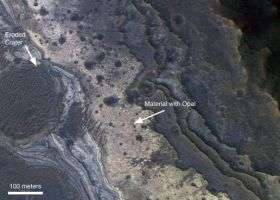
NASA's Mars Reconnaissance Orbiter has revealed Martian rocks containing a hydrated mineral similar to opal. Image credit: NASA/JPL-Caltech/Univ. of Arizona
(PhysOrg.com) -- NASA's Mars Reconnaissance Orbiter has observed a new category of minerals spread across large regions of Mars. This discovery suggests that liquid water remained on the planet's surface a billion years later than scientists believed, and it played an important role in shaping the planet's surface and possibly hosting life.
Researchers examining data from the orbiter's Compact Reconnaissance Imaging Spectrometer for Mars have found evidence of hydrated silica, commonly known as opal. The hydrated, or water-containing, mineral deposits are telltale signs of where and when water was present on ancient Mars.
"This is an exciting discovery because it extends the time range for liquid water on Mars, and the places where it might have supported life," said Scott Murchie, the spectrometer's principal investigator at the Johns Hopkins University Applied Physics Laboratory in Laurel, Md. "The identification of opaline silica tells us that water may have existed as recently as 2 billion years ago."
Until now, only two major groups of hydrated minerals, phyllosilicates and hydrated sulfates, had been observed by spacecraft orbiting Mars. Clay-like phyllosilicates formed more than 3.5 billion years ago where igneous rock came into long-term contact with water. During the next several hundred million years, until approximately 3 billion years ago, hydrated sulfates formed from the evaporation of salty and sometimes acidic water.
The newly discovered opaline silicates are the youngest of the three types of hydrated minerals. They formed where liquid water altered materials created by volcanic activity or meteorite impact on the Martian surface. One such location noted by scientists is the large Martian canyon system called Valles Marineris.
"We see numerous outcrops of opal-like minerals, commonly in thin layers extending for very long distances around the rim of Valles Marineris and sometimes within the canyon system itself," said Ralph Milliken of NASA's Jet Propulsion Laboratory in Pasadena, Calif.
Milliken is lead author of an article in the November issue of "Geology" that describes the identification of opaline silica. The study reveals that the minerals, which also were recently found in Gusev Crater by NASA's Mars rover Spirit, are widespread and occur in relatively young terrains.
In some locations, the orbiter's spectrometer observed opaline silica with iron sulfate minerals, either in or around dry river channels. This indicates the acidic water remained on the Martian surface for an extended period of time. Milliken and his colleagues believe that in these areas, low-temperature acidic water was involved in forming the opal. In areas where there is no clear evidence that the water was acidic, deposits may have formed under a wide range of conditions.
"What's important is that the longer liquid water existed on Mars, the longer the window during which Mars may have supported life," says Milliken. "The opaline silica deposits would be good places to explore to assess the potential for habitability on Mars, especially in these younger terrains."
The spectrometer collects 544 colors, or wavelengths, of reflected sunlight to detect minerals on the surface of Mars. Its highest resolution is about 20 times sharper than any previous look at the planet in near-infrared wavelengths.
Provided by NASA


et al in the series.
We have been told that the temperature is
We have been told that the temp. is 36
We have been told that the temp. is -23
We have been told that the temp. is 127.0.0.1
Hmmmm...
I thought the link would give me a good laugh and I wasn't disappointed. Even by tinfoil hat standards it's pretty weak. All I see is dark material inside cavities of light material, which in this case is dirt. The current atmosphere on Mars simply can't support this kind of ground water. Just because something looks a bit like something else doesn't mean it is. I think that the Crab nebula looks like it's made of delicious cotton candy but have resigned myself to the fact that it isn't.
The way the brain interprets images is pretty weird sometimes, but I can't see anybody traveling to mars or the moon anytime soon to find out if any of it is true.
All I am saying is; for those of you who are capable, take the time to read, inspect, read some more, and look at some pictures that others have sharpened as best they could given the poor official quality of the originals. All the while, putting the jig saw pieces in place to form your own universal picture.
If the gov'ts would release the RAW images (that we paid for) we would know one way or the other and these exchanges would be moot.
Not sure if you mean RAW images in the digital camera sense or if you're using caps for emphasis. I do a lot of digital photography and only shoot RAW as it gives you much more to work with. The only disadvantage is that these images are huge. I think I heard they are capturing in JPG because of bandwidth considerations (that's what the rovers do). Remember that the Earth orbit satellites are way closer so they can transmit much faster at lower power than their Martian cousins.
I think if you look at pictures of Opportunity at Victoria Crater with a practical resolution of .9M and compare them with cars in Cambridge at .15M it they seem to compare reasonably well.
I would also like to see the pre-processed images but am not sure how much love they need to make them presentable. With all the artifacts that probably exist you would likely have to deal with people misinterpreting the noise.
It is my understanding that ALL images are received by JPL in RAW format (maybe their own proprietary)in spite of the power needed and the bit rate. The official photo's have "love" applied to optimize for internal use then are converted to HIGHLY compressed JPEG, after they have been digitally masked. This digital doctoring after the fact is so readily apparent, in many (most) cases as a fog or smudge selectively layer applied to what must be critical areas. I want ALL images available in RAW format as a matter of course. If we have to purchase DVD's to save bandwidth so be it. Just make the images (and the software to read) available to the people who paid the bill. We can apply our own love.
PRS - If you are really interested I suggest you review the whole site I referenced (and also search for early moon photos released by NASA and the same photo's released by the USSR). The author does come to some poorly supported conclusions but has excellent insights into others. It may give you some new insights too.
If I get some time later and can find the info I'll see if there's enough bandwidth to transmit the number of images they've sent in a RAW format. When I talk about bandwidth I am talking Earth-to-Mars, not the internet. I'd like to have a crack at those images too.
I am wondering if you have credible references for your assertions that they get RAW images and are hiding them from us. Seems to me if they had found long-term surface water or evidence of structures that they would be eager to share, it would be great for the funding. The only reason we have an aggressive Mars program now is because of the Martian meteorite that hinted at life.
Not trying to be rude or dismissive but extraordinary claims require extraordinary evidence and so far I'm not seeing adequate evidence or rigor in your analysis to convince me.
I hope you are able to come up w/ info on M to E bit rate but what do you use for a RAW file size? Those strip photo's are mighty big. Please post here if you're successful.
It's going to be a guess of course assuming I can get enough info. I'll call it 12 bits per pixel. I'll also assume about a third can be saved by some lossless compression scheme, that's what my camera does and there hasn't been any huge gain in lossless compression in a long time, inherently noisy data being harder to compress too. May not be able to come up with a good figure. Line of sight issues will limit some transmission and I know the DSN is overloaded so practical rate will be lower than theoretical. We'll see... If anyone knows the bit rate of the transmitter or any other vars pls post.
- Each square kilometer would be 3333 pixels square or 11.1 Mega Pixels.
- The surface area of Mars is 144,798,500 km˛
- The total number of pixels would be 1,607,263,350 Mega Pixels.
- I said before 12 bits per pixel, I meant 12 bits per channel, so 36 bits per pixel. Allowing for some lossless compression lets call it 3 bytes a pixel which would give us 4.8 Petabytes of raw image data.
- MRO Radio gives an impressive 6 Megabits of throughput (DSL in space!) or .75 MB a second.
- Non-stop transmission time for 4.8 Petabytes would be 203 years.
- approx 1/2 the time is spent behind Mars and it has other duties and DSN may not always be ready to receive the data so lets say 500-1000 years for one pass.
I somehow doubt it.
According to the HiRISE camera site they capture in JPEG 2000. As I suspected the data has to go through tons of manipulation to be usable. See: http://hirise.lpl...na.edu/. The FAQ answers many questions and also tells you how to get the raw data and even tells you where to get the software to perform your own transformations of the data.
In the interest of fairness I subjected myself to Mr Skipper's site further and found nothing beyond the level of "It kinda looks like trees, therefore it's trees". He has no qualifications, no publications and since there is no scientific method used, it's not science. At least he doesn't seem to be trying to make money off it so I won't call him a crook, merely delusional. It reminded me of another poor soul who insists the sun is made of iron because he thinks the pictures look like they support it. http://www.thesur...un.com/.
Obvious mud flows at around the time photo's were taken are readily available (much, much less verbiage than Skipper [tho JPS has some different but similar quality photos too] at: http://xenotechre...hp?cat=6 )
It is readily apparent that the water present has not yet crystallized so surface conditions must be much milder than we have been led to believe.
This has been fun, but I have to move on. Besides, we're probably the last ones in the room anyhow. I'm afraid the site you've linked still suffers from "If it looks a bit like a duck, then it's a duck" problem. Seeing hydrological features isn't a surprise, we know this was a wet area at one time. The shape of things that used to be wet can be preserved, that's why we can still see dinosaur footprints in what used to be mud.
I also believe it's possible that surface water can come out of underground aquifers and exist for short periods of time. The problem isn't surface temperature, temps of up to 25C have been recorded. The problem is atmospheric pressure, theres not enough to prevent the water from boiling off. If water could last long term on the surface we would see more of it in the atmosphere. For example the mars gullies that were spotted are plausible (although there are debates about that too) and if you we're trying to suppress water evidence then you should not hold a press conference stating you have water evidence.
These atmospheric observations aren't the sole domain of NASA, they have been going on from ground based telescopes for a long time. You would need a long-running perfect conspiracy from the scientific community to suppress information to the contrary. A large number of people cannot keep a big secret for a long time.
As far as the imagery goes, you can get what the craft sends back and they give you the software to do your own manipulations. Not sure what else you want from them. Artifacts come in from the fact that they are sent as jpg to start with, they have to be de-skewed if the camera isn't pointing straight down, they have to be projected onto a sphere, compensation for all types of movement. Any time you do any of these operations you will destroy some information, it's unavoidable. If you check the FAQ page from the HiRISE link in my previous you can get the jp2 files the craft sends back. If they were any more transparent they would be arrested for public nudity.
To close I'll quote the Wikipedia article on the scientific method:
"To be termed scientific, a method of inquiry must be based on gathering observable, empirical and measurable evidence subject to specific principles of reasoning. A scientific method consists of the collection of data through observation and experimentation, and the formulation and testing of hypotheses."
Emphasis on the last sentence. That is what separates fact from guesswork.