Researchers find key to Sonic hedgehog control of brain development
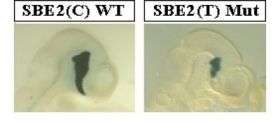
University of Pennsylvania School of Medicine researchers have discovered how the expression of the Sonic hedgehog gene is regulated during brain development and how mutations that alter this process cause brain malformations. The results appear online this month in Nature Genetics.
Sonic hedgehog (Shh) plays a key role in regulating many aspects of embryonic development including, growth of digits on limbs and organization of neurons in the brain. It controls cell division of adult stem cells and has been implicated in some cancers.
"Elucidating the regulators of Shh expression in the forebrain will not only improve our fundamental understanding of brain development, but may also lead to novel insights into the pathogenesis of holoprosencephaly and possibly other malformations in the brain," says senior author Douglas J. Epstein, PhD, Associate Professor of Genetics.
Holoprosencephaly occurs when an embryo's forebrain, the large frontal area of the human brain, fails to divide to form left and right halves, causing defects in the development of the face and in brain structure and function. Symptoms can be moderate, in the case of a cleft lip or palate to severe, as in cyclopia, the development of one eye rather than two. About one in 16,000 live births display a type of holoprosencephaly.
A decrease in the Shh protein by 50 percent predisposes humans to craniofacial problems such as holoprosencephaly. Too much Shh can lead to tumor formation. Shh is the most commonly mutated gene in holoprosencephaly and can involve about seven other genes.
In a previous study published in the journal Development, the Penn group surveyed one million bases, the basic building blocks of DNA, in transgenic mice for the sequences that turn on Shh during the development of the forebrain. They identified a brain specific enhancer that drives expression of Shh in the hypothalamus. Enhancers are regulatory sequences that drive a gene's transcription, ensuring that it is turned on and off at the appropriate time. Enhancers can be located nearby to the genes they regulate or, as in the case of Shh, operate over hundreds of thousands of base pairs away.
In the current study, the investigators searched for mutations in the enhancer sequence in holoprosencephalic patients. They identified one mutation in a region of the enhancer that has been conserved for over 300 million years of evolution, attesting to the importance of these sequences. The mutation caused a significant reduction in Shh enhancer activity in the hypothalamus.
In turn, they screened for proteins that assemble on the Shh brain enhancer. They found a protein called Six3 that binds less tightly to the mutated form of the Shh enhancer. The enhancer can't work without the proteins that bind to it, and this study showed a direct link between the Six3 DNA- binding protein, the sequence that regulates Shh, and hence brain development. Interestingly, mutations in Six3 also cause holoprosencephaly, but the mechanism by which this occurs was previously unknown. Results from the Penn study now indicate that it is likely through the failure to activate Shh.
Identifyng additional components of the Shh brain enhancer complex will further our understanding of how gene regulatory networks operate during normal brain development. This type of basic research should also be instrumental in identifying additional causes of holoprosencephaly and other congenital brain anomalies resulting from the misregulation of Shh expression.
Source: University of Pennsylvania


